Monday, June 15, 2026 · Adhika Jyeshtha Amavasya · Somvati Amavasya · Closing of Purushottam Maas
On Monday, June 15, 2026 — a rare Somvati Amavasya — the intercalary month that bears Bhagavan Vishnu’s own name comes to its close. Here is how the Acharyas instruct it be sealed.
For thirty days, since the morning of May 17, the Vaishnava households of Bharata have been keeping a month that comes only once in two and a half years. They have lit a deepa each evening before Bhagavan Vishnu. They have offered tulsi in the morning sandhya. They have read from the Vishnu Sahasranama, fed at least one hungry person each week, and kept the rare vratas the month carries — the Varada Chaturthi, the Padmini Ekadashi, the Adhik Jyeshtha Purnima, the Parama Ekadashi.
On Monday, June 15, 2026, the month closes.
The closing day is the Adhik Jyeshtha Amavasya — the new-moon day that ends the intercalary chamber and returns the calendar to its ordinary reckoning. And this year, because the Amavasya falls on a Monday, it is also a Somvati Amavasya — a confluence the Acharyas teach occurs roughly once in three years. Somvati Amavasya is itself among the most fruitful new-moons of the entire calendar. To have it fall as the closing of Purushottam Maas is a rare grace within a rare grace.
This is the day the month-long vrat is sealed.
Why the Closing Day Carries the Greatest Weight
The Acharyas have always taught that a vrat is not measured by its duration but by its closing. A fast kept for thirty days and broken carelessly is a fast unmade. A fast kept for one day and closed with the full ceremony of the prescribed parana is a fast complete. The merit, they say, gathers at the rim — like water gathering at the lip of a pot — and what is given to the rim, the rim returns to the whole.
Purushottam Maas is itself a kind of month-long vrat. From the moment Bhagavan Vishnu took the intercalary month onto Himself and gave it His own name, the Puranas have treated it as one sustained observance — thirty days of dana, japa, fasting, and remembrance, held together by a single sankalpa.
Adhik Amavasya is the parana of that vrat. What is done on this day — the snan, the deepa, the dana, the offering of merit — is what closes the seal on everything that has been done through the month.
The same hour passed unobserved breaks the seal. The Acharyas are exact about this. Vrat ka samapan vrat se bhi badi hai. The closing of a vrat carries weight even greater than the vrat itself.
What the Puranas Prescribe for the Closing
The Padma Purana (Uttara Khanda, Purushottam Mahatmya) lays out the closing observances in unusual detail. The Acharyas of the Bhagavata tradition have preserved the practice across centuries. The day is observed in three movements: a morning of snan and puja, a daytime of dana, and an evening of satsangha and the final sankalpa-arpana.
At Brahma Muhurta
Rise. Take a snan in the Ganga, Yamuna, Narmada, Godavari, or any river held sacred in your region. If no river is accessible, bathe at home with a few drops of Ganga jal in the water. Wear clean clothes — yellow, saffron, or white is the traditional choice. Take the closing sankalpa before the household altar:
“O Purushottama, I offer to You the merit of every observance kept by this household through this month — the deepas, the japas, the fasts, the readings, the dana. Receive what was small as though it were great. Receive what was forgotten as though it were remembered. Hold this household in Your gaze in the year that comes.”
The Closing Puja
Establish the household altar one final time. Offer to Bhagavan Vishnu: tulsi leaves, yellow flowers, sandal paste, a ghee deepa, fruits, panchamrita, and the day’s naivedya. Recite the Vishnu Sahasranama in full. The Padma Purana says that the one who completes the Sahasranama on Adhik Amavasya receives the entire merit of having recited it every day of the month — even if it was never opened until this morning.
Through the Day — Dana
The closing day is, more than any other day of the month, the day of dana. Whatever was set aside through the thirty days — clothes, grains, oil, ghee, books, money — should be given today. The Padma Purana lists the items most beloved of Bhagavan Vishnu when offered on this day: tulsi malas, ghee, til (sesame), white cloth, a copy of the Bhagavad Gita or the Vishnu Sahasranama. Feed at least one Brahmana, one sadhu, one widow, or one hungry person. The Bhavishyottara Purana enjoins purna-bhojana — a full meal of rice, dal, vegetable, sweet, and ghee — to whoever is fed today.
At Sunset
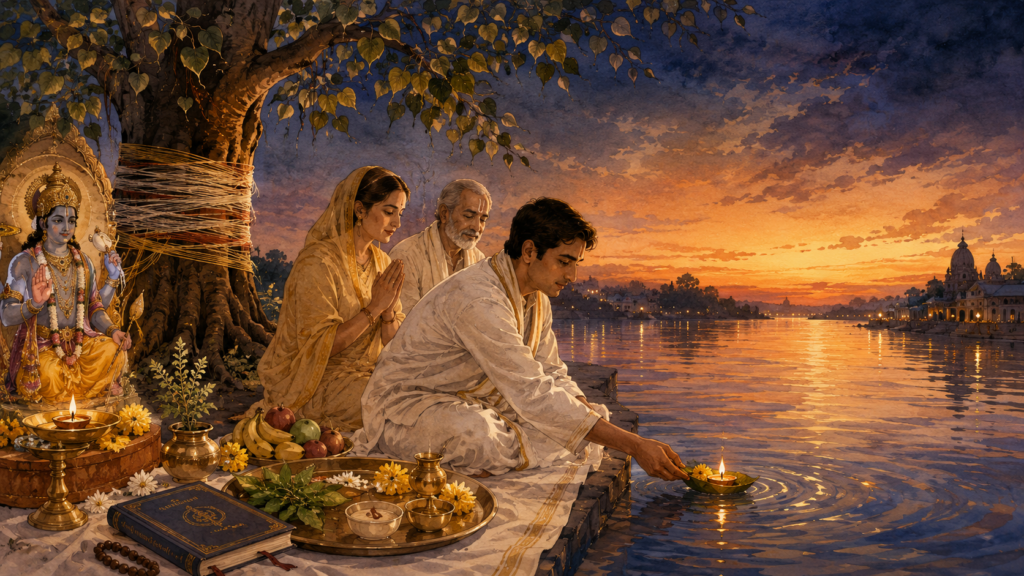
Light a single ghee deepa. If you can, set it on a small leaf-boat and let it float down a flowing stream. As the lamp departs, mark in your heart the closing of the month.
The Final Sankalpa — Sarva-Arpana
Before sleep, sit before the household altar one last time. Offer the merit of the entire month to Bhagavan Vishnu — not to keep, but to redistribute as He sees fit to whatever household stands most in need of it. This act of sarva-arpana — the offering of all merit at the feet of the Lord — is the highest form of vrat closure the Acharyas describe. The household that gives back what was earned receives, the Puranas say, many times more than it set aside.
The Somvati Amavasya Gift
Because the Adhik Amavasya this year falls on a Monday — Somvar, the day of Bhagavan Shiva and of Chandra — the day carries an additional grace.
Married women across Bharata observe Somvati Amavasya by circumambulating the peepal tree at dawn, tying a length of cotton thread around its trunk, and offering jal to Bhagavan Shiva and to the Pitrs. The Mahabharata records that Bhishma described Somvati Amavasya to Yudhishthira as the new-moon on which the merit of every act of bhakti is doubled — and the merit of dana given to ancestors (the pitr-tarpan) is many times multiplied.
To observe Somvati Amavasya and the closing of Purushottam Maas on the same morning is, the Acharyas say, an opportunity that the calendar opens roughly once in a decade. Whatever is offered today is heard with particular completeness.
Mantras for the Day
Om Namo Bhagavate Vasudevaya — the dvadasha-akshara closing mantra
Om Namo Bhagavate Purushottamaaya — the Purushottam closing mantra
Om Pitrabhyah Svadhayibhyah Svadha Namah — the Pitr-tarpan mantra for Somvati Amavasya
The Closing Word
The Acharyas teach a small detail worth carrying away from this day.
Purushottam Maas began as a month no deity would claim. It ends as the month that bears Bhagavan Vishnu’s own name. In thirty days, what was rejected became what is supreme. And what was withheld from the calendar became the season in which the smallest sincere offering carried the greatest fruit.
The closing of such a month should not be passive. The seal placed today is what carries the merit of the past thirty days forward into the year that comes. Whatever was lit in the household during this month — whatever quiet shift the morning deepa and the evening japa worked on the inner room of the seeker — is held in the world only by the closing rite.
When the sun sets on Monday, June 15, 2026, the rare thirteenth chamber of the calendar will close. It will not open again until the autumn of 2029.
Whatever was begun must, before sunset, be sealed.
Om Namo Bhagavate Purushottamaaya