The Bengali festival that began with a stolen hilsa, a false accusation, and the wrath of the Devi who protects every child of Bharata.
If you walk through a Bengali neighbourhood on the morning of Saturday, June 20, you will catch the same scent rising from a hundred kitchens at once. Hilsa, sizzling in mustard oil. Mango, sliced and cooled in earthen bowls. Mishti — sandesh, rasagolla, kheer kadam — laid out in silver thalis. The mother-in-law of the house has been awake since before dawn. The daughter and her husband — the jamai, the son-in-law — are coming home.
This is Jamai Shashthi — the sixth tithi of the bright fortnight of Nija Jyeshtha, the Real Jyeshtha that finally arrived this year after the rare Adhika Maas at last closed on June 14. In Bengal, Odisha, Assam, and the eastern reaches of Bharata, it is the day on which a married daughter and her husband are formally invited back to her parents’ house. The mother-in-law performs the Shashthi Vrata for them — for the long life of the jamai, for the welfare of the marriage, and above all for the children, born and yet to be born, of the union.
But behind the warmth of the feast lies a story most Bengalis know by heart and most non-Bengalis have never heard. It is the story of how this festival began. It is the story of a wife who told a lie, the cat she blamed, and the Devi who refused to let the lie pass.
It is, above all, the story of Maa Shashthi.
Who Is Maa Shashthi
Before the cat, before the lie, one must know the Devi the festival is named for.
Maa Shashthi — also called Shasthi Devi, Skanda-mata in some traditions, and Aranya Shashthi in this particular form — is the protective Devi of every child of Bharata. From the moment a child is born, she is invoked. On the sixth day after birth — the shashthi — a household altar is set in the mother’s room, the child is placed before it, and Maa Shashthi is asked to take the new life into her keeping. The Bengali tradition believes that no infant is fully protected until that sixth-day rite has been performed.
Her vahana is the biraal — the cat. The Acharyas of the Bengali Tantras teach that the cat was chosen as her mount because it has the fiercest maternal instinct of any animal. A cat will fight a dog three times its size to protect its kittens. The cat, in the Shashthi tradition, is the form of vatsalya rasa — the love of a mother for her young — that no Jivatma can ever fully match.
To injure a cat, the Bengali grandmothers will tell you to this day, is to injure Maa Shashthi. To blame a cat falsely — as the wife in our story did — is worse.
The Vrat Katha — The Lie and the Cat
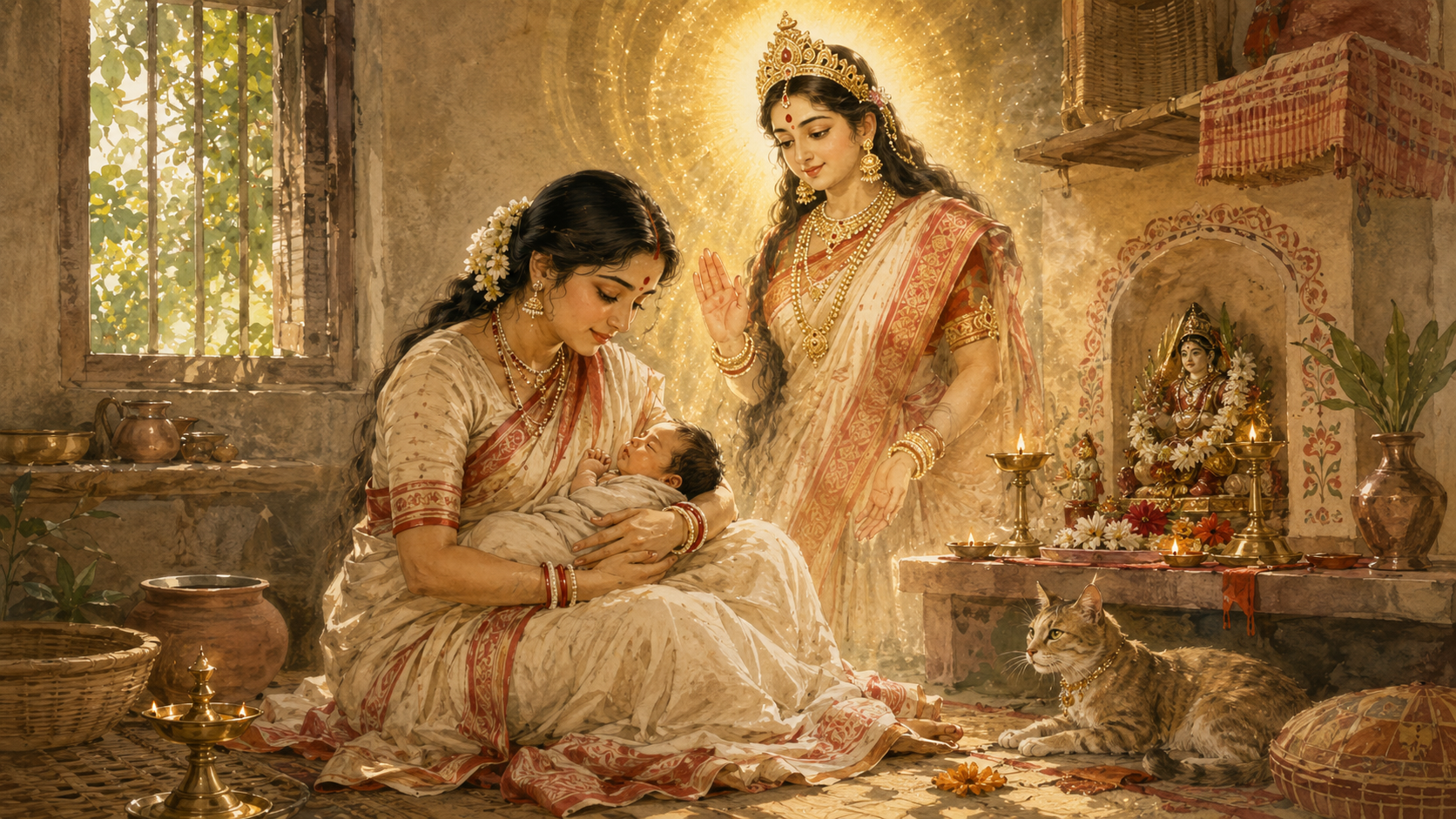
In a certain household, in a certain village somewhere along the Padma or the Hooghly, there once lived a woman known only as the grihini — the mistress of the house. Her husband had brought home, the night before, a fine ilish — a hilsa — that he had bought at the river ghat with great care. The whole household was to share it the next day.
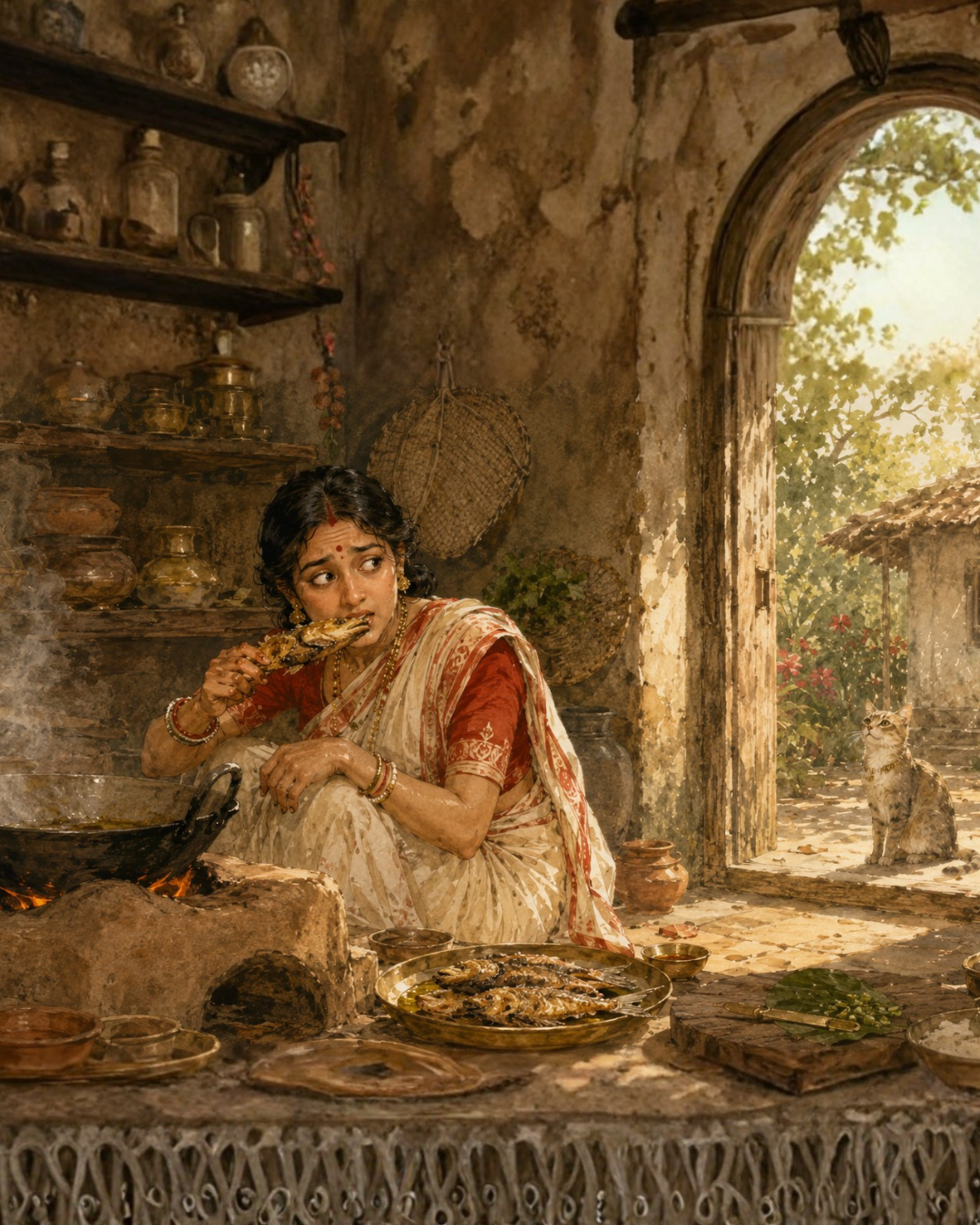
The grihini woke early. She salted the fish. She fried it in mustard oil. And before anyone else had risen, she sat down quietly in the kitchen and ate it. All of it.
When the household woke and asked where the hilsa was, she said: “The cat took it.”
The cat was nowhere in the room. The cat had been outside in the courtyard the whole morning. But the cat was the cat. No one questioned her.
The cat, however, was the cat of Maa Shashthi.
That night, the cat returned to her mistress. She was the vahana of the Devi. She told the Devi what had been said in her name. “My lady — I was outside. I took nothing. The grihini ate the fish and laid the blame on me. The household believes I am a thief.”
The Mahabharata teaches us that the deities of Sanatana Dharma do not strike quickly. They give a Jivatma time. They give a second chance. They give a third. Maa Shashthi gave the grihini all three. The lie was not corrected. The cat was not exonerated. The grihini, having got away with it once, began to do it more often — taking what was not hers, blaming the cat each time.
In the fullness of time, the grihini was blessed with a son. The child was beautiful. He was loved. He did not live to his sixth day.
A year passed. Another son was born. He, too, was lost.
The Puranas record that this happened six times. Six sons. Each radiant. Each lost. The grihini’s grief became a thing the village did not know how to look at. She stopped eating. She stopped speaking. She walked out of the house one morning and into the forest behind the village, intending not to return.
The Old Woman in the Forest
She walked for a long time. The trees thickened. The sun climbed. At last, exhausted, she sat down beneath a great vata vriksha — a banyan — and wept.
An old woman appeared on the path. She wore the white sari of a widow. Her hair was loose. She carried no basket, no walking-stick. She sat down beside the grihini without invitation.
“Why do you weep, daughter?”
The grihini told her. The six sons. The unbearable losing. The not-knowing why the Devis had refused to keep them.
The old woman listened. When the grihini was finished, the old woman spoke once.
“And the cat?”
The grihini went still.
“Six times you ate what was not yours. Six times you laid the blame on a creature who had taken nothing. The cat was the vahana of Maa Shashthi. Each time you spoke the lie, the Devi heard it. Each time, she sent her cat to ask whether you would correct what you had said. You did not. The Devi who protects every child in the three worlds cannot let a household where lies are told against her vahana keep its children. She did not punish you, daughter. She simply withdrew. The children went where they came from.”
The grihini did not move for a long time.
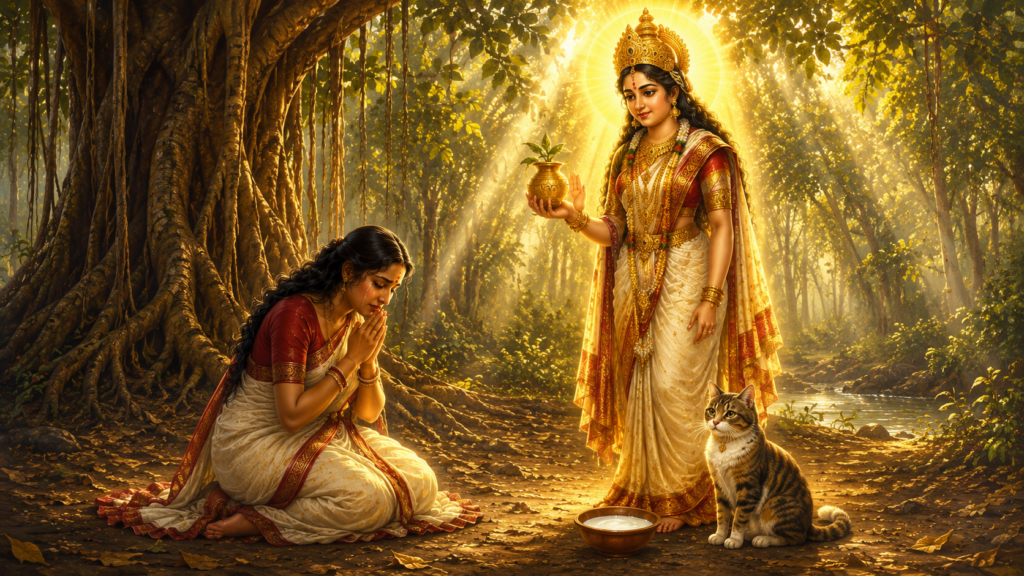
When at last she rose to her knees, the old woman was no longer the old woman. She was Maa Shashthi — radiant, gold-skinned, her cat seated at her feet, her hands holding a small clay pot of milk.
The grihini fell forward.
“Devi — there is no reparation I can make. I do not ask for the sons back. I ask only that the cat be restored in the eyes of my household. I ask that my lie be undone.”
Maa Shashthi smiled.
“Daughter — there is a vrat. Keep it on the sixth tithi of the bright fortnight of Jyeshtha. Honour the cat. Speak the truth before your household. Invite your married daughter and her husband to your home and place their welfare before me. I will hear it. I will return what was withdrawn.”
The grihini returned. She did as the Devi instructed. She told her household the truth. She honoured the cat. On the next Jyeshtha Shashthi she performed the vrat with full sincerity, and she invited her daughter and her son-in-law — her jamai — to her house, and laid before Maa Shashthi a vow for their welfare.
The Puranas record that, in the year that followed, six sons were born to that household. All six lived. All six grew strong.
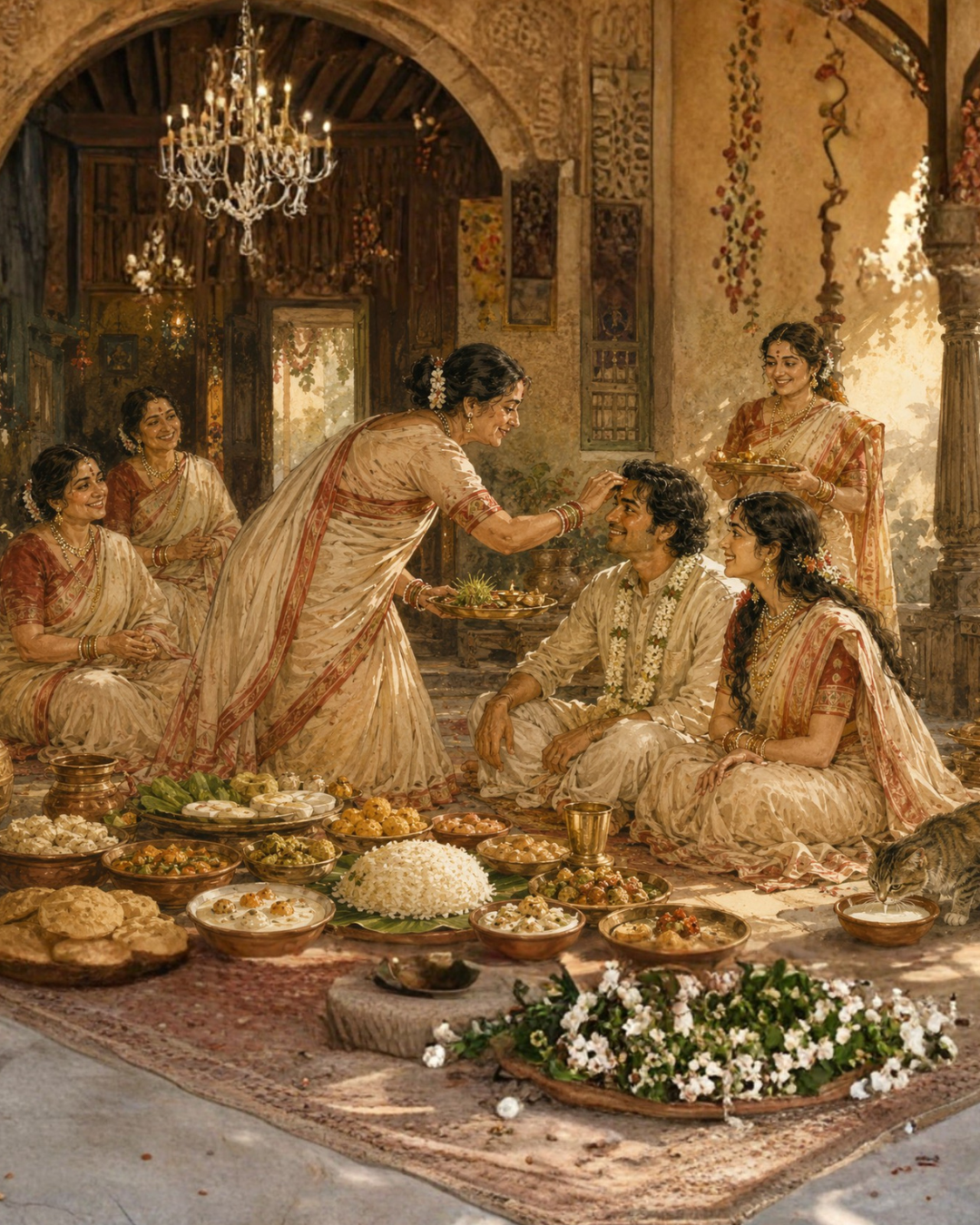
From that day, the sixth tithi of the bright fortnight of Jyeshtha has been called Jamai Shashthi in Bengal — the day on which a mother invites her daughter and son-in-law home, places their welfare before Maa Shashthi, and honours the cat that took the blame.
Jamai Shashthi 2026 — Date and Vidhi
All timings as per Drik Panchang (IST). Verify with your local panchang for regional variations.
| Shashthi Tithi Begins | Friday evening, June 19, 2026 |
|---|---|
| Shashthi Tithi Ends | Saturday evening, June 20, 2026 |
| Vrat Day | Saturday, June 20, 2026 |
| Best Puja Window | Morning, before the jamai arrives |
A note on the date: This year, because of the rare Adhika Jyeshtha Maas (May 17 – June 14), the Nija Jyeshtha — the “real” Jyeshtha — only opened on June 15. The Shukla Paksha Shashthi of Nija Jyeshtha therefore falls on June 20.
How the Day Is Kept
The mother-in-law — shasuri — wakes before sunrise. She bathes, wears a fresh saree (red, yellow, or saffron is the tradition), and prepares the puja thali. The traditional offerings to Maa Shashthi include:
- Five or seven kinds of fruit (yellow mango, jackfruit, banana, palmyra, and seasonal others)
- A small bunch of fresh durva grass and the leaves of the bel tree
- A red thread — naroon shutoor — tied around a small earthen pot
- Five small bowls of homemade batashas, moa, or sandesh
- A vermilion mark in turmeric on the floor where the puja is set
- A small clay bowl of milk placed for the household cat — the offering by which the household, every year, acknowledges the lesson the grihini learned
The mother sits before the household altar and recites the Shashthi mantra. She offers arghya — water with a single durva blade. She takes the sankalpa: “O Maa Shashthi, protect this household. Protect my daughter and her husband. Bless their children, born and unborn. Hold them in your gaze through the year that comes.”
The jamai is then welcomed at the threshold with a tilaka of sandal, kumkum, and dahi. The mother-in-law touches a small bunch of durva to his forehead, ties a yellow thread around his wrist, and seats him for the feast — the legendary jamai-aador meal: hilsa in mustard, posto begun, mango chutney, kosha mangsho, payesh, sandesh. Whatever the household can afford, the best of it goes to the jamai’s plate.
The daughter is blessed. The grandchildren — if any — are blessed. And the cat, somewhere in the courtyard, gets a small clay bowl of milk all to herself.
Mantras for the Day
Om Hrim Shrim Shashthayai Namah — the Maa Shashthi Mool Mantra
Om Shrim Shrim Shashthi-Devyai Svaha — the Aranya Shashthi mantra
“Salutations to You, Devi of auspicious welfare. Remover of every inauspiciousness. Shashthi, giver of children. To You I bow again and again.”
The Deeper Teaching
Three threads run through the story the Bengali grandmothers tell.
The first is about the cat. Sanatana Dharma has always held that the animals of the world are not lesser to us. They are forms. Each vahana is a deity in a body the deity has chosen. To injure a vahana is to injure the deity. To lie about a vahana is to test the patience of the deity directly. The Bengali household that places a bowl of milk for the cat on Jamai Shashthi is not being sentimental. It is honouring a covenant.
The second is about truth in the household. The Puranas teach that the children of a household are protected not by what is offered at the altar but by what is said in the kitchen. A house in which lies are told routinely is a house in which the Devi who protects children has nothing to bind herself to. The Acharyas put it bluntly: Maa Shashthi cannot stand where speech is loose. The grihini’s six sons were not punished. They simply went where they belonged — back to the Devi who could not entrust them to a tongue that lied.
The third is about the in-law dharma. When a daughter marries, the Shastras teach, she joins her husband’s gotra. She becomes — in the formal reckoning — the daughter of her in-laws and only the visiting one of her natal parents. This formal shift can leave a mother on either side wondering: what is my role now? Jamai Shashthi answers it. Once a year, the natal mother claims her daughter back — not to remove her from her marital home, but to bless the union. The shasuri who receives the jamai is performing an act of dvi-paksha vatsalya — the mother-love that flows in two directions. The daughter remembers that she is still a daughter. The jamai is reminded that he is, by marriage, a son. And Maa Shashthi, who has been watching, is content.
When the jamai-aador feast ends this Saturday evening, when the daughter touches her mother’s feet and the jamai folds his palms before his shasuri’s small Shashthi altar, somewhere in the courtyard a cat will be drinking milk from a clay bowl.
The grihini, somewhere in time, will be smiling.
Om Hrim Shrim Shashthayai Namah