Monday, June 29, 2026 · Nija Jyeshtha, Shukla Paksha Purnima · Vat Purnima Vrat · Religion · Festivals
The Mahabharata’s most audacious story of bhakti, wifely steadfastness, and the woman whose words made Death itself turn around.
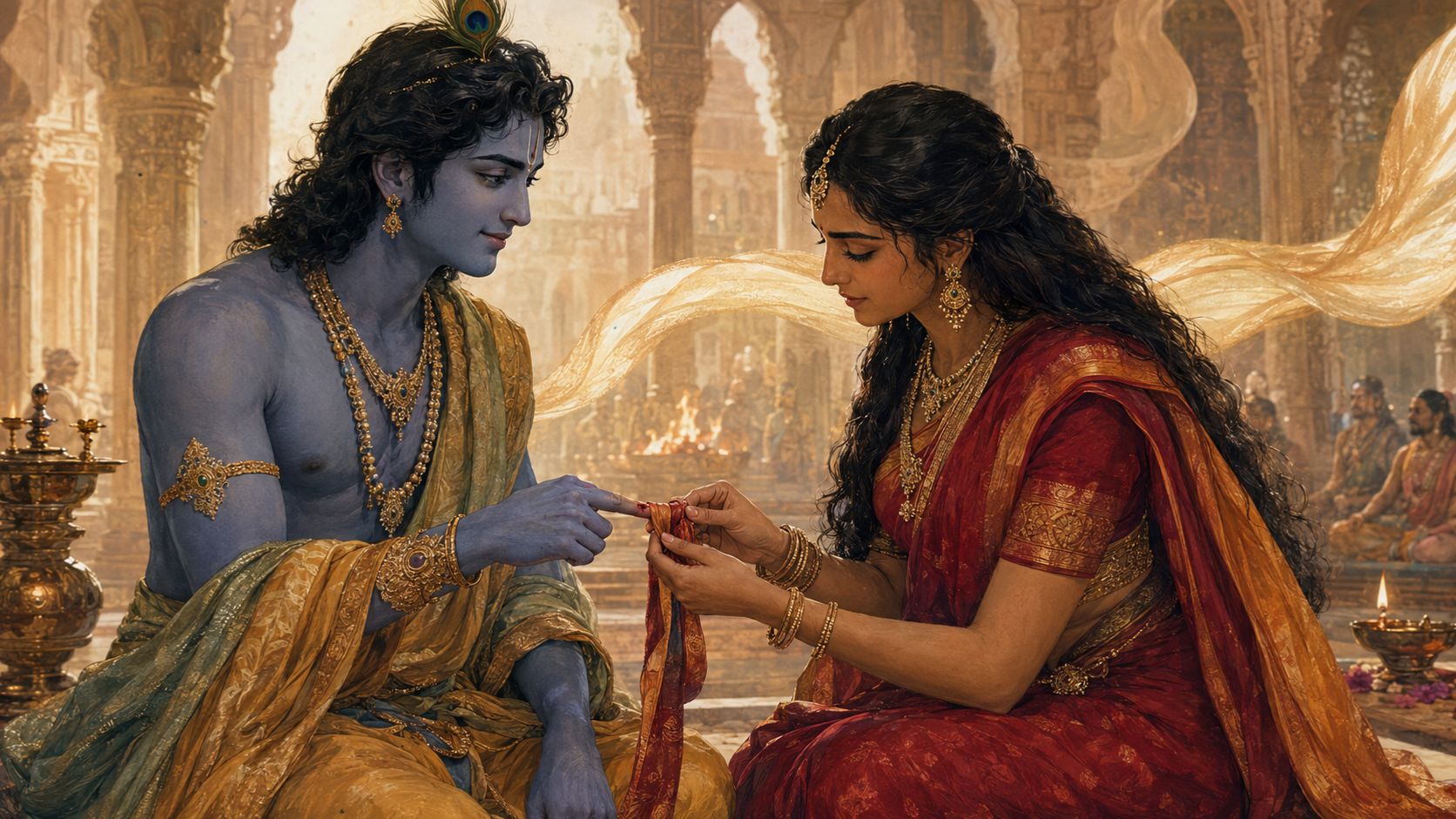
On the morning of Monday, June 29, 2026, women across Maharashtra, Gujarat, and the southern reaches of Bharata will wake before sunrise, bathe, dress in bridal red or saffron, and walk to the oldest banyan tree they can find. They will circle it seven times. Then they will circle it again — and again — until they have circled it a hundred and eight times, tying a single thread of red or yellow cotton around its trunk on each pass. Then they will sit beneath it, place a small leaf-plate of haldi, kumkum, fruit, and a coin at its roots, and listen, as women have listened for two thousand years, to the Vrat Katha of Savitri.
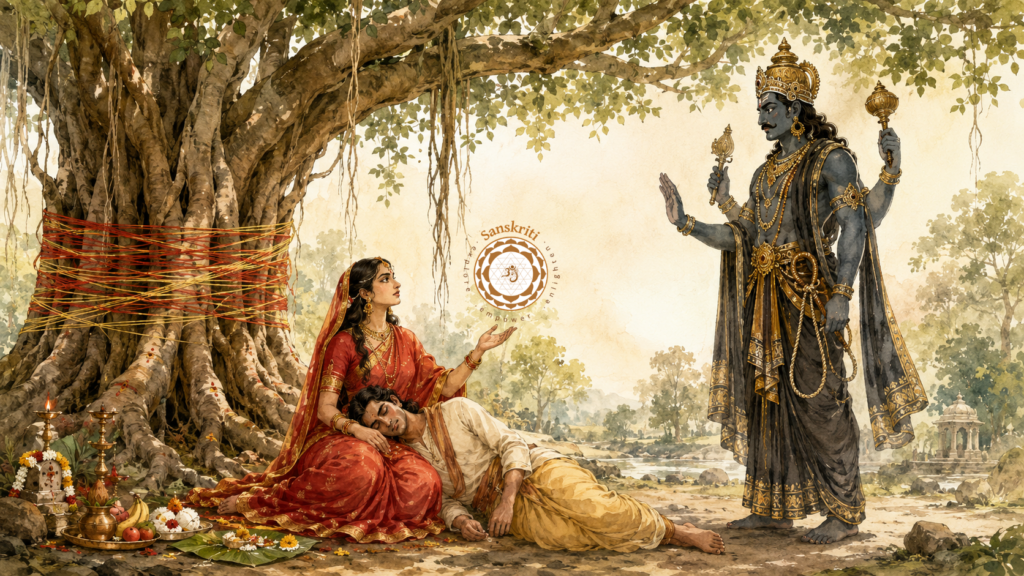
The day is Vat Purnima — the full moon of Nija Jyeshtha, the Real Jyeshtha Purnima after the rare Adhika Maas of this year has finally closed. The tree is the vata vriksha — the banyan — chosen because it was beneath a banyan, in the high noon of an ordinary forest day, that the most extraordinary argument in Sanatana Dharma took place: a young woman of nineteen, sitting on the forest floor with her husband’s head on her lap, looking up at the four-armed form of Bhagavan Yamaraja Himself, and refusing — politely, exactly, and with the full force of her bhakti — to let Him leave with her husband’s life.
She won.
This is her story, as Maharishi Markandeya told it to Yudhishthira in the Vana Parva of the Mahabharata.
The King Who Performed Tapas for a Daughter
There once lived, in the country of Madra, a king named Ashwapati. He was virtuous, learned, and loved by his people. He had only one sorrow: he was without a child.
For eighteen years, the Mahabharata tells us, he performed tapasya. He fasted. He kept silence. He recited the Savitri mantra — the Gayatri itself, named for Devi Savitri, the consort of Bhagavan Brahma — one hundred thousand times each day. At the end of the eighteenth year, the Devi appeared before him and asked what he would have.
He asked for sons.
The Devi smiled. “You shall have a daughter,” she said. “By the grace of the mantra you have kept, she shall be born of My own brilliance. Name her after Me.”
He returned to his palace. In time, a daughter was born to him — radiant, calm, with eyes that seemed to look further than the room she sat in. He named her Savitri, after the Devi who had given her.
She grew. And as she grew, the Mahabharata records, her brilliance grew with her — until no prince in any kingdom would come forward to ask for her hand. They said she was too luminous. They said no ordinary man could match her tejas. They said she was a Devi herself, walking among them.
Her father, watching the years pass, finally called her to him.
“Daughter, the time has come for you to marry. But no man has come forward to claim you. The choice, therefore, must be yours. Go out into the kingdoms. Find the husband you wish to bring home. The man you choose, I will accept.”
The Bride Who Chose Her Own Husband
Savitri travelled. She passed through cities and forest hermitages, through royal courts and ashramas. She listened. She watched. She spoke quietly with those she met. And at last, deep in a forest, she came to a small hut where an old, blind, exiled king lived with his wife and his only son.
The king’s name was Dyumatsena — once the ruler of the Shalva country, now blinded and dethroned by his enemies, living in the forest on roots and fruit. His son was a young man of nineteen, strong, gentle-eyed, given to the recitation of the Vedas and the gathering of firewood for his parents’ kitchen. His name was Satyavan — the one who walks in truth.
Savitri returned to her father’s palace and announced her choice.
Before her father could speak, the great rishi Narada — who happened to be visiting the court that day — rose from his seat.
“Pause, daughter. I know this Satyavan. He is everything you say. He is the truest atma I have seen in my wanderings through the three worlds. But there is one thing I must tell you. I have read in the akashic record. One year from this day, on this exact tithi, at the time the sun stands directly overhead — Satyavan will die. His prarabdha karma permits no extension. Choose another.”
Savitri did not blink.
“Maharishi, my choice was not made for the years. It was made for him. A wife chooses her husband only once. The years are not mine to bargain with. The husband is.”
She married Satyavan. She moved into the forest hut. She wore the bark cloth her mother-in-law wore, ate the roots her father-in-law ate, walked the long path with her husband when he went out to gather wood, and through it all, she counted the days.
The Triratra Vrata
Three days before the year was to end, she rose at Brahma Muhurta and took a vow before her in-laws: she would neither eat nor sit nor sleep for the next three days. She would stand. She would keep silence. She would keep her gaze on the ground.
Her mother-in-law worried. Satyavan, who did not know what she knew, gently teased her about her sudden severity. Savitri only nodded and continued.
On the morning of the fourth day — the morning the rishi had named — Satyavan rose to go out to gather wood. Savitri turned to her father-in-law and asked his permission to accompany her husband into the forest that day. The old king was puzzled — she had never asked before. But he gave it.
The two walked into the forest together. Satyavan, axe in hand, climbed a tree and began to cut a heavy branch. The sun moved toward the meridian. Savitri stood beneath the tree, her eyes never leaving him.
Suddenly Satyavan paused. He laid down his axe.
“My head,” he said. “It is burning.”
He climbed down. He laid his head on Savitri’s lap. He closed his eyes.
And then, says the Mahabharata, the breath left him.
Yamaraja Himself Comes
The Vana Parva contains a detail that the Acharyas have always pointed to. Yama did not send His dutas. The ordinary Jivatma is gathered by Yama’s messengers. Satyavan was not ordinary. Yama came Himself — four-armed, His skin the colour of deep monsoon cloud, His noose looped at His waist, His mahisha-vahana waiting beyond the trees.
Savitri saw Him. She did not move her husband’s head from her lap. She bowed.
“Lord of Dharma,” she said quietly.
Yama paused. “Daughter,” He said. “You have seen me. That is rare. It means your tapas has been considerable. Your husband’s hour has come. I am here for him.”
He bent and drew, from Satyavan’s body, a small bright form the size of a thumb — the angushtha-matra purusha, the subtle form of the Jivatma. He bound it with His noose. He turned and began to walk south, toward Yamaloka.
Savitri rose. Satyavan’s body lay on the grass behind her. She did not look back. She walked behind Yama.
The Four Boons — and the Trap of the Fourth
Yama walked. Savitri walked behind Him.
After some time He stopped and turned. “Daughter, no living being walks behind Me when I carry a Jivatma. You should return. You have come further than any mortal has come.”
“Lord, my husband is with You. My dharma as his wife is to be where he is. The shastras teach that seven steps walked together make a friendship for life. You and I, Lord, have now walked many more than seven. We are friends. And to a friend, one offers a boon. Grant my father-in-law back his sight.”
Yama considered this. The reasoning was exact. “It is granted,” He said. “Dyumatsena’s sight is restored. Now return.”
She did not. She walked behind Him.
After a longer distance, He turned again. “Daughter — “
“Lord, there is one more boon I would ask. My father-in-law has lost not only his sight but his kingdom. Grant his kingdom back to him.”
“It is granted,” said Yama. “Now return.”
She did not.
A third time He turned. “Daughter — “
“Lord, my own father Ashwapati has no son to continue his line. Grant him a hundred sons.”
Yama hesitated. Then He said: “It is granted. Ashwapati shall have one hundred sons. Now — daughter — return.”
She did not.
A fourth time He turned. By now, the Mahabharata tells us, His voice carried the first edge of impatience. “Daughter. This is the last boon. Ask for anything except the life of Satyavan.”
Savitri bowed.
“Lord of Dharma, grant that I — Savitri, daughter of Ashwapati, wife of Satyavan — may bear a hundred strong sons of my own.”
There was a silence in the forest.
The Mahabharata, with the dry exactness Vyasa reserves for the great turning-points of dharma, records what happened next: Yama, Lord of Dharma, considered the words of the maiden and could not find a way out of them. For He could not grant her a hundred sons without granting her the husband whose sons they would be — and He had already, by the unbroken word of a Devata, granted her the boon.
Yama turned. He looked at Satyavan’s small bright Jivatma still bound in His noose. He looked at Savitri.
And then, says the Mahabharata, the Lord of Dharma smiled.
“Daughter, you have not only argued with Yamaraja. You have caught Him in His own word. There has not been an atma like you born in the world, and there will not be another for many ages. Take your husband back. Live with him four hundred years. And the hundred sons shall be.”
He loosened His noose. Satyavan’s Jivatma rose. Yama mounted His mahisha and was gone.
Savitri returned to the tree where Satyavan’s body lay. She placed his head once more in her lap. His eyes opened. He looked up, confused, at the angle of the sun.
“How long did I sleep?” he asked.
“Long enough,” said Savitri.
Why the Banyan?
The Acharyas teach that the tree above Satyavan’s body was a vata vriksha — a banyan. The banyan witnessed everything: the conversation with Yama, the noose, the four boons, the return.
The banyan is unique among trees. Its branches send down roots that become new trunks. A single tree, given centuries, becomes a forest. Nothing dies in a banyan. The old wood stands, the new roots descend, the canopy widens. It is the tree the Vedas chose for the symbol of amrita — the unbroken continuity of life that does not end.
This is why women circle the banyan on Vat Purnima. The tree is the witness. The thread tied around its trunk is the thread of the marriage that Savitri refused to let be cut. And the jal and milk poured at its roots are an offering to the same continuity Savitri argued out of Yama’s hand.
Vat Purnima 2026 — Date and Vidhi
All timings as per Drik Panchang (IST). Verify with your local panchang for regional variation.
| Purnima Tithi Begins | 03:06 AM, Monday, June 29, 2026 |
|---|---|
| Purnima Tithi Ends | 05:26 AM, Tuesday, June 30, 2026 |
| Vrat Day | Monday, June 29, 2026 |
| Best Puja Window | Brahma Muhurta through the morning, before noon |
A note on the date: This year, because of the rare Adhika Jyeshtha Maas (May 17 – June 14), the Nija Jyeshtha Purnima — the “real” full moon of Jyeshtha — falls late, on June 29. In Maharashtra, Gujarat, and the southern traditions that observe Vat Purnima on Jyeshtha Purnima, the vrat is therefore on June 29. In the Purnimanta traditions of North Bharata, which observe Vat Savitri on Jyeshtha Amavasya, the vrat was already kept on May 16, 2026.
Vrat Vidhi for the Day
- Rise at Brahma Muhurta. Bathe in cool water with a few drops of Ganga jal added. Wear bridal red, saffron, or yellow.
- Walk to a banyan tree — ideally the oldest in your area. If no banyan is accessible, a small banyan twig kept at the household altar serves.
- Take sankalpa for the long life and well-being of the husband. Offer water, milk, haldi, kumkum, sandal paste, and a length of red or yellow cotton thread.
- Circle the tree, tying the thread around its trunk on each pass — 108 circumambulations is the traditional count; seven, twenty-one, or one mala (108) are all observed.
- Sit beneath the tree and read or hear aloud the Savitri Vrat Katha from the Vana Parva of the Mahabharata — the Pativrata Mahatmya Parva.
- Keep a phalahari fast (fruits, milk, water) through the day. The fast is broken at moonrise after offering arghya to Bhagavan Chandra.
- Take the blessing of the mother-in-law and any elder married woman of the house.
Mantras for the Day
The Savitri Mantra (the Gayatri)
“At the root of the banyan is Brahma. In the middle, Janardana (Vishnu). At the crown, Shiva. And Savitri herself dwells within the tree.”
Om Namo Bhagavate Savitryai Namah — the closing mantra of the vrat
The Deeper Teaching
The Acharyas have always pointed out a quiet detail in the story. Savitri did not weep before Yama. She did not beg. She did not invoke any deity to intercede on her behalf. She did not even raise her voice.
She reasoned.
She had walked with the Lord of Dharma seven steps. Therefore, by the shastras He Himself upheld, He was her friend. Therefore, He could not refuse her a boon. Therefore, the boon she asked was binding. And therefore, the husband whose life made the boon possible had to be returned.
This is the teaching of Vat Purnima. The Mahabharata is not telling us that Death can be defeated by tears. It is telling us that there is a force in Sanatana Dharma stronger than karma, stronger than prarabdha, stronger than even Yama’s own noose — and that force is the steadiness of a sincere heart, exact in its dharma, refusing to bend.
Savitri did not change her husband’s prarabdha. She changed nothing of the cosmic ledger. What she did was meet the Lord of Dharma on His own ground, and out-argue Him.
The banyan witnessed it. The banyan remembers. And every year, on this Purnima, the women of Bharata gather at its roots and tie a thread around its trunk — not because the thread will save anything by itself, but because Savitri showed it could be done. The thread is a remembrance of the steadiness that wins what cannot ordinarily be won.
When you see, this Monday, a woman in red walking seven times around a banyan tree, know what she is doing.
She is reminding the universe that there has been, once, a wife who argued with Death and won — and that the door Savitri opened has never been closed since.
Om Namo Bhagavate Savitryai Namah