Monday, May 18, 2026 · Adhika Jyeshtha, Shukla Paksha · Religion · Spirituality
There is a month in the Hindu calendar that does not appear every year. It arrives quietly, every two and a half to three years, slipping itself between two ordinary lunar months like a scribe adding a missing page back into a sacred ledger. Most calendars mark it in pale ink, almost as an aside. Most households move through it without a second look.
And yet, of all the twelve months of the year, this is the one Bhagavan Vishnu took for His own.
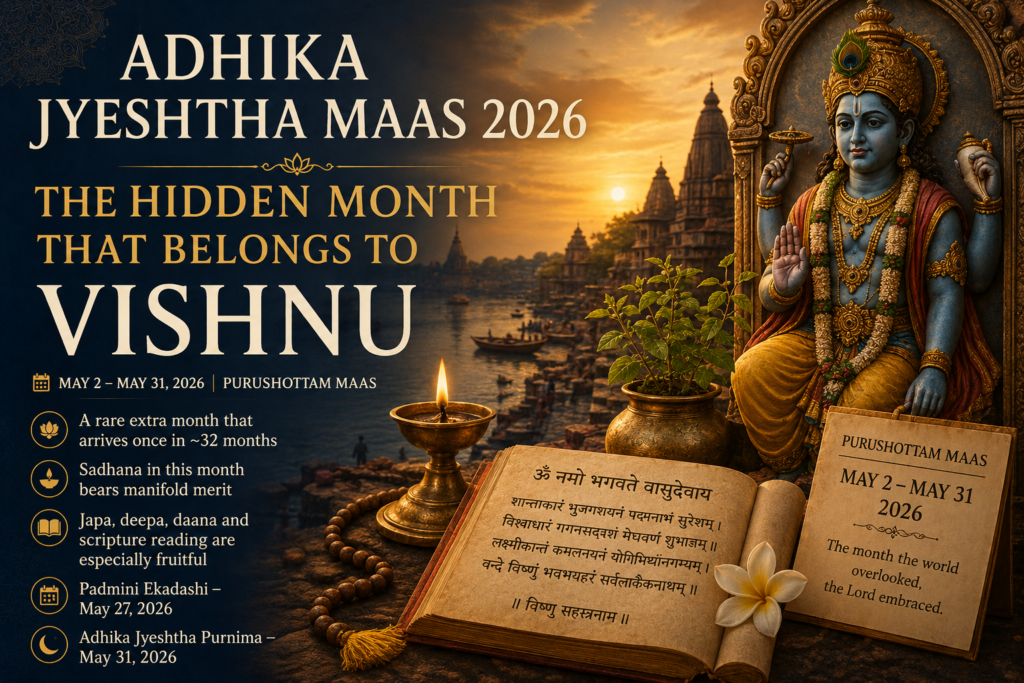
This is Adhika Maas — also called Purushottam Maas, the month of the Supreme Person. In 2026, it has fallen across Jyeshtha — beginning on the second of May and closing on the thirty-first. For thirty days, the Hindu calendar has held a quiet, hidden chamber, and the Puranas urge the seeker to step inside.
Why an “Extra” Month Exists
The Hindu calendar is luni-solar — it counts the months by the moon and the year by the sun. A lunar month is roughly twenty-nine and a half days; a solar year is just over three hundred and sixty-five. Each year, the lunar count falls about eleven days behind the solar one.
Left uncorrected, the months would slowly drift through the seasons — Shravana would arrive in winter, Magha in summer, the festivals would lose their tie to the rhythm of Bharata’s land. And so the Rishis, who were astronomers as much as they were sages, built into the calendar a self-correction: roughly every thirty-two and a half months, an entire lunar month is added in. That added month is Adhika Maas.
By that gentle adjustment, the calendar realigns. The months return to their seasons. The festivals stay tied to the soil and the sky.
But the Rishis went further. They did not let this extra month be merely a technical insertion. They placed it under the protection of the highest authority in creation — Bhagavan Vishnu Himself — and they gave it a name worthy of that protection.
How Adhika Maas Became Purushottam Maas
The story is preserved in the Padma Purana, in the Naradiya Purana, and in the Bhavishyottara Purana.
When the Rishis first calculated this extra month and announced its presence, the month itself fell into despair. The other twelve months each had a presiding deity — Vaishakha was beloved of Vishnu, Shravana of Shiva, Kartika of Damodara. Each had its festivals, its tirthas, its prescribed worships. But the new thirteenth month had no deity, no observances, no fruit promised for any sadhana performed in it. The other months refused even to share their names.
Adhika Maas, in the form of a month-personified, went weeping to Bhagavan Vishnu on the slopes of Vaikuntha and laid her grief at His feet.
The Lord listened. He did not give a small answer.
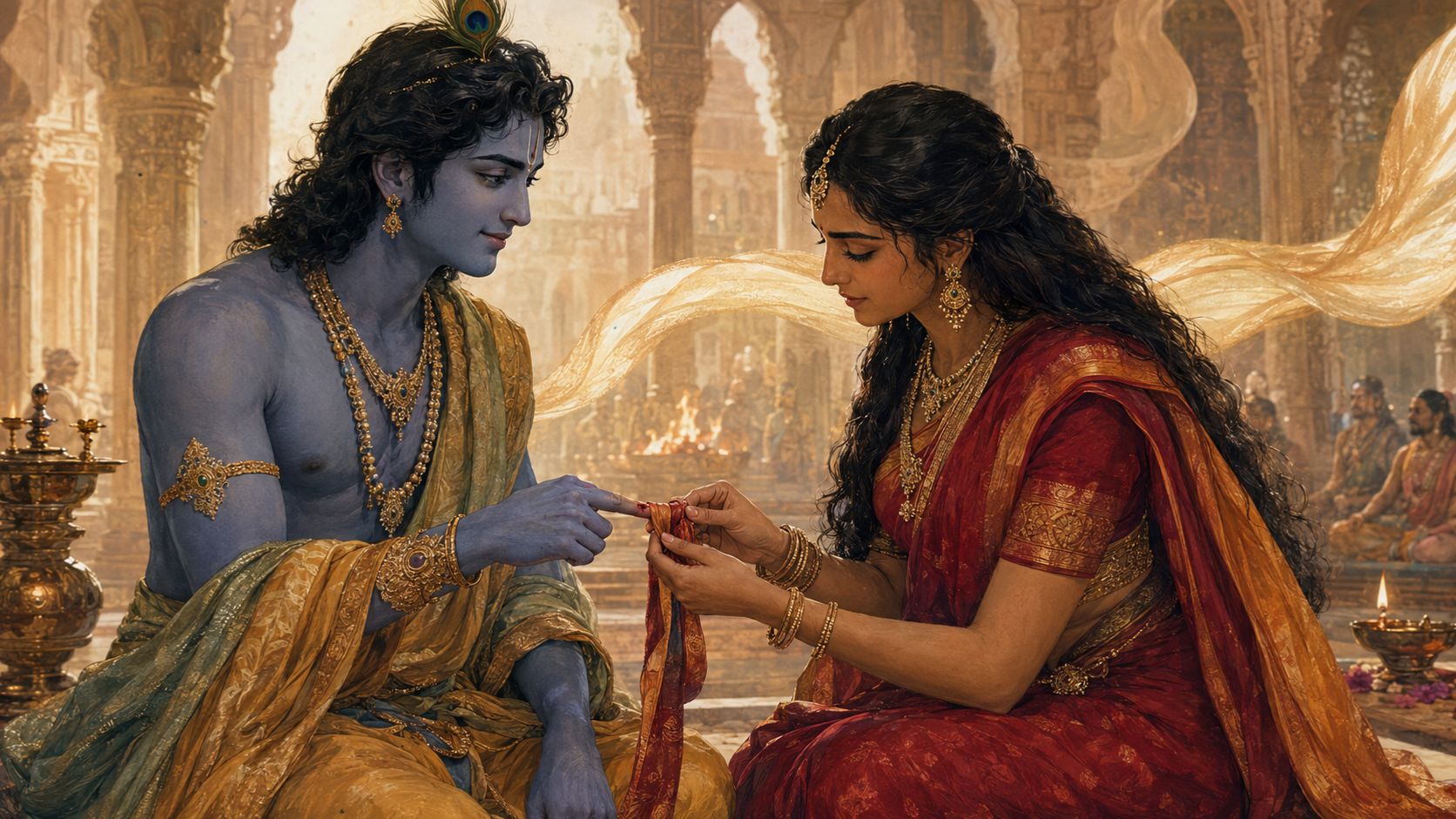
He took her by the hand, the Puranas say, and bestowed upon her His own most sacred name — Purushottama, “the Supreme Person.” From that day, He decreed, this month would no longer be called merely “the extra one.” It would be Purushottam Maas, and any sadhana performed within it — any japa, any vrat, any daana, any reading of scripture — would yield merit greater than the same act performed in any other month of the year.
“Whatever was excluded from the other twelve months,” Vishnu told her, “shall find its full home in you. The seeker who finds you shall find Me.”
This is the month we have been walking through since the second of May.
What the Puranas Promise to the One Who Observes It
The promises of the Puranas regarding Purushottam Maas are extraordinary even by the standards of Sanatana Dharma. The Padma Purana declares that one mala of the dvadasha-akshara mantra — Om Namo Bhagavate Vasudevaya — recited during this month equals ten malas in any other. The Bhavishyottara Purana says that the Vishnu Sahasranama heard with sincerity even once during these days releases the Jivatma from countless lifetimes of accumulated paapa.
A single deepa lit before the Lord. A single tulsi leaf offered. A single chapter of the Bhagavata Purana read aloud. A single hungry person fed. The Puranas count each of these, in Purushottam Maas, as if the act had been multiplied many times over and stored in an akshaya treasury that no force in creation can deplete.
Two practices are singled out for particular emphasis: the daily reading of the Purushottam Mahatmya (preserved in the Padma Purana), and the offering of a ghee deepa each evening before an image of Bhagavan Vishnu. The simplest household, the Puranas insist, may earn through these two acts alone the same fruit that the great kings of old earned through royal yajnas.
What to Do — A Householder’s Guide for the Remaining Days
Even now, with most of the month behind us, the closing days of Purushottam Maas hold immense fruit. The Acharyas advise that the final fortnight is in some ways the most charged — the merit accumulated through the month is sealed by what is done in its last days.
Daily, through to May 31
Rise before sunrise, bathe in cool water, and offer pranama to the rising Sun. Light a single ghee deepa before an image or murti of Bhagavan Vishnu and let it burn through the morning sandhya. Recite, even briefly, the Vishnu Sahasranama — and if time does not permit the full text, simply the Achyutashtakam or the Madhurashtakam.
Through the day, keep japa of Om Namo Bhagavate Vasudevaya on the breath. The Acharyas suggest a daily target of one mala — one hundred and eight repetitions — for the householder, and three for the seeker who can spare the time.
Once a week, through to May 31
Observe a single sattvic fast — phalahari (fruits, milk, water) is enough. Hear or read aloud one chapter of the Bhagavata Purana, or the entire Purushottam Mahatmya from the Padma Purana. Feed one hungry person, or offer dakshina to a Brahmana who has kept the tradition.
On Padmini Ekadashi — Wednesday, May 27
The Shukla Paksha Ekadashi of Adhika Maas is called Padmini Ekadashi, and it is the rarest Ekadashi in the entire Hindu calendar — it appears only during Purushottam Maas, which itself appears only every thirty-odd months. Observe it as you would the most important Ekadashi of your year. (A separate post in this series will cover its vidhi in detail.)
On Adhika Jyeshtha Purnima — Sunday, May 31
The closing day of the month. A snan in the Ganga or in any sacred river is the prescribed observance, but a simple bath at home with a touch of Ganga jal added to the water carries the same merit if undertaken with sraddha. Light a deepa. Read the closing chapter of the Purushottam Mahatmya. Offer the merit of the entire month to Bhagavan Vishnu and ask only that He keep you in His remembrance.
Mantras for Purushottam Maas
Om Namo Bhagavate Vasudevaya
Om Namo Narayanaya
Om Shreem Hreem Kleem Purushottamaaya Namah
A mala of any one of these mantras at dawn, repeated through the remaining days of Purushottam Maas, is the gentlest and most fruitful sadhana the householder can keep.
The Deeper Teaching — The Month That Was Almost Forgotten
There is a small, quiet wisdom hidden in the story of Purushottam Maas that does not announce itself.
The other twelve months of the year were already established. They had their deities, their festivals, their devotees, their place in the calendar of every Hindu household. They were the expected months — the ones the world had already learned to honour. And when a new month appeared without a place, without a deity, without a festival of its own, the world’s first response was to turn away.
It was Bhagavan Vishnu who turned toward her.
This is the teaching the Puranas wanted to plant in the heart of every devotee who reads this month’s mahatmya: the Lord has a particular tenderness for what the world overlooks. The month that was almost forgotten became the month that bears His own name. The fruit promised in it is not lesser than the fruit of the great festivals — it is greater, because it was set there by the One who knew what it meant to be unloved.
Every Jivatma who has ever felt overlooked by the rhythms of the world has a friend in Purushottam Maas. The Lord who took this month onto Himself takes that Jivatma onto Himself in just the same way.
We have until the thirty-first of May. The month is still here. The Lord is still listening.