Maa Kalaratri
Into the Darkness — The Form That Destroys All Fear
We have journeyed far in these seven days. We began at the mountain, rooted and still. We sat with the ascetic and her unbreakable fire. We heard the warrior goddess's bell ring out across the cosmos. We watched the universe be born from a smile. We rested in a mother's arms. We felt the fury of righteousness rise like a tide that cannot be turned. And now, on Day 7, we enter the night.
Not just any night. The deepest night. The darkness that carries every fear we have ever had — of death, of loss, of the unknown, of the parts of ourselves we have not yet been willing to look at directly. On Day 7 of Chaitra Navratri, we bow to Maa Kalaratri — the darkest, most formidable, most terrifying of all nine forms of the Goddess. And in bowing to her, we discover the most astonishing truth of the entire Navratri journey: that the darkest form is also the most liberating, and that the goddess who looks most like fear is the one who destroys it completely.
Who Is Maa Kalaratri?
The name Kalaratri joins two Sanskrit words: Kala (काल) — meaning both time and death — and Ratri (रात्रि) — night. She is "the night of time" and "the night of death" — the cosmic darkness that is the inevitable endpoint of all created things, and simultaneously the fertile void from which all new creation arises.
Kalaratri is Parvati in her most extreme and uninhibited form. She emerges in the Devi Mahatmya when the demons Shumbha and Nishumbha send their commanders Chanda and Munda to capture the Goddess. In response, Parvati's face darkens with absolute wrath, and from that concentrated divine fury, Kali erupts — dark, wild, unstoppable. In the Navdurga system, this same primal energy is Kalaratri: the dark night of the divine, fully, completely unleashed.
The Mythology: When Parvati Shed Her Golden Skin
A second, equally powerful origin story is found in the Shiva Purana. The demons Shumbha and Nishumbha sent a message to the Goddess: "You are beautiful. Come to us willingly, or we will take you by force."
The Goddess's response was not panic. It was not negotiation. It was something far more disquieting: she smiled quietly, and then she shed her golden outer form — the radiant, beautiful, conventionally appealing face of the divine feminine — and revealed what lay beneath. Dark as deep space. Wild as the primordial void. Absolutely without the softening veil of beauty the world finds comfortable. This is the teaching at the heart of Kalaratri: beneath every ornamental face we present to the world, there is a truth that is darker, rawer, more powerful, and ultimately more real. Kalaratri is that truth. She is what remains when everything merely decorative has been stripped away.
The Sacred Iconography of Maa Kalaratri
Dark as the Night Sky
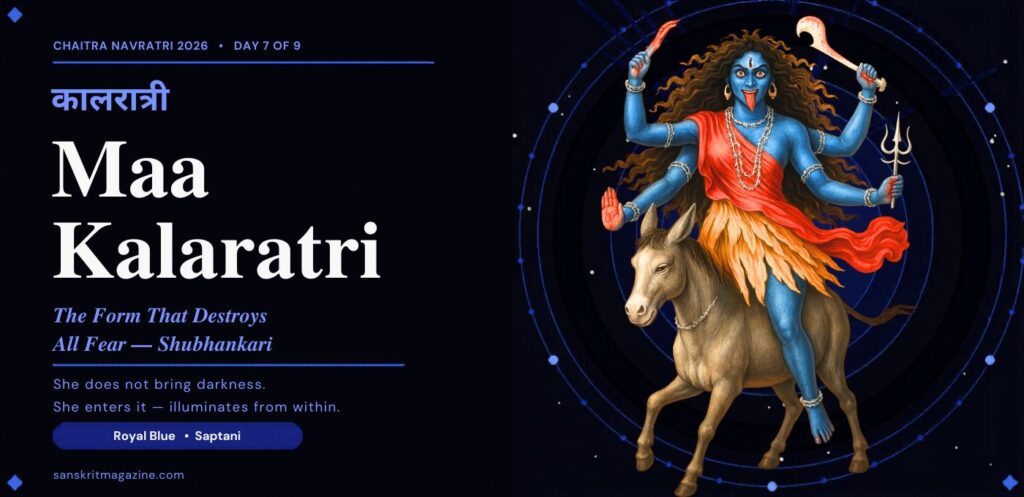
Kalaratri's complexion is dark as the deepest moonless night — not the grey of twilight, but the total, absolute darkness of a new moon sky far from any city. This darkness is not a deficiency; it is a fullness. Just as the night sky contains stars beyond counting, Kalaratri's darkness holds all possibility, all potential, all the seeds of every future moment yet to be born.
Three Blazing Eyes
She has three eyes, all wide open, from which pour streams of fire like lightning. The three eyes see past, present, and future simultaneously. Nothing is hidden from her gaze. The fire from her eyes is the fire of absolute, compassionate seeing — a seeing that burns away every lie, every self-deception, every comfortable fiction standing between the devotee and liberation.
Wild, Unbound Hair
Her long black hair is wild and loose — not braided or adorned. In the Indian tradition, a woman's unbound hair signals extremity: grief, rage, or a spiritual power that has burst through every social convention. Kalaratri's unbound hair declares: I am the power of the cosmos, and I will not be tamed.
The Humble Donkey Mount
Unlike the lion or tiger of the other warrior forms, Kalaratri rides a donkey — the humblest of mounts, associated with the ordinary working world, with the unglamorous and unremarkable. The most terrifying cosmic goddess on the most humble creature: true power needs no impressive display. The divine has no ego investment in appearing magnificent.
Sword, Iron Thorn, Abhaya, Varada
Her four arms carry a gleaming sword, a sharp iron thorn club, and two hands in the Abhaya and Varada mudras — fearlessness and boon-giving. Even at her most terrifying, she extends the gesture of protection to her devotees. "I am not here to harm you," those hands say. "I am here to free you."
- Form: Parvati's most raw cosmic form; manifestation of Kali energy in the Navdurga
- Also known as: Shubhankari — the auspicious one
- Vehicle: Donkey — humility; power that needs no display
- Complexion: Dark as the deepest moonless night sky
- Eyes: Three, blazing with cosmic fire
- Colour worn today: Royal Blue — cosmic depth, divine protection, infinite mystery
- Planet governed: Saturn (Shani) — karma, justice, discipline, transformation
- Bhog (offering): Jaggery (gur) — removes obstacles; protects from harsh karma
- Chakra: Sahasrara (Crown Chakra) — pure consciousness, liberation, union with the divine
Shubhankari: The Paradox at the Heart of Kalaratri
The most important key to understanding Maa Kalaratri is her epithet Shubhankari — "she who grants auspiciousness." In a tradition that includes forms as tender as Skandamata and as radiant as Kushmanda, why is the most terrifying form called auspicious?
Because what Kalaratri destroys is not life or love or goodness — but fear itself. The Devi Mahatmya identifies the enemies she slays not as external monsters but as the internal demons of the human soul: anger calcified into hatred, greed become compulsion, pride become delusion, fear hardened into a prison around the self.
When these inner demons are destroyed, what remains is not emptiness but liberation. The devotee who has passed through Kalaratri's night does not emerge diminished — they emerge purified, stripped of every false identity they were carrying, left with only what is truly, indestructibly themselves.
Kalaratri and Saturn: The Governance of Shani
Maa Kalaratri governs Saturn (Shani) — the most feared and most just planet in Vedic astrology. Saturn is the lord of karma: impartial, unflinching, absolutely committed to the principle that every action has its consequence, that nothing unresolved remains hidden forever. Saturn's transits — particularly Sade Sati and Dhaiya — are dreaded because they bring exactly what Kalaratri brings: the stripping of false securities, forced encounters with what has been avoided, the confrontation with accumulated karma.
But Saturn's ultimate purpose, like Kalaratri's, is not punishment — it is purification. Those who bow to Kalaratri with genuine devotion receive her protection not by escaping their karma, but by facing it willingly, with an open heart. That is the only true protection from Saturn's justice — and it is the greatest gift Kalaratri gives.
एकवेणी जपाकर्णपूरा नग्ना खरास्थिता ।
लम्बोष्ठी कर्णिकाकर्णी तैलाभ्यक्तशरीरिणी ॥
Ekveni Japaakarna Poora Nagna Kharaasthitaa
Lamboshthi Karnigakarni Tailaabhyakta Shareeriini
"She who wears a single braid, adorned at the ear, standing on the donkey, anointed with oil — I bow to Maa Kalaratri."
Bhog: Sacred Offering for Maa Kalaratri
The traditional bhog for Maa Kalaratri is jaggery (gur). Offering jaggery removes obstacles from the devotee's path and protects them from the harsher manifestations of Saturn's karmic justice. It connects to Saturn's affinity for black sesame and earthy, unrefined sweets.
- 1 cup white sesame seeds, dry roasted until golden
- ½ cup jaggery, grated
- 1 tbsp ghee
- ¼ tsp cardamom powder
Method: Melt jaggery in a pan with ghee over low heat until soft-ball consistency (test in water). Add roasted sesame and cardamom. Mix quickly and shape into small balls while warm. Offer to Maa Kalaratri and distribute as prasad. These are also one of the most auspicious offerings for Saturn (Shani) worship.
Why Royal Blue? The Significance of Today's Navratri Colour
Royal Blue is the colour of the night sky at its deepest — not the black of absolute darkness but the deep, luminous, star-filled blue that the eye sees when looking up at a clear sky far from any city. It is the colour of infinite depth, of mystery, of the space in which all the stars of consciousness shine. It is also associated with the Ajna chakra — the third eye of penetrating, unflinching, compassionate inner vision. Wearing royal blue today is an act of alignment with the courage to see clearly, even in the dark.
The Deeper Teaching: Your Shadow Is Not Your Enemy
The path to wholeness runs directly through the shadow, not around it. The parts of ourselves we have disowned, suppressed, refused to acknowledge — these do not disappear when ignored. They grow stronger in the dark. They drive our behaviour from below the surface. They become the demons we project outward onto others.
Kalaratri is the goddess who says: stop running. Turn around. Look at what is chasing you. And when you look at it with her eyes — the three-eyed fire of absolute, compassionate seeing — you will find that what looked like a monster was only a shadow. And shadows, in the presence of true light, simply cease to exist.
This is the gift of Day 7. Not comfort. Not reassurance. Something far more valuable: the absolute, certain, first-hand knowledge that there is nothing in the darkness that can harm you more than your refusal to look at it.
🙏 Jai Maa Kalaratri! Jai Shubhankari! Wear royal blue today. Offer jaggery at your altar. Light a ghee lamp, sit with it in silence for a few minutes before your puja — just you, the flame, and the night. Chant ॐ देवी कालरात्र्यै नमः 108 times. And today, face one thing you have been avoiding. That is your Kalaratri sadhana. 🌑
Published by Sanskriti Magazine — India's largest digital platform for Hindu heritage, culture, and spirituality.
Read more at sanskritimagazine.com · Follow us on Instagram & Facebook: @indian_sanskriti
Continue the journey tomorrow: Day 8 — Maa Mahagauri, the snow-white goddess of redemption. Durga Ashtami & Kanya Puja.