Maa Kushmanda
The Smiling Goddess Who Created the Universe
Before the sun existed, before the planets swung into their orbits, before the first star ignited in the primordial darkness — there was nothing. Not even darkness in the way we understand it. Just a vast, total, absolute absence. The scriptures describe it as a state of deep, pre-cosmic stillness — Tamas at its most complete, a darkness so profound that not even a single photon had yet been imagined into existence.
And then Maa Kushmanda smiled.
That smile — one smile from the face of the primordial goddess — shattered the void and poured light into existence. The universe was born not from an explosion of force or an act of will, but from a single moment of divine joy. This is the breathtaking teaching at the heart of Maa Kushmanda's story: that the deepest creative act in the cosmos was an act of happiness. And it is the teaching she offers to every human being who has ever created anything — that the most powerful source of creativity is not discipline, not strategy, not effort, but the deep, spontaneous, unstoppable joy of being alive.
Who Is Maa Kushmanda?
The name Kushmanda is a compound Sanskrit word with multiple layers of meaning. The most widely accepted interpretation breaks it into three parts: Ku (कु) — little or small; Ushma (उष्मा) — warmth, energy, cosmic heat; and Anda (अण्ड) — egg or cosmic sphere. Together, Kushmanda means "she who is the small, warm cosmic egg" — or more poetically, "she who contains the seed of the entire universe within a tiny, warm sphere of divine energy."
This cosmic egg — the Brahmanda — is one of the oldest cosmological concepts in Hindu thought. Long before Western science conceived of the Big Bang, Vedic cosmology understood the universe as having emerged from a primordial egg of pure concentrated energy. And Maa Kushmanda is identified as the goddess who is the source of that egg — who contains it within herself and releases it through the act of smiling.
She resides in the center of the sun — Surya Mandal — and is said to radiate light and energy in all directions, just as the sun radiates light to the entire solar system. She is, in a very real sense, the divine intelligence within solar energy. Every ray of sunlight that falls on your skin is, in the Kushmanda tradition, a touch of her grace.
The Sacred Iconography of Maa Kushmanda
Eight Arms — Ashtabhuja
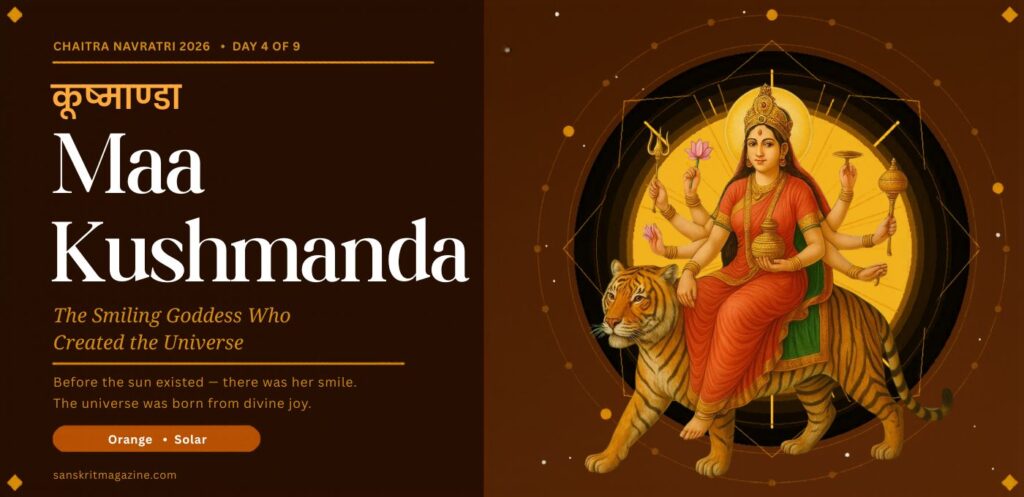
Maa Kushmanda is one of the most elaborately armed of the Navdurga, bearing eight arms — earning her the epithet Ashtabhuja Devi. Her eight arms hold: a kamandal (water pot), a dhanush (bow), a baan (arrow), a kamal (lotus flower), an amrit kalash (vessel of immortal nectar), a chakra (divine discus), a gada (mace), and a japamala (prayer beads). The eighth arm sometimes holds all of these simultaneously in varying traditions. The combination of weapons, symbols of life (lotus, amrit), and instruments of devotion (japamala) in a single divine form tells us she encompasses the complete range of cosmic functions.
The Lion Mount
Like several of the Navdurga, Maa Kushmanda rides a lion — the symbol of royal power, courage, and dharmic authority. The solar goddess riding the lion is a striking image: the warmth of the sun and the courage of the lion, combined in a single figure who radiates both light and strength in equal measure.
Radiant Golden Complexion
Her complexion is described as golden and luminous — like the sun at midday. She does not merely reflect light; she generates it. This inner luminosity is the visual representation of her nature as the source of all cosmic light and energy. Meditating on her golden form is said to kindle the same inner light within the devotee.
The Smile
Uniquely among the Navdurga, Maa Kushmanda is always depicted with a gentle, radiant smile — the very smile that created the universe. In a tradition that includes fearsome forms like Kalaratri and Chandraghanta, this smiling goddess stands as a reminder that the divine is not only awe-inspiring but also deeply, warmly, personally joyful.
- Form: The primordial creator; source of the cosmic egg (Brahmanda)
- Vehicle: Lion — royal authority, solar courage
- Arms: Eight — kamandal, bow, arrow, lotus, amrit kalash, chakra, gada, japamala
- Complexion: Radiant golden — luminous as the sun at noon
- Defining quality: The divine smile that created the universe
- Colour worn today: Orange — solar energy, vitality, creative fire
- Planet governed: Sun (Surya) — health, vitality, authority, success
- Bhog (offering): Malpua, white pumpkin (petha)
- Chakra: Anahata (Heart Chakra) — love, joy, creative expression
Kushmanda and the Sun: The Governance of Surya
Among the Navdurga, Maa Kushmanda governs the Sun (Surya) — the most powerful of all the celestial bodies in Vedic astrology. In the Vedic system, the Sun is not merely a star — it is the Atmakaraka, the significator of the soul itself. A well-placed Sun in a birth chart gives the native vitality, authority, clarity of purpose, healthy self-esteem, and the ability to command respect without demanding it.
Since Kushmanda resides within the sun and is its divine inner intelligence, worshipping her is said to strengthen the sun in the devotee's horoscope — bringing improved health, enhanced leadership qualities, renewed creative energy, and a sense of purposeful direction in life. Those who suffer from low energy, lack of confidence, or a sense of purposelessness are encouraged to pray to Maa Kushmanda with particular devotion.
Offering water to the rising sun (Arghya) each morning during Navratri while chanting her mantra is considered especially efficacious — a practice that connects the outer solar energy with the inner divine light that Kushmanda represents.
सुरासम्पूर्णकलशं रुधिराप्लुतमेव च ।
दधाना हस्तपद्माभ्यां कूष्माण्डा शुभदास्तु मे ॥
Suraasampoorna Kalasham Rudhiraaplutameva Cha
Dadhaana Hastpadmaabhyam Kushmanda Shubhadaastu Me
"May Kushmanda — who holds in her lotus hands a pot full of divine nectar — be auspicious to me."
The Brahmanda: Creation as an Act of Joy
The philosophical teaching embedded in Maa Kushmanda's origin story is one of the most radical and liberating in all of Hindu cosmology. In many creation narratives — Hindu, Abrahamic, and otherwise — the universe is created through an act of will, command, or effort. The creator decides to create, designs a plan, and executes it.
But Kushmanda's creation is different. There is no plan, no effort, no prior intention. There is only a spontaneous upsurge of joy — a smile — and from that smile, everything flows. This tells us something profound about the nature of authentic creativity: it cannot be forced. The most powerful creative acts — the works of art that move people to tears, the scientific discoveries that rewrite reality, the businesses that genuinely change people's lives — arise not from grinding effort alone, but from moments of genuine, spontaneous, joyful engagement with the work.
The Sanskrit tradition has a word for this: Ananda — divine bliss. Ananda is not happiness in the ordinary sense, not the pleasure of getting what you want. It is the deep, non-contingent, self-arising joy of existence itself — the joy that the universe feels at being alive. Kushmanda is Ananda made manifest. She is the proof that at the very foundation of creation is not darkness, not struggle, not void — but joy.
Why the Pumpkin? Kushmanda's Sacred Vegetable
One of the most distinctive aspects of Maa Kushmanda's worship is her strong association with the pumpkin (Kushmanda in Sanskrit). In fact, some scholars believe the goddess derives her name from the vegetable, not the other way around — though the most accepted interpretation remains the cosmic egg etymology.
White pumpkin — known as petha or safed kaddu in Hindi — is the traditional bhog offering for Maa Kushmanda. It is also used in a distinctive puja ritual where a whole white pumpkin is offered and then broken open, symbolising the breaking of the cosmic egg and the release of creation. The pumpkin's round shape, its pale outer skin concealing a bright orange interior, and its abundance of seeds (each carrying the potential for a new plant) make it a natural symbol of the cosmic egg containing all of creation's potential.
According to tradition, offering petha to Kushmanda during Navratri is said to remove diseases, bring prosperity, and fulfil wishes — particularly wishes related to creative endeavours and professional success.
Bhog: Sacred Offering for Maa Kushmanda
The traditional bhog for Maa Kushmanda is malpua and white pumpkin (petha). Malpua is a sweet pancake — one of the most ancient and beloved sweets in India, made from wheat or buckwheat flour, milk, and sugar, fried in ghee and soaked in saffron syrup.
- 1 cup kuttu atta (buckwheat flour)
- ½ cup mashed banana or grated apple (as binder)
- 3–4 tablespoons sugar
- ½ cup milk
- ¼ tsp cardamom powder
- A pinch of saffron soaked in 2 tbsp warm milk
- Ghee for frying
Method: Mix flour, mashed fruit, sugar, cardamom, saffron milk, and enough plain milk to form a pourable batter. Heat ghee in a flat pan. Pour small rounds of batter and cook on medium-low heat until golden and crisp at edges. Flip and cook the other side. Serve warm, drizzled with honey or sugar syrup, as prasad.
Why Orange? The Significance of Today's Navratri Colour
Orange is the colour of Day 4 — and it is perhaps the most perfectly aligned colour in the entire Navratri sequence. Orange is the colour of the sunrise, of sacred fire, of the marigold that adorns every Hindu altar. In the Vedic tradition, orange-saffron (kesari) is the colour of renunciation, courage, and the sacred fire of the yajna. It is the colour that Hindu monks wear — not as a fashion statement, but as a declaration that they have surrendered everything to the divine fire of transformation.
For Kushmanda, orange is the colour of solar energy made visible — the warm, radiant, life-giving orange of the sun as it rises. It is also the colour of creative fire: the fire in the belly of the artist, the scientist, the entrepreneur, the parent who creates a family. Wear orange today as an alignment with the creative force of the cosmos — a reminder that you, too, carry within you the capacity to smile and bring something new into the world.
The Deeper Teaching: Creation Flows from Joy
On this fourth day of Navratri, as we move deeper into the nine sacred nights, Maa Kushmanda invites us to examine our relationship with creation and joy. Too many of us have been taught — by culture, by education, by hard experience — that creation is painful. That good work requires suffering. That if it doesn't hurt, it isn't real. That joy is a luxury, not a prerequisite.
Kushmanda overturns all of this. She shows us that the universe itself — the most complete, complex, magnificent act of creation ever accomplished — was born from a smile. Not from toil or pain, but from the overflow of divine happiness, from a heart so full that it poured itself into the void and became everything.
What would your life look like if you approached your creative work — whatever that work is — from that place? Not from the anxious need to produce, not from fear of failure, but from the simple, solar, Kushmanda-like joy of doing what you love? This is the question she places in the heart of every devotee on Day 4. And her presence is the answer.
🙏 Jai Maa Kushmanda! Wear orange today. Offer malpua or white pumpkin. If possible, offer water to the rising sun at dawn while chanting her mantra. Chant ॐ देवी कूष्माण्डायै नमः 108 times. And today, do at least one thing — anything — purely for the joy of it. May her solar grace fill your home and heart with light. ☀️
Published by Sanskriti Magazine — India's largest digital platform for Hindu heritage, culture, and spirituality.
Read more at sanskritimagazine.com · Follow us on Instagram & Facebook: @indian_sanskriti
Continue the journey tomorrow: Day 5 — Maa Skandamata, the Divine Mother of Kartikeya and the cosmos.