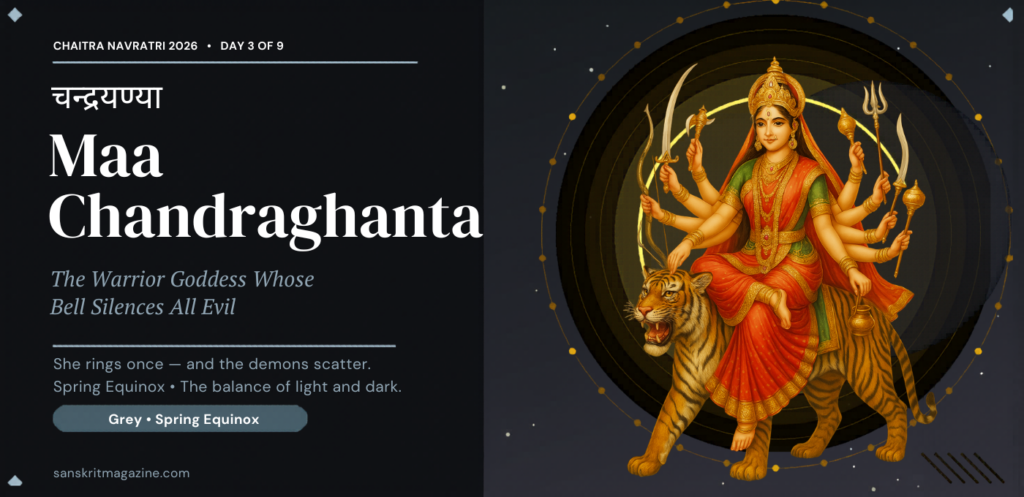
Maa Chandraghanta
The Warrior Goddess Whose Bell Silences All Evil
There is a moment in every spiritual journey when the inner work of the first two stages — the grounding of Day 1, the austerity of Day 2 — must meet the outer world. When the meditator must rise from her seat. When the devotee must step out of the forest of tapas and into the open field of life. When the love that has been forged in silence must put on armour and go forward.
This is the moment of Maa Chandraghanta, the third form of Navdurga, worshipped on Day 3 of Chaitra Navratri. She is Parvati transformed — no longer the ascetic sitting barefoot in the forest, but the fully awakened, battle-ready goddess who has emerged from her marriage to Shiva as the most formidable warrior in all the three worlds.
And today, March 21, 2026, carries a rare additional significance: it is also the Spring Equinox — the astronomical moment when day and night are in perfect balance, when the sun crosses the celestial equator and light begins its long ascent toward summer. On the day when the universe itself finds balance between darkness and light, we worship the goddess who embodies exactly this balance: fierce and gentle, powerful and graceful, the warrior who wins not through destruction alone, but through the radiant authority of righteousness.
Who Is Maa Chandraghanta?
The name Chandraghanta combines two Sanskrit words: Chandra (चन्द्र) — the moon — and Ghanta (घण्टा) — a bell. She is the goddess who bears a half-moon shaped like a bell on her forehead. The half-moon itself is familiar from Shailputri and from Shiva himself — but on Chandraghanta, it takes a specific form: the crescent is bent and shaped precisely like a ghanta, the sacred bell that is rung at the beginning of every Hindu puja to announce the arrival of the divine and to dispel negative energies from the space.
Chandraghanta is Parvati after her wedding to Shiva. This is a crucial distinction from her previous forms. Shailputri was Parvati as a child — grounded, nascent, rooted in her mountain origins. Brahmacharini was Parvati as the tapasvi — enduring, inward, building the inner fire. But Chandraghanta is Parvati having crossed the threshold into union with the divine — and from that union, she has emerged not softened but empowered beyond all previous measure.
The Wedding of Shiva and Parvati: Chandraghanta's Moment of Birth
The story of how Chandraghanta emerged deserves to be told in full, because it illuminates the essential quality of this goddess — which is not just courage or power, but the kind of confidence that comes only from love.
When Shiva agreed to marry Parvati, he arrived for the wedding ceremony in his most authentic, unvarnished form — the way he truly was, with no performance for the occasion. He came riding his bull, smeared in ash, matted locks flying, surrounded by his ganas (divine attendants) — ghosts, spirits, ascetics with matted hair, beings from the burning ghats. It was not a conventional wedding procession.
Mena, Parvati's mother, fainted. The assembled guests were terrified. The wedding was on the verge of becoming a catastrophe of cosmic proportions. And then Parvati intervened.
She went to Shiva and, gently but with complete authority, asked him to make himself more presentable for her family's sake — not because she needed him to be different, but because she was ready to act as the bridge between his unbounded, formless nature and the world of form, duty, and social reality that her family inhabited. Shiva, who loved her completely and trusted her completely, agreed. He returned as a radiant, bejewelled, magnificent bridegroom — and the wedding proceeded in glory.
In this act, Parvati became Chandraghanta: the one who knows when to be fierce and when to be gracious, when to stand her ground and when to build a bridge. She did not defeat Shiva's wildness — she honoured it and also held the space for the world. This is warrior wisdom of the highest order.
The Sacred Iconography of Maa Chandraghanta
The Bell-Shaped Crescent Moon
The defining feature of Chandraghanta is the half-moon bell on her forehead. In Hindu worship, the bell (ghanta) is rung at the beginning of puja to awaken the deity, purify the space, and drive away negative energies. The sound of a bell in a temple is not merely decorative — it operates at a specific frequency that is said to clear the subtle atmosphere and create a field of sacred receptivity. When this bell is worn on the forehead of the goddess herself, it means her very presence performs this function constantly. Wherever Chandraghanta turns her gaze, that space is purified.
Ten Arms
Chandraghanta has ten arms — five on each side — carrying an array of weapons and sacred symbols: a trishul (trident), a gada (mace), a sword, an arrow, a lotus flower, a kamandal (water pot), a bow, and two hands in Abhaya mudra (the gesture of fearlessness and protection). The multiplicity of arms is a visual teaching: she is simultaneously capable of action on multiple fronts, just as a warrior mother must at once protect, nurture, fight, and bless — all without dropping a single thread.
The Tiger Mount
She rides a tiger — in some traditions, a lion. The tiger represents the untamed life-force, the raw energy of nature that has been harnessed and directed rather than suppressed. The goddess riding the tiger means she does not fear power — she has integrated it. The tiger does not carry her unwillingly; it recognises her authority and serves willingly. This is the relationship between Chandraghanta and the forces of the natural world: they are not her enemies but her instruments.
Complexion: Golden
Unlike the dark Kalaratri or the snow-white Mahagauri, Chandraghanta is described as having a golden complexion — the colour of the sun, of ripened grain, of the sacred fire. Gold in the Hindu tradition represents both spiritual purity and the abundance of the divine. Her golden form radiates a light that simultaneously warms and protects.
- Form: Parvati as warrior-queen, after marriage to Shiva
- Defining mark: Half-moon bell (chandraghanta) on forehead
- Vehicle: Tiger (or lion)
- Arms: Ten — carrying weapons and sacred objects
- Complexion: Golden — radiant as the sun
- Colour worn today: Grey — strength, resilience, steadfast courage
- Planet governed: Venus (Shukra) — beauty, love, material prosperity
- Bhog (offering): Milk and milk sweets (kheer, rabri)
- Chakra: Manipura (Solar Plexus) — personal power, courage, action
Chandraghanta and Venus: The Governance of Shukra
Among the Navdurga, Maa Chandraghanta governs Venus (Shukra) — the planet of beauty, love, material pleasure, artistic gifts, and harmonious relationships. This assignment is at first surprising: why does a warrior goddess govern Venus? The answer lies in one of the deepest insights of the Vedic tradition: true beauty is not passive. It requires courage.
Venus without strength becomes vanity, dependency, and the inability to protect what one loves. But Venus in its highest expression — the Venus that Chandraghanta governs — is the beauty of the warrior who fights precisely because she loves, the lover who is capable of laying down her weapons because she is also capable of picking them up. She is grace backed by power. She is love that knows how to say no.
Devotees who seek blessings in love and relationships, those who wish to cultivate beauty and artistic gifts, and those whose Venus is afflicted in their birth chart are advised to pray to Chandraghanta with sincere devotion. Her blessings balance the qualities of love and strength, giving the devotee the ability to love fully without losing oneself.
पिण्डज प्रवरारूढा चण्डकोपास्त्रकैर्युता ।
प्रसादं तनुते मह्यम् चन्द्रघण्टेति विश्रुता ॥
Pindaj Pravararudha Chandkopastrakairyuta
Prasadam Tanute Mahyam Chandraghanteti Vishruta
"I bow to Chandraghanta — renowned throughout the universe — who rides the finest bull, is armed with weapons of fierce anger, and grants blessings upon me."
The Sacred Power of the Bell in Hindu Worship
Since Chandraghanta's very name and defining symbol is the bell, it is worth dwelling on the profound role of the ghanta in Hindu ritual and its deeper spiritual significance.
The Agama Shastra, the ancient texts governing temple worship, prescribes that a bell must be rung at the beginning of every puja. The reason given is both practical and metaphysical: the sound of the bell awakens the deity, signals to all beings in the subtle realms that worship is about to begin, and purifies the space of any inauspicious energies. But there is a deeper reason that the sages understood.
The sound of a bell — particularly a large, well-cast temple bell — produces what acousticians call a binaural beat effect. The complex overtones of a bell's resonance create simultaneous frequencies that affect the brain's wave patterns, shifting the listener from the busy beta state (ordinary waking consciousness) into the calmer, more receptive alpha state. The ancient temple architects knew this, which is why the bells in great temples like Brihadeeswara or Vaishno Devi are sized and cast to produce specific frequencies for specific effects.
When Chandraghanta's crescent-bell rings, it is not merely a sound — it is a frequency of liberation. The texts say that even hearing her name — Chan-dra-ghan-ta — produces a subtle vibrational shift in the listener, as though a small bell were being rung in the very center of the mind.
Spring Equinox and Navratri: A Cosmic Alignment
Today's confluence of Navratri Day 3 with the Spring Equinox is a reminder of one of the most profound aspects of the Hindu calendar: its fundamental attunement to the rhythms of the natural world. The Hindu calendar is a lunisolar system — it tracks both the moon and the sun, both the tidal rhythms of the inner world (the moon's influence on the mind and emotions) and the solar cycle of seasons and light.
The Spring Equinox is the moment when night and day are precisely equal — a perfect balance of light and darkness. After this moment, light begins to gain. It is the astronomical beginning of the ascent toward summer, toward the fullness of solar energy. The earth herself is in a state of Chandraghanta-like balance: she has come through winter (the tapas, the darkness, the root-holding of Shailputri), endured the austerity of early spring (Brahmacharini's patience), and now stands at the threshold of full blossoming — poised, balanced, ready to move forward with the light.
Worshipping Chandraghanta on the Spring Equinox is an act of deep alignment with this cosmic moment. You are not just asking for her blessings — you are placing yourself in harmony with the universe's own movement from darkness toward light, from root to bloom, from austerity to flowering.
The Deeper Teaching: Courage as Grace in Action
The cultural conversation around courage often frames it as a quality of the fearless — the hero who feels no fear and therefore acts. But Chandraghanta offers a different and more honest model. She is Parvati, who loved deeply and therefore was afraid — afraid of losing Shiva, afraid of her family's distress, afraid of the demons who threatened the cosmos. And she acted anyway. She stood at the threshold between the wild god and the ordered world and held them both, fearlessly.
This is the gift she offers her devotees: not the elimination of fear, but the capacity to act despite it. To say the difficult thing to the person who needs to hear it. To take the step that your life is calling you to take, even though you cannot see the full staircase. To show up in the world with your full self — including your wildness and your tenderness — without apology and without armour.
She asks you to be, in the most precise sense, what her name describes: the one who carries both the moon and the bell. The moon of inner sensitivity, of feeling deeply and responding to the subtlest shifts of the heart. And the bell of outer action, of speaking and moving and engaging with the world in a way that announces: I am here. I have something to offer. Let it begin.
Bhog: Sacred Offering for Maa Chandraghanta
The traditional bhog for Maa Chandraghanta is milk and milk-based sweets — particularly kheer (rice pudding) or rabri (reduced sweetened milk). Offering milk is said to relieve suffering and grant clarity of mind. The white of milk mirrors the purity of the crescent moon on her forehead, and the sweetness of the offering reflects the grace that lies beneath her ferocious exterior.
- 1 litre full-fat cow's milk
- 4 tablespoons sugar (or to taste)
- 4–5 strands of saffron
- 4 cardamom pods, crushed
- 1 tablespoon each of chopped pistachios and almonds
Method: Bring milk to a boil in a wide, heavy-bottomed pan. Reduce heat and simmer, stirring frequently and scraping the cream that forms on the sides back into the milk. Continue until the milk reduces to about one-third of its original volume and thickens significantly. Add sugar, saffron, and cardamom. Garnish with chopped nuts. Serve warm as prasad after offering to the Goddess.
Why Grey? The Significance of Today's Navratri Colour
Day 3 belongs to Grey — and this is one of the most thoughtfully chosen colours in the Navratri sequence. In common usage, grey is sometimes associated with dullness or ambiguity — neither one thing nor another. But in its deeper symbolism, grey is the colour of steel, of granite, of the storm cloud that carries both destruction and the rain that brings life. It is the colour of resilience made material — the kind of strength that does not glitter but endures.
Grey is also the colour of the space between black and white — the space of nuance, of maturity, of the wise person who has lived long enough to understand that reality is rarely either/or. Chandraghanta herself inhabits this space: she is both warrior and mother, both fierce and gracious, both the bell that drives away evil and the moon that lights the night with gentle beauty.
Wear grey today as an act of claiming this nuanced strength — the strength that does not need to announce itself, that is not loud or bright, but is absolutely, unmistakably, unshakeably there.
🔔 A Practice for Day 3: Before your puja today, ring a bell in each corner of your puja room (or your home). As you ring it, consciously set the intention: "I am clearing this space — and my mind — of all fear, all negative energy, all that is not in alignment with my highest good." Then sit quietly for five minutes and simply listen to the silence that follows the bell's resonance. This is Chandraghanta's gift: the silence after the sound, where the divine is most clearly heard.
A Prayer for Courage
On this third day of Navratri, as you light your lamp and bow before the goddess, you might carry this thought into your prayer: wherever in your life you have been holding back — whatever conversation you have been avoiding, whatever step you have been postponing, whatever truth you have been keeping in the dark — bring it before Chandraghanta today and ask for her grace.
She is not the goddess of reckless boldness. She is the goddess of righteous courage — the courage that emerges from love, that is tempered by wisdom, that knows when to strike and when to be still. She will give you not just the will to act, but the discernment to act well.
🙏 Jai Maa Chandraghanta! Wear grey today. Ring a bell at the start of your puja. Offer milk or rabri. Chant ॐ देवी चन्द्रघण्टायै नमः 108 times. And step forward into this day with the grace of the warrior whose very presence makes all darkness retreat. 🔔
Published by Sanskriti Magazine — India's largest digital platform for Hindu heritage, culture, and spirituality.
Read more at sanskritimagazine.com · Follow us on Instagram & Facebook: @indian_sanskriti
Continue the journey tomorrow: Day 4 — Maa Kushmanda, the Cosmic Creator who lit up the universe with a smile.