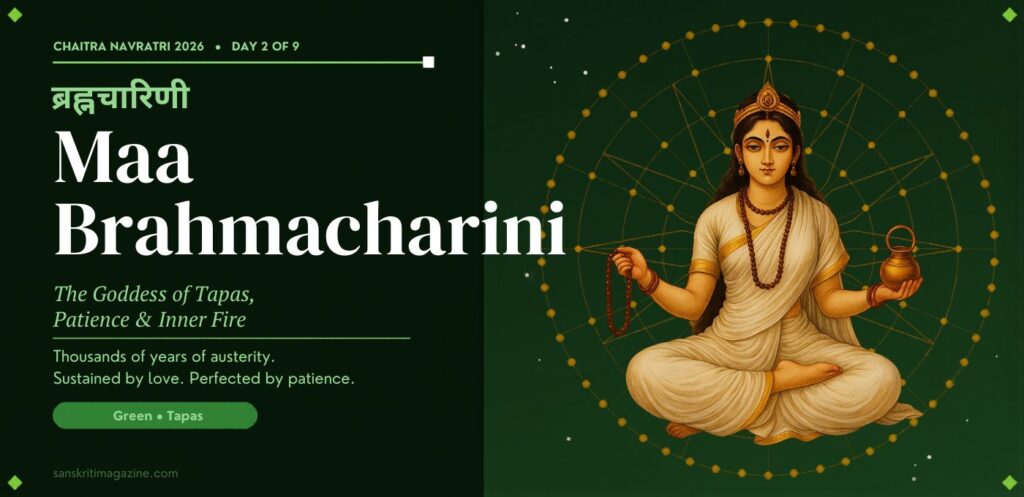
Maa Brahmacharini
The Goddess of Tapas, Patience & Unbreakable Inner Fire
There is a kind of spiritual power that is rarely celebrated in the modern world — not the power of grand gestures or miraculous events, but the power of staying. The power of returning to your practice every single day. The power of continuing when it is difficult, when results are not visible, when the world around you has long since moved on to easier paths. This is the power of tapas — and it is the power of Maa Brahmacharini, the second form of Navdurga, worshipped with reverence and deep devotion on Day 2 of Chaitra Navratri.
Her story is one of the most astonishing in all of Hindu mythology — not because of a dramatic battle or a cosmic creation, but because of something far rarer and harder to sustain: absolute, unwavering commitment to the divine, carried through thousands of years of austerity without a single moment of doubt.
Who Is Maa Brahmacharini?
The name Brahmacharini comes from two Sanskrit words: Brahma (ब्रह्म) — the ultimate reality, or in some readings, "Vedic knowledge and austerity" — and Charini (चारिणी) — "one who moves towards" or "one who practises." She is therefore the goddess who moves incessantly toward the divine through the sustained practice of tapas and brahmacharya.
Brahmacharini is Parvati — the same mountain princess who in her previous life was Sati, the devoted wife of Shiva. Reborn as the daughter of Himavat, she carried within her the soul-memory of her love for Shiva. From her earliest childhood, there was only one thought in her heart: Shiva. And she knew, with a certainty that defied all worldly logic, that the only way to reach him was through the fire of tapas — the disciplined inner heat that burns away everything impure and leaves only the essence of the divine.
The Tapasya: A Story of Unparalleled Devotion
What followed is recorded in the scriptures as one of the most extraordinary acts of spiritual austerity ever undertaken by any being in any realm. Parvati, as Brahmacharini, performed tapas of increasingly intense degrees across thousands of years:
The First Stage: Forest Austerities
In the beginning, Parvati went into the forests and performed austerities that would challenge the endurance of the greatest sages. She ate only fallen leaves — no prepared food, no cooking, just whatever the forest offered on its own terms. This stage earned her the name Aparna — "one who does not eat even a leaf," though this name would come later. But this was merely the beginning.
The Second Stage: Surviving on Water
As her tapas deepened, she gave up even the fallen leaves. She survived on nothing but water — standing in rivers, sitting beneath waterfalls, enduring the monsoon rains, the scorching summer sun, and the biting cold of Himalayan winters. For thousands of years, only water touched her lips.
The Third Stage: Nothing at All
Then came the final, most extreme stage of austerity — the one that shook the three worlds. Parvati gave up even water. She stood in deep meditation, eating and drinking nothing at all. The gods trembled. The earth shook. Even the demons were stilled. Such was the power of her tapas that the entire cosmos was affected by the heat of her devotion.
Her mother Mena, unable to bear watching her daughter suffer, came to her and cried out: "U-ma! U-ma!" — "O, do not do this! Do not do this!" But Parvati would not stop. From this cry of her mother, she received another of her many names: Uma.
Finally, Brahma himself descended from the heavens to tell her that her tapas had been heard. Shiva would be hers. The tapasya was complete. The universe rejoiced. And Parvati — quiet, steady, smiling — simply bowed her head in gratitude.
The Sacred Iconography of Maa Brahmacharini
Maa Brahmacharini's form is deliberately simple — a powerful contrast to the ornate, jewel-laden forms of many Hindu deities. She is the ascetic, and her appearance reflects the beauty of renunciation.
The White Sari
She is dressed in a simple white sari — white representing purity, austerity, and the transcendence of worldly attachment. No elaborate jewels, no rich fabrics. Just the clean, bright white of one who has stripped away everything that is not essential.
Bare Feet
Brahmacharini walks barefoot. In a tradition where footwear carries significant cultural and symbolic meaning, this deliberate bareness speaks of complete humility and direct contact with the sacred earth. She is grounded in her practice, touching the world without the protection of comfort or status.
The Rudraksha Mala
In her right hand, she holds a japamala (prayer beads) made of rudraksha — the sacred seeds said to be the tears of Lord Shiva himself, fallen as he wept in compassion for the suffering world. The rudraksha mala is the instrument of japa — the repetitive, meditative chanting of divine names or mantras. It is both the tool and the symbol of her practice: continuous, rhythmic, devoted return to the divine, one bead at a time.
The Kamandal
In her left hand, she carries a kamandal — the water pot of the ascetic. The kamandal is one of the most ancient symbols in Hindu and Vedic iconography, carried by sages and wandering monks who have renounced worldly possessions. For Brahmacharini, the kamandal represents the sustaining grace of the divine — even in the most extreme austerity, she is sustained.
- Form: Parvati in her austere, tapas-performing form
- Attire: Simple white sari; barefoot
- Right hand: Rudraksha mala (prayer beads)
- Left hand: Kamandal (water pot of the ascetic)
- Colour worn today: Green — growth, perseverance, new life
- Planet governed: Mars (Mangal) — courage, will-power, sustained action
- Bhog (offering): Sugar, panchamrit (five-nectar mixture)
- Chakra: Svadhisthana (Sacral Chakra) — creativity, desire, emotional movement
Brahmacharini and Mars: The Governance of Mangal
Among the Navdurga, Maa Brahmacharini governs Mars (Mangal) — the planet of courage, action, ambition, and the will to persevere against obstacles. In Vedic astrology, a well-placed Mars gives a person the capacity for sustained effort, righteous anger in the face of injustice, and the courage to pursue long-term goals regardless of short-term difficulties.
The connection between Brahmacharini and Mars is profound and perfectly calibrated. Her entire story is about doing exactly what a strong Mars enables: committing to a goal, enduring hardship for it, and refusing to stop no matter what the outer world says. Devotees who struggle with a weak or afflicted Mars in their birth chart — those who find it hard to sustain effort, who give up too easily, or who lack the courage to pursue what truly matters — are encouraged to pray to Brahmacharini with particular devotion.
दधाना कर पद्माभ्याम् अक्षमाला कमण्डलू ।
देवी प्रसीदतु मयि ब्रह्मचारिण्यनुत्तमा ॥
Dadhana Kara Padmaabhyaam Akshamala Kamandalu
Devi Praseedatu Mayi Brahmacharinyanuttamaa
"O Devi Brahmacharini — the best of all — who holds a rosary and a water pot in her lotus hands, may you be gracious unto me."
What is Tapas? The Ancient Science of Inner Fire
The word tapas (तपस्) comes from the Sanskrit root tap — to heat, to burn, to glow. In its deepest sense, tapas is not self-punishment or forced suffering. It is the deliberate, sustained generation of inner heat through disciplined practice — the heat that burns away impurity and reveals the gold of the soul beneath.
In the Bhagavad Gita, Lord Krishna describes three kinds of tapas: tapas of the body (purity, non-violence, celibacy, offering to the divine), tapas of speech (truthful, kind, beneficial, recitation of scripture), and tapas of the mind (serenity, gentleness, silence, self-control). The highest tapas integrates all three — and this is what Brahmacharini embodies.
In the modern world, tapas need not mean standing in a forest without food. Your tapas might be:
- Waking up 30 minutes earlier each day to meditate
- Maintaining a daily practice of reading scripture or listening to spiritual teachings
- Observing silence for a period each day
- Fasting on Ekadashi or other sacred days with genuine intention
- Persisting in a creative or professional pursuit even when results are slow
- Practising patience with a difficult person or situation, day after day
All of these are forms of tapas. And Brahmacharini's grace is available to anyone who undertakes them with sincerity.
Navratri Fasting: A Practical Guide
Fasting during Navratri is one of the most widely observed practices in the Hindu tradition — and fasting on Day 2 carries a special resonance, as we honour the goddess of austerity herself. But Navratri fasting is not a rigid, one-size-fits-all practice. It is meant to be adapted according to your body, health, and circumstance.
What Navratri Fasting Involves
At its core, Navratri fasting involves abstaining from grains (wheat, rice, regular flour), non-vegetarian food, onion, garlic, and alcohol. The focus shifts to sattvic (pure) foods — fruits, dairy, rock salt, and a category of grain-free foods specifically permissible during Navratri.
Foods Permitted During Navratri Vrat
- Fruits: All fruits — bananas, apples, mangoes, pomegranates, grapes
- Dairy: Milk, curd (yoghurt), paneer, ghee, butter, khoya
- Grains: Singhara atta (water chestnut flour), kuttu atta (buckwheat flour), sabudana (tapioca/sago), rajgira (amaranth flour), samak rice
- Vegetables: Potatoes, sweet potatoes, arbi (taro root), tomatoes, bottle gourd (lauki)
- Nuts and seeds: All nuts and seeds — almonds, cashews, walnuts, peanuts
- Spices: Rock salt (sendha namak) — regular table salt is avoided; cumin, cardamom, black pepper, cloves are permitted
- Sweeteners: Sugar, jaggery, honey
🌿 Brahmacharini's teaching on fasting: The purpose of fasting is not deprivation — it is the redirecting of the energy normally spent on digestion toward spiritual practice. When you fast, eat simple, wholesome, sattvic food and spend the energy saved on mantra, meditation, or reading of sacred texts. If you have health conditions, are pregnant, elderly, or under medical supervision, always consult your doctor before observing a strict fast. The Goddess does not require your suffering — she requires your sincerity.
The Deeper Teaching: Patience as the Most Radical Act
We live in what might be called the age of instant gratification. Everything is available faster than ever before — faster food, faster information, faster connections, faster results. Into this world, Maa Brahmacharini steps, quiet and barefoot, holding her prayer beads, and offers a teaching that is almost revolutionary in its simplicity: the most powerful thing you can do is wait.
Not passive waiting — not the waiting of resignation or laziness. But the active, engaged, practice-sustained waiting of the tapasvi: the one who trusts so deeply in the rightness of the goal that no amount of time or difficulty can shake the commitment. Parvati did not know when Shiva would come. She did not know if her tapas would be "enough." She simply kept going. Day after day. Year after year. Millennium after millennium.
And this is Brahmacharini's deepest gift to us. She shows us what becomes possible when we stop measuring our spiritual life in days or weeks, when we stop asking "is this working yet?" and simply commit to the practice — for its own sake, for the love of the divine, for the inexplicable certainty of the heart that this is the right path.
Bhog: Sacred Offering for Maa Brahmacharini
The traditional bhog for Maa Brahmacharini is sugar and panchamrit. Offering sugar to Brahmacharini is said to bring longevity and good health to all family members — particularly to the elders of the household. Panchamrit — the five-nectar mixture of milk, curd, honey, ghee, and sugar — is used to bathe the idol and then distributed as prasad.
- 2 tablespoons cow's milk
- 1 tablespoon curd (yoghurt)
- 1 teaspoon honey
- 1 teaspoon pure ghee
- 1 teaspoon sugar or mishri (rock candy)
Method: Mix all five in a copper or silver bowl. Use to bathe the idol or pour over the Shivalinga (if you have one on the altar). The remaining panchamrit is distributed as prasad — a few drops in each devotee's palm, consumed with a prayer.
Why Green? The Significance of Today's Navratri Colour
The colour of Day 2 is Green — the colour of living growth, of forests and fields, of the push of a new shoot through winter-hardened soil. Green is the colour of perseverance made visible — the colour of life insisting on itself even in difficult conditions.
It is a perfectly chosen colour for Brahmacharini. Her tapas was not static — it was the growth of the most extraordinary plant imaginable, pushing its roots deeper and deeper into the earth of divine reality, year after year, century after century, until the growth was complete. Wear green today as a reminder that you are also growing — slowly, surely, sustainably — toward the light.
A Practice for Day 2: Your Personal Tapas
On this second day of Navratri, Brahmacharini invites you to identify one practice that you will commit to for the remaining eight days of Navratri — and ideally, beyond. It need not be grand. It need not be painful. It simply needs to be real — something you will actually do, every day, with sincerity.
Perhaps it is waking ten minutes earlier for prayer. Perhaps it is reading one page of the Bhagavad Gita each morning. Perhaps it is chanting the Brahmacharini mantra 108 times before breakfast. Whatever it is, write it down today. Make it your sankalp — your conscious intention, offered to the Goddess.
🙏 Jai Maa Brahmacharini! Wear green today. Offer sugar or panchamrit at your altar. Chant ॐ देवी ब्रह्मचारिण्यै नमः 108 times. And choose your tapas — the one practice you will sustain across these nine sacred days. May her unbreakable inner fire light the way in your own life. 🌿
Published by Sanskriti Magazine — India's largest digital platform for Hindu heritage, culture, and spirituality.
Read more at sanskritimagazine.com · Follow us on Instagram & Facebook: @indian_sanskriti
Continue the journey tomorrow: Day 3 — Maa Chandraghanta, the Warrior Goddess whose bell silences all evil.