IndianSanskriti
Gayatri Mantra

Gayatri Mantra

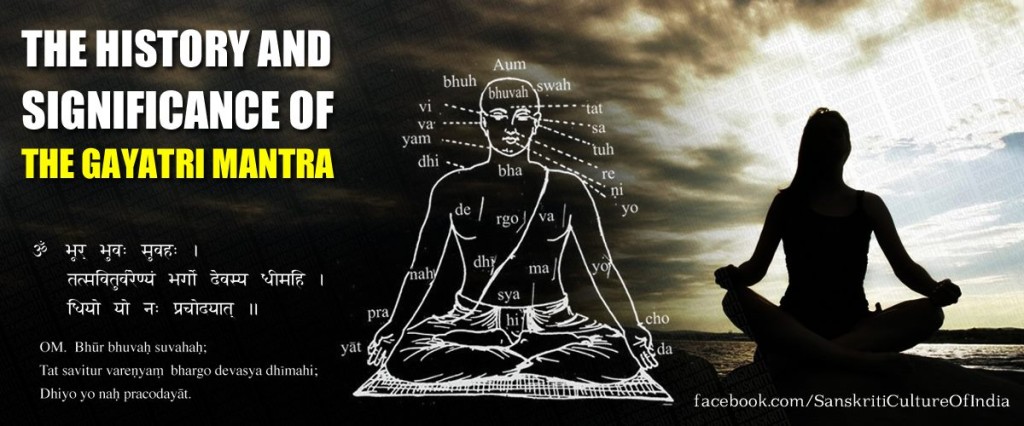
The Gayatri Mantra, chronicled in the Rig Veda and written in Sanskrit, has been chanted for many centuries before.

ॐ भूर्भुवः स्वः
तत्सवितुर्वरेण्यं ।
भर्गो देवस्य धीमहि
धियो यो नः प्रचोदयात् ॥
Om Bhuur-Bhuvah Svah
Tat-Savitur-Varennyam |
Bhargo Devasya Dhiimahi
Dhiyo Yo Nah Pracodayaat ||

~ The Rig Veda (10:16:3)

Breakdown:
1: Om, that (Divine Illumination) which Pervades the Bhu Loka (Physical Plane), Bhuvar Loka (Antariksha Loka or the Astral Plane) and Suvar Loka (Swarga Loka or the Celestial Plane),
2: That Savitr (Divine Illumination) which is the Most Adorable,
3: On that Divine Radiance we Meditate,
4: May that Enlighten Our Intellect and Awaken our Spiritual Wisdom

Meaning:
We meditate on the transcendental Glory of the Deity Supreme, who is inside the heart of the earth, inside the life of the sky and inside the soul of Heaven. May He stimulate and illuminate our minds.

OR:

OM. I adore the Divine Self who illuminates the three worlds — physical, astral and causal; I offer my prayers to that God who shines like the Sun. May He enlighten our intellect.

According to the Vedas, there are seven realms or spheres or planes of existence, each more spiritually advanced than the previous one. It is written that through spiritual awareness and development, we can progressively move through these realms and ultimately merge with the Supreme Being. Many Buddhist teachings have also referred to these seven realms.

The Gayatri mantra is one of the oldest and most powerful of Sanskrit mantras. It is believed that by chanting the Gayatri mantra and firmly establishing it in the mind, if you carry on your life and do the work that is ordained for you, your life will be full of happiness.

The word “Gayatri” itself explains the reason for the existence of this mantra. It has its origin in the Sanskrit phrase Gayantam Triyate iti, and refers to that mantra which rescues the chanter from all adverse situations that may lead to mortality.

Goddess Gayatri is also called “Veda-Mata” or the Mother of the Vedas – Rig, Yajur, Saam and Atharva – because it is the very basis of the Vedas. It is the basis, the reality behind the experienced and the cognized universe.

The Gayatri mantra is composed of a metre consisting of 24 syllables – generally arranged in a triplet of eight syllables each. Therefore, this particular meter (tripadhi) is also known as the Gayatri Meter or “Gayatri Chhanda.”

By chanting this mantra, it is said that Divine spiritual light and power is infused in each of our seven chakras and connects them to these seven great spiritual realms of existence.

Other Benefits of Gayatri Mantra:
1. Removes obstacles from your life
2. Protects you from danger
3. Brightens you mind
4. Dispels ignorance
5. Improves communication abilities
6. Opens your psychic vision
7. Brings direct knowledge of the eternal truths
You may also like

Search the website

Like us on Facebook

Get daily updates via Email

Enter your email address:

Recent Posts

Yogini Ekadashi 2026 — The Yaksha Who Missed the Morning Flowers, and the Ekadashi That Undid His Curse

On Friday, July 10, 2026, the rare Krishna Paksha Ekadashi of Nija Ashadha arrives. The Padma Purana tells the story of Hemamali — the Yaksha gardener of Bhagavan Kubera in Alaka, whose single morning of distraction with his wife Vishalakshi cost him his form, his wife, and his celestial city. Cursed to wander the earth of Bharata as a leper for a long time, he was at last shown the way back by Sage Markandeya — a single sincere keeping of Yogini Ekadashi.

Jamai Shashthi 2026 — The Story of Maa Shashthi, the Cat, and the Wife Who Was Forgiven

Jamai Shashthi 2026 — The Story of Maa Shashthi, the Cat, and the Wife Who Was Forgiven

On Saturday, June 20, 2026, Bengali households across Bharata will welcome their married daughters and sons-in-law home for the legendary jamai-aador feast and perform the Shashthi Vrata. But behind the warmth lies a story most Bengalis know by heart and most non-Bengalis have never heard — the wife who stole the hilsa, blamed the cat, lost six sons to Maa Shashthi’s wrath, and was finally forgiven. The Vrat Katha, the vidhi, the mantras, and the deeper teaching.

Vat Purnima 2026 — The Wife Who Argued Yama Into Returning Her Husband’s Life

On Monday, June 29, 2026, women across Maharashtra, Gujarat, and southern Bharata will tie red thread around banyan trees and hear the story of Savitri — the wife who walked behind Yamaraja Himself when He came for her husband, and out-argued the Lord of Dharma into returning Satyavan’s life. The Mahabharata’s Pativrata Mahatmya Parva, the vrat vidhi, and why the banyan witnessed everything.

Nija Jyeshtha 2026 — The Real Jyeshtha Begins, and the Calendar Resumes

Nija Jyeshtha 2026 — The Real Jyeshtha Begins, and the Calendar Resumes

With Adhik Maas now closed on the Somvati Amavasya of June 15, the long-postponed festivals of Jyeshtha return — Vat Purnima (June 29, the Savitri-Yamaraja katha), Jamai Shashthi (June 20, the Bengali festival of Maa Shashthi), Sankashti Chaturthi (June 28), Yogini Ekadashi (July 10), and Devshayani Ekadashi (July 16, opening the four-month Chaturmas of Bhagavan Vishnu’s yoga-nidra). A guide to what the next four weeks hold and what the household that kept Purushottam Maas now carries forward.

The Closing of Purushottam Maas 2026 — Adhik Amavasya and the Sealing of the Month-Long Vrat

On Monday, June 15, 2026 — a rare Somvati Amavasya — the intercalary month that bears Bhagavan Vishnu’s own name comes to its close. The Acharyas teach that a vrat is not measured by its duration but by its closing. Here are the Padma Purana’s instructions for sealing the month-long Purushottam Maas vrat: the morning snan, the closing puja with the Vishnu Sahasranama, the day of dana, the Somvati Amavasya gift, and the final sarva-arpana — the offering of all merit at the feet of the Lord.

css.php