IndianSanskriti
Goddess Kalaratri


Navratri Series – Day 7: Goddess Kalaratri – The Fierce Protector

As we progress to Day 7 of Navratri, we honor Goddess Kalaratri, the seventh form of Goddess Durga. Known for her formidable appearance and fierce power, she is revered as the protector against all evils and misfortunes.

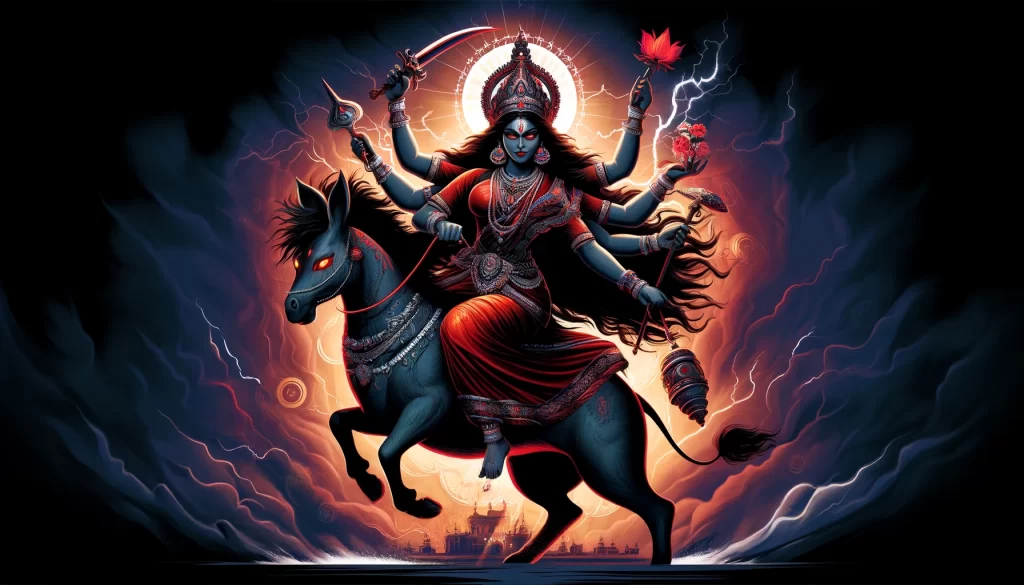
Who is Goddess Kalaratri? Goddess Kalaratri is depicted with a dark complexion, disheveled hair, and a fearless posture riding a donkey. She has four hands, with two holding a thunderbolt and a weapon, and the other two bestowing blessings. Her appearance symbolizes death of darkness and the dawn of knowledge.

Symbolism and Significance Worshipping Goddess Kalaratri destroys ignorance and removes darkness from the lives of her devotees. She is considered the most powerful and fierce form of Goddess Durga, embodying the destruction of negativity and protection from evil spirits.

The Story of Kalaratri Goddess Kalaratri’s legend involves her battle with the demons Sumbha and Nisumbha, whom she defeated to protect the universe. Her name and form are associated with the night of absolute darkness, yet she enlightens the paths of her devotees.

Cultural Practices and Rituals Devotees often perform the “Kalaratri Puja” with great devotion, dressing in red as a symbol of energy and passion. The day is particularly significant for spiritual seekers as it is believed to bring relief from adverse planetary influences.

Contemporary Reflections In today’s context, Goddess Kalaratri teaches us about the power of transformation and courage. She inspires individuals to face challenges head-on and to embrace the changes that lead towards growth and enlightenment.

Call to Action Join us tomorrow for Day 8 as we explore the mysteries of Goddess Mahagauri. Dive deeper into the spiritual journey of Navratri with insightful articles and reflections at Sanskriti Magazine.

You may also like

Search the website

Like us on Facebook

Get daily updates via Email

Enter your email address:

Recent Posts

Padmini Ekadashi 2026 — The Ekadashi Even the Devas Descend to Keep

Padmini Ekadashi 2026 — The Ekadashi Even the Devas Descend to Keep

The rarest Ekadashi of the entire Hindu calendar is three days away. The Padma Purana preserves a conversation between Bhagavan Krishna and Yudhishthira about a single Ekadashi the great Rishis spend lifetimes waiting for — Padmini. The Vrat Katha of Queen Padmini of Mahishmati, the lotus teaching, and why May 27, 2026 is the morning Vaishnavas across Bharata are preparing for.

Varada Chaturthi 2026 — The Rare Ganesha Day of Purushottam Maas

Varada Chaturthi 2026 — The Rare Ganesha Day of Purushottam Maas

Once every 2.5–3 years — when the rare 13th month of Adhika Maas opens — a thirteenth Vinayaka Chaturthi appears. The Mudgala Purana calls it Varada Chaturthi, the “boon-giving” Chaturthi, and holds it as the most fruit-bearing Ganesha day of the entire calendar. Today, Wednesday May 20, 2026, is that day.

Padmini Ekadashi 2026 — The Rare Ekadashi That Comes Only in Purushottam Maas

Padmini Ekadashi 2026 — The Rare Ekadashi That Comes Only in Purushottam Maas

Padmini Ekadashi 2026 falls on Wednesday, May 27 — the Shukla Paksha Ekadashi of Adhika Maas, the rarest Ekadashi in the entire Hindu calendar (it appears only every 2.5–3 years). The Padma Purana conversation between Bhagavan Krishna and Yudhishthira, the Vrat Katha of Queen Padmini, complete vrat vidhi with jagrana, mantras, and the lotus symbolism that gives the Ekadashi its name.

Ganga Dussehra 2026 — The Day Maa Ganga Came Down to Bhagiratha

Ganga Dussehra falls on Monday, May 25, 2026 — commemorating the day Maa Ganga descended from Vaikuntha to the earth through the millennia-long tapasya of King Bhagiratha. The full account from the Valmiki Ramayana, snan vidhi, dana traditions, mantras, and the teaching of sustained sincerity.

Adhik Jyeshtha Maas 2026 — The Hidden Month That Belongs to Lord Vishnu

Once every 2.5–3 years, the Hindu calendar opens a quiet thirteenth chamber — the intercalary month Lord Vishnu took for His own. A Puranic look at Adhik Jyeshtha Maas 2026 (May 2–31), the Padma Purana account of how it became Purushottam Maas, and a complete householder’s guide for its closing days.

css.php