Introduction
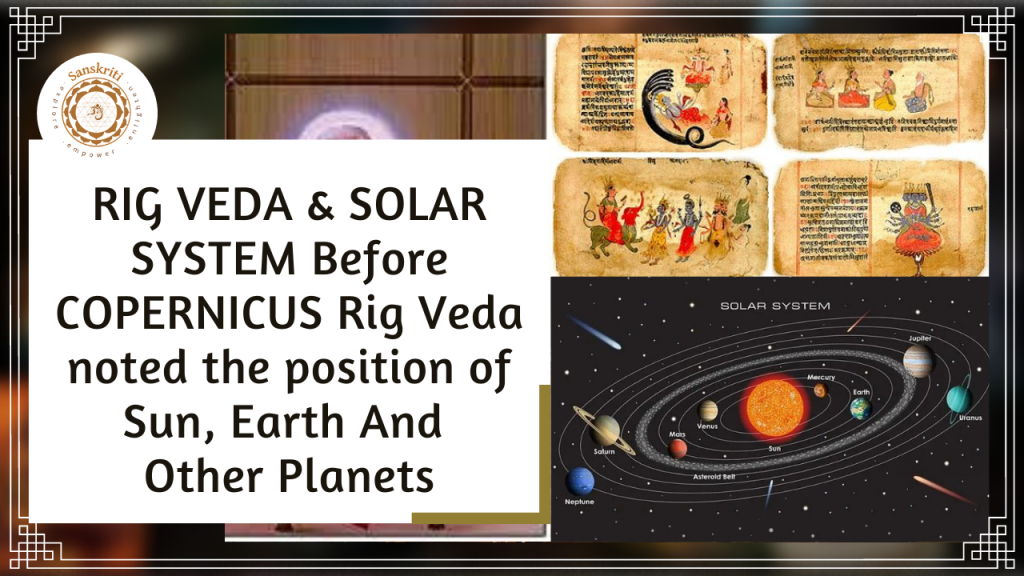
In the Vedic literature, there are many references to planetary movements. Rig Veda (the oldest of them) dated back to 1500 BC contains a hymn that describes the movements of Sun, Moon and other planets around Earth. This hymn was discovered in Arabia recently. Along with this there are other references in Vedic literature that describe the motion of other planets around their own axes while moving around Earth at same time they rotate around Sun in fixed positions relative to each other as per Newton’s law on gravitation which states that two objects attract each other by force which is directly proportional to product of their masses and inversely proportional square of distance between them which means gravity decreases as distance increases if same amount of matter present in both bodies then gravitational attraction between them is same irrespective how far away each one might be from earth or sun or any other object .
When Copernicus had his theory on heliocentric system, it was regarded as a revolutionary discovery by the scientific community. However, historians of Vedic science have dated the Earth orbiting the Sun long before Copernicus.
The Rig Veda is the oldest collection of sacred hymns known to man. It consists of more than a thousand hymns divided into ten mandalas (books). The earliest version of the Rig Veda was compiled in India around 1500 B.C., long before any Greek or Roman philosophers were born.
The Vedic sages have given us precise dates for all planets including our solar system and Earth’s rotation around it. These are given by their observations through telescopes much before Galileo ever invented one! The Rig Veda mentions that our planet Earth rotates on its axis every 24 hours, which means we see different parts of our planet as we rotate around Sun every day with respect to other planets in our solar system!
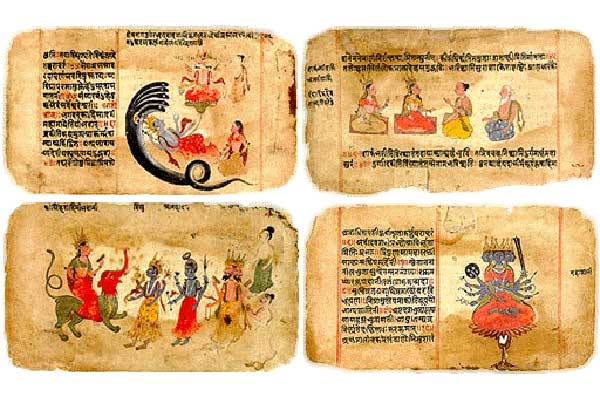
Appearing in the Rig Veda about 6000 years ago, parts of it were very recently discovered in the desert of Arabia. They describe the motion of Earth, Sun and other planets. The Rig Veda is a collection of over 1000 hymns divided into 10 mandalas (chapters).
Rig Veda is the oldest book known to man. It describes our Solar System in great detail, and includes information about the Sun, Earth and other planets.
The Rig Veda was written by 10 rishis who were contemporaries with Lord Krishna and Buddha. These rishis were very intelligent men because they knew that matter could be destroyed but not destroyed in its entirety (the law of conservation). They also knew that nothing could be created out of nothing, which is the second law of thermodynamics.
The Rig Veda consists of 1000 hymns divided into 10 mandalas (chapters) consisting of 1008 hymns each – totaling 10,008 verses! The number has been calculated using Vedic mathematics which only requires simple addition or subtraction but no multiplication or division!”
Hymn 1, verse 12 of Mandal 9 by Maharishi Angirasa clearly states that Sun moves around the stationary Earth. He further says that along with Sun there are two other planets that move around a same point near which all three revolve.
Hymn 1, verse 12 of Mandal 9 by Maharishi Angirasa clearly states that Sun moves around the stationary Earth. He further says that along with Sun there are two other planets that move around a same point near which all three revolve.
It is said that he was the first person in recorded history who described our Solar System using this method and gave its exact structure, size and distance from each other.
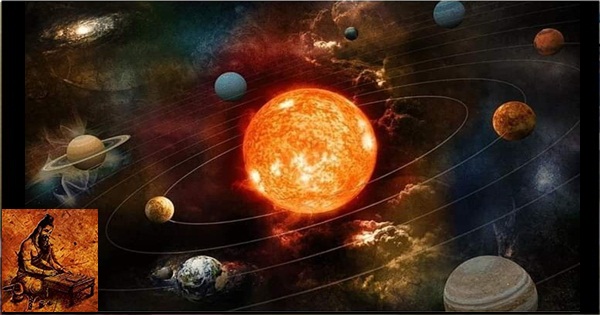
The text states that our planet (Earth) is at rest and all others move
The text states that our planet (Earth) is at rest and all others move. The Rig Veda describes the motion of Earth, Sun and other planets in detail. It is not just a collection of over 1000 hymns divided into 10 mandalas (chapters).
The text gives information on the size of these bodies, their orbits and distances apart from each other within this system.
Conclusion
In conclusion, I would like to say that Rig Veda is one the oldest scriptures of humanity. It is a collection of hymns and prayers, which are said to be composed by sages over a period of thousands of years starting circa 1500 BC. Hymn 1:12 states that Sun moves around the stationary Earth. Along with Sun there are two other planets that move around a same point near which all three revolve.