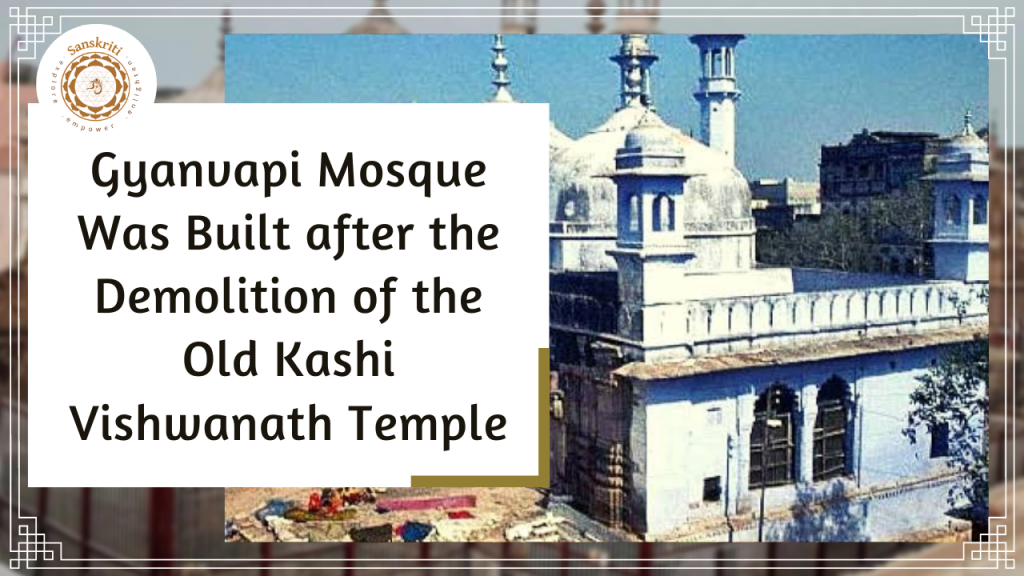
Gyanvapi Mosque was built on the site of the demolished Kashi Vishwanath Temple, as per the Aurangzeb’s order.
You may have heard that the Gyanvapi Mosque in Varanasi was built on the site of the demolished Kashi Vishwanath Temple, as per the Aurangzeb’s order. The facts, however, are a little different:
It is true that Aurangzeb ordered it to be demolished. However, he did not build his mosque on top of it because his wife Dilrasa wanted to build a mosque for her father firstly before him. He had promised her this when she converted from Buddhism to Islam and married him at Agra Fort. It was built in 1669 by Dilrasa and named after her father’s name – “Dil Rasah.”
The inscription on the arch of the mosque, built in 1664 by Aurangzeb’s wife Dilras, states that it was built on the site of the famous Kashi temple.
The inscription on the arch of the mosque, built in 1664 by Aurangzeb’s wife Dilras, states that it was built on the site of the famous Kashi temple.
The inscription reads: “In the year 933 [Hijri] corresponding to 1750 [Christian Era] there was an old temple of Vishwanath (Shiva), which had been destroyed by Mahmud Ghaznavi; but later on it had been rebuilt by a Brahman named Basu Deva in 970 Hijri corresponding to 1563 AD… This mosque was built here after demolishing this temple at this very spot.”
Now let us see what happened in 1750 CE when this mosque was built?
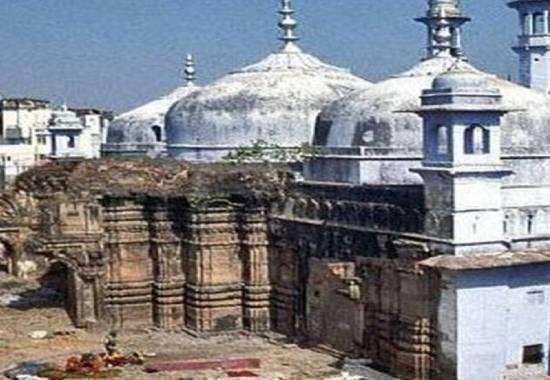
It is said that the portion of this mosque was built after demolishing part of the temple.
It is said that the portion of this mosque was built after demolishing part of the temple. The area called ‘Kaurava Pokhra’, which is currently situated near Gyanvapi, has a strong resemblance with that section of the temple.
The portion called ‘Kaurava Pokhra’ has a strong resemblance with that section of the temple.
It is believed that Aurangzeb had ordered the reservoir to be built on the site of the temple. The portion called ‘Kaurava Pokhra’ has a strong resemblance with that section of the temple where water was stored.
It is also said that Aurangzeb wanted to build a mosque in place of every temple but failed to do so because of his sudden death.
Some historians say that Aurangzeb wanted to build a mosque in place of every temple but failed to do so because of his sudden death. It is also said that Aurangzeb had demolished only some temples and not all of them.
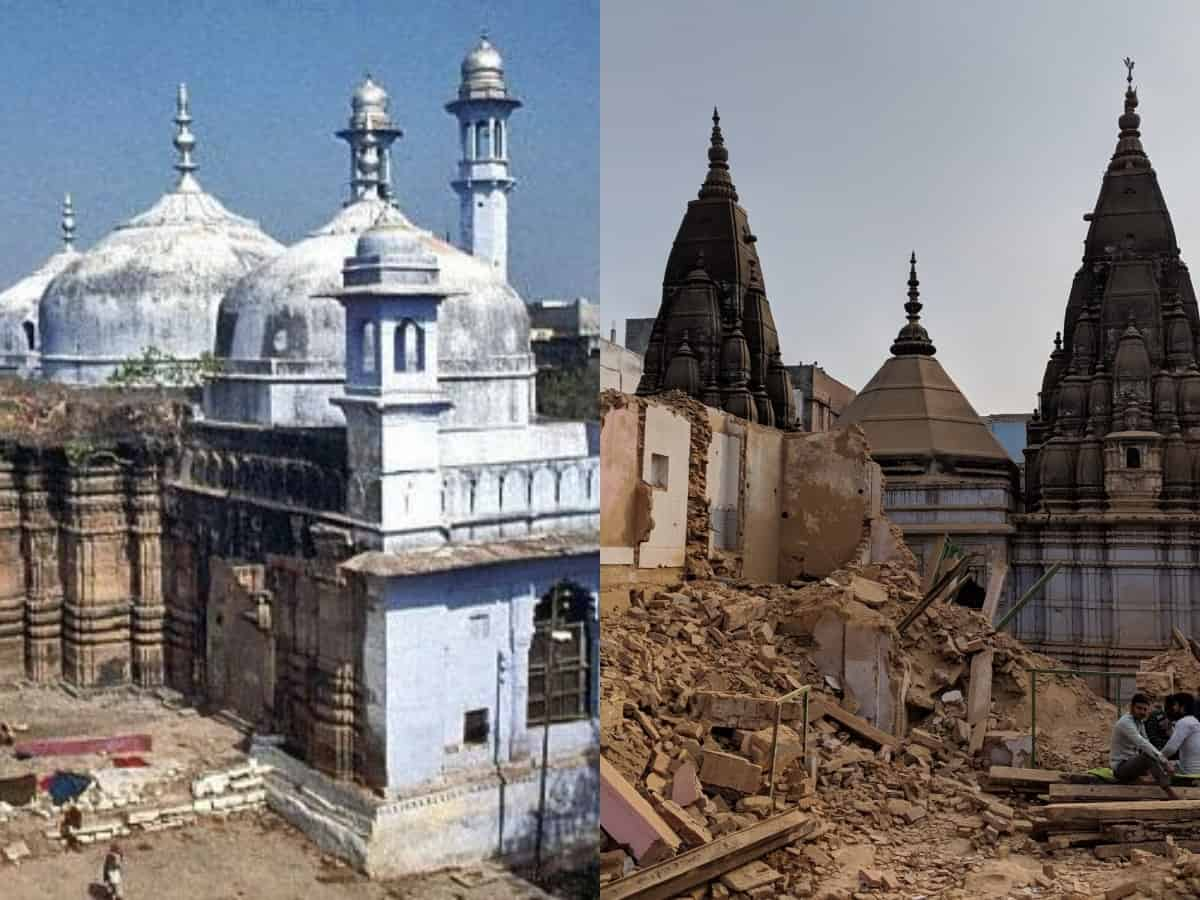
In 1839, British Governor General William Bentinck had demolished one-third part of this mosque and left it open for Hindus only.
In 1839, British Governor General William Bentinck had demolished one-third part of this mosque and left it open for Hindus only.
For the first time in history of Kashmir, a large number of lakhs of Muslims rose against the government’s decision and started protest demonstrations. All over Kashmir Valley people gathered at Srinagar’s Lal Chowk where they were protesting against this injustice.
The then king Lieut.-Colonel Sher Singh had to face huge trouble because the situation was getting out of control due to the protests by Muslims all over valley against this act by British Government.
It was after 80 years that Raja Gulab Singh built Hindu Temple Kashi Vishwanath on same place where Mughal Mosque used to exist earlier
But it is maintained by Muslims and Hindustan Muslim Association.
The temple was demolished in 1867 by the British, and the mosque was built in its place. But it is maintained by Muslims and Hindustan Muslim Association. The maintenance of the temple is done by Hindu trust which was formed for this purpose only.
Gyanvapi Mosque forms an important site among other mosques in India
Gyanvapi Mosque, one of the most important sites in India, was built after the demolition of a Hindu temple in 1670-71 CE. The mosque has been widely used by pilgrims, especially during the holy month of Ramzan (Ramadan). It’s also one of the largest mosques in India and serves as a hub of activity during Ramzan.
Gyanvapi Mosque is an essential part of India’s history.