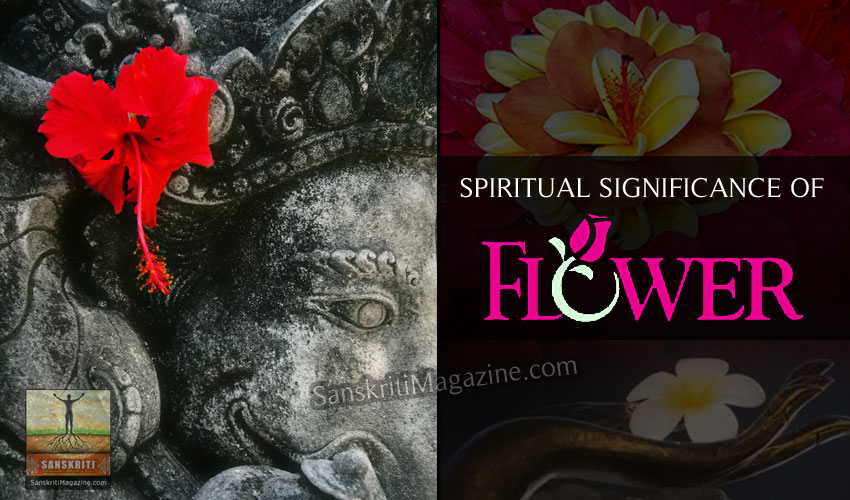
Flowers teach us the charm of silence and thus the self-giving which demands nothing in return Puja is an integral part of a Hindu household, either on a daily basis or during some important religious function or ceremony. The process can be either a simple ritual or a complicated one, depending on the occasion and according to the Vedas, it is equally important to perform rituals a certain way to derive full benefits from them.
One of the offerings given in puja is flowers, as they vibrate a certain state of consciousness that represents purity. They are rich with abundant qualities of design, color, fragrance, and soft touch and by nature they are a supreme source of joy in this world. Moreover, flowers are substances that are extremely pure, as they can be obtained without engaging in any evil deed. They can be offered without any risk that we may feel miserly or regretful afterwards. So the offering will be made with a pure mind at the beginning, in the middle, and at the end.
These flowers have to be offered in a particular way with a certain understanding at the feet of the deity. Feet represent the foundation on which we stand, which is none other than the supreme reality and flowers represent the desires in man. It is believed there are subtle frequencies of deities active in the atmosphere and these are attracted towards certain flowers. One must offer flowers that are fresh, unused and clear of any infestation.
The flowers are picked with five fingers of the right hand, with the fingers initially facing downwards which are then slowly turned upwards to gently place the flowers at the feet of the deity; this process is continued until the chant or the prayer is complete. The five fingers represent the five senses of sight, touch, taste, sound and smell. When these senses are directed towards the mundane world, they pick up the “desires” (flowers). When the fingers are turned towards the higher self, then the desires are eliminated. In sum, flowers represent renouncing all of one’s desires except enlightenment.
Flowers are also offered by bringing it close to one’s heart. This symbolically suggests that one is offering the soul or atman to the deity.