In a day, I use 5,000 words. You may be thinking, ‘I am talking too much’ — you are wrong. Once I have talked, I keep quiet — but I never go beyond the limit of 5,000 words. You can spread it out over the whole day, but in my case, I finish my quota in the morning. But I never go beyond the limit. I go on looking at the clock.
Looking For Thrills
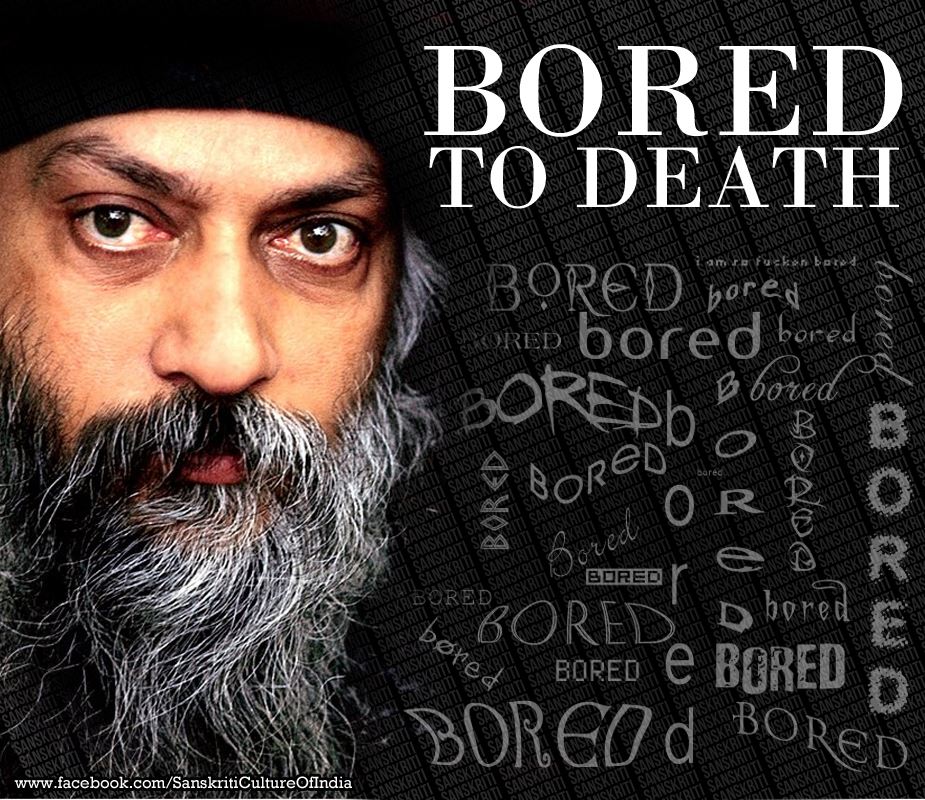
People go on talking just to avoid their being, avoid their boredom. The husband is bored with the wife, the wife is bored with the husband, the mother is bored with the children, the children are bored with parents — everybody is simply bored! But we keep it below consciousness, otherwise you will wish to die. If boredom becomes clear to you, what are you going to do then? If life is just a rut, then what is the point of it all? You go on avoiding it.
In a religious community, it is brought to your notice; you are not allowed to avoid it. In a Zen monastery, they have a very boring routine — fixed for ever, for centuries. Never a thrill, never a sensation. In the morning, they get up, they do their zazen, they drink tea, perform walking meditation, eat breakfast. And everything is the same: the breakfast is the same, the tea is the same; again they do za-zen, again they go into the garden to work. And have you looked at the Zen garden?
Around their meditation hall, they don’t allow trees. They make a rock garden — to bore you completely. Because trees change: sometimes it is spring and there are flowers and greenery, and sometimes it is fall and the leaves are dropping. Trees are not monks. Trees go on changing round the year. In a Zen monastery, they make a rock garden, so nothing changes. You go on doing the same thing every day, and you look out and there are rocks and sand, and the same pattern. Why?
Boredom As Device
In Zen, boredom is used as a device: you are bored to death, and you are not allowed to escape. You are not to go outside, you are not to entertain yourself, you are not to do, you are not to talk, you are not to read novels and detective stories. No thrill. No possibility to escape anywhere.
And all the monks look alike: shaved. If you shave your head, remove your moustache, beard, you become almost a nonentity. Your face loses individuality. The monks look all alike, you cannot make out any difference. You see the shaven heads and you are bored.
The work is to bring boredom to such a point where no escape is possible and you have to go through the breakthrough. When it is unbearable, when it comes to a crescendo and you cannot bear it, then it explodes. From that extreme, you jump. Suddenly all boredom disappears, because the mind itself disappears.
Boredom is an indication of mind. That’s why animals are not bored. When boredom disappears, the mind, too disappears. That’s what in Zen they call ‘satori’.
Laughter can also be used in the same way. If you can go on laughing at the ridiculousness of things, one day you will see that there is no more laughter. That’s the point. When one day laughter disappears, the mind disappears too.
I use both together. First I bore you, then I help you to laugh. From one extreme to another, like a tightrope-walker: when he is falling towards the left, he leans towards the right; when he leans towards the right too much and feels now he will fall, he leans towards the left. And by and by a balance arises.
~Courtesy Osho International Foundation