
IndianSanskriti
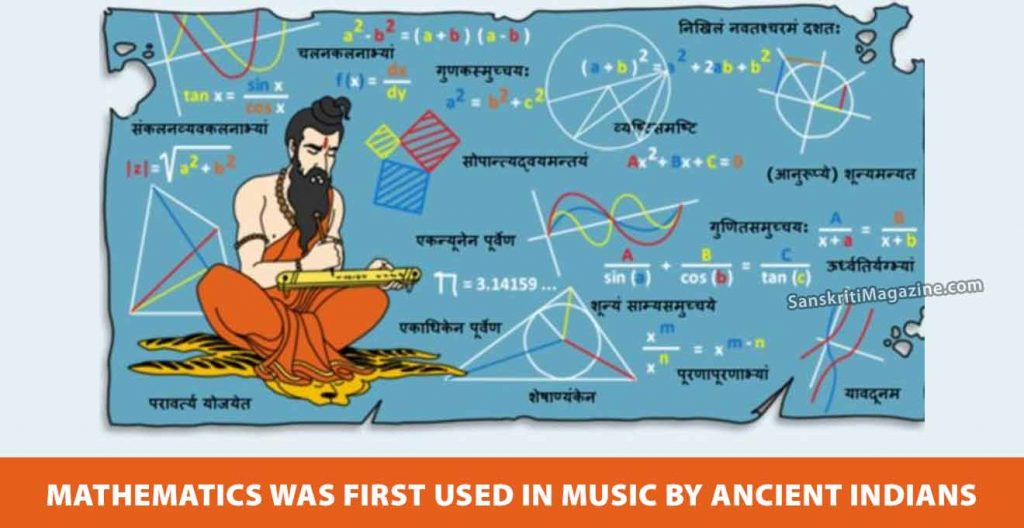
Mathematics was first used in Music by Ancient Indians

Mathematics was first used in Music by Ancient Indians

By Vedveer Arya

Pingala (1800 BCE) of Chandasastra pioneered the mathematical study of meters. He developed advanced mathematical concepts for explaining prosody and its characteristics. Pingala was the first to establish the relationship between the theory of poetic rhythm and combinatorics much earlier than Marin Mersenne (1588-1648 AD) a French music theorist.

Shārgadeva, a Kashmiri Pandit, authored Sangitaratnākara which is a greatest treatise on Indian music (vocal & instrumental) and dance after Bharata’s Nātya Shāstra. His grandfather, Bhāskara was a Kashmiri Brāhmin and Ayurveda scholar. Yādava King Bhillama (523-530 AD) invited Bhāskara to his capital Devagiri and appointed him as Rājavaidya or royal physician. Bhāskara’s son Sodhala became Accountant-General in the court of King Bhillama. Shārgadeva was the son of Sodhala and also became Accountant-General in the court of Yādava King Singhana (541-585 AD).
ANCIENT INDIANS WERE THE FIRST TO USE MATHEMATICS IN MUSIC

In his Sangitaratnākara, Shārngadeva defined almost 264 rāgas as combination of swaras. He mathematically analyzed the permutations and combinations of swaras. He classified rāgas as Janaka rāga (parent rāga) and Janya rāga (child rāga). Seven basic swaras i.e. must be used once in Ārohanam (ascending order) and also, the seven swaras must be used once in Avarohanam (descending order) in every Janaka rāga. Each Janaka rāga can have many Janya rāgas derived from them but Janya rāga need not use seven swaras compulsorily in ascending and descending orders. He also mapped 22 shruti (octave) into seven swaras.

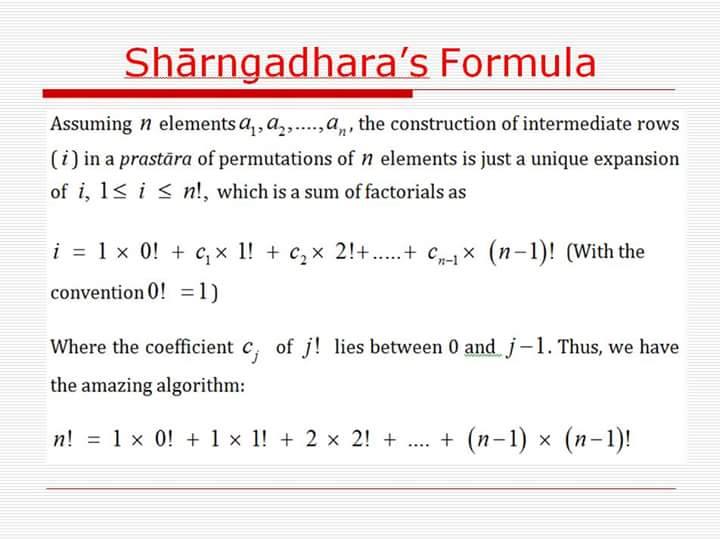
Shārngadeva worked extensively on the subject of permutations and combinations. He described various algorithms to list all permutations and combinations of seven swaras and notes. Shārngadeva mentioned a method of singing called “Merukhanda” which consists of varied permutations and combinations of swara patterns. Merukhanda is a mathematically sequenced prastāra of all 5040 swara patterns (7×6×5×4×3×2×1 = 5040) that can be generated from seven swaras. Actually, these combinations of swaras are factorial and can be derived mathematically.

According to Shārngadeva, the 1st row of prastāra of seven swaras starts with the natural order of swaras as s,r,g,m,p,d,n and the last 5040th row ends with the reverse order as n,d,p,m,g,r,s. He gave a mathematical formula (as shown in image) for the construction of intermediate rows. Interestingly, the algorithms described by Shārngadeva are now being used in computer programming.
You may also like

Search the website

Like us on Facebook

Get daily updates via Email

Enter your email address:

Recent Posts

Jamai Shashthi 2026 — The Story of Maa Shashthi, the Cat, and the Wife Who Was Forgiven

Jamai Shashthi 2026 — The Story of Maa Shashthi, the Cat, and the Wife Who Was Forgiven

On Saturday, June 20, 2026, Bengali households across Bharata will welcome their married daughters and sons-in-law home for the legendary jamai-aador feast and perform the Shashthi Vrata. But behind the warmth lies a story most Bengalis know by heart and most non-Bengalis have never heard — the wife who stole the hilsa, blamed the cat, lost six sons to Maa Shashthi’s wrath, and was finally forgiven. The Vrat Katha, the vidhi, the mantras, and the deeper teaching.

Vat Purnima 2026 — The Wife Who Argued Yama Into Returning Her Husband’s Life

On Monday, June 29, 2026, women across Maharashtra, Gujarat, and southern Bharata will tie red thread around banyan trees and hear the story of Savitri — the wife who walked behind Yamaraja Himself when He came for her husband, and out-argued the Lord of Dharma into returning Satyavan’s life. The Mahabharata’s Pativrata Mahatmya Parva, the vrat vidhi, and why the banyan witnessed everything.

Nija Jyeshtha 2026 — The Real Jyeshtha Begins, and the Calendar Resumes

Nija Jyeshtha 2026 — The Real Jyeshtha Begins, and the Calendar Resumes

With Adhik Maas now closed on the Somvati Amavasya of June 15, the long-postponed festivals of Jyeshtha return — Vat Purnima (June 29, the Savitri-Yamaraja katha), Jamai Shashthi (June 20, the Bengali festival of Maa Shashthi), Sankashti Chaturthi (June 28), Yogini Ekadashi (July 10), and Devshayani Ekadashi (July 16, opening the four-month Chaturmas of Bhagavan Vishnu’s yoga-nidra). A guide to what the next four weeks hold and what the household that kept Purushottam Maas now carries forward.

The Closing of Purushottam Maas 2026 — Adhik Amavasya and the Sealing of the Month-Long Vrat

On Monday, June 15, 2026 — a rare Somvati Amavasya — the intercalary month that bears Bhagavan Vishnu’s own name comes to its close. The Acharyas teach that a vrat is not measured by its duration but by its closing. Here are the Padma Purana’s instructions for sealing the month-long Purushottam Maas vrat: the morning snan, the closing puja with the Vishnu Sahasranama, the day of dana, the Somvati Amavasya gift, and the final sarva-arpana — the offering of all merit at the feet of the Lord.

Parama Ekadashi 2026 — The Other Rare Ekadashi of Purushottam Maas, and the Poor Brahmin Who Kept It

Two weeks ago, Vaishnavas across Bharata kept Padmini Ekadashi — the rare Shukla Paksha Ekadashi of Adhik Maas. Padmini has a twin. On Thursday, June 11, 2026, the Krishna Paksha Ekadashi of the same intercalary month appears: Parama — the Supreme Ekadashi. The Padma Purana names it the rarer and more secret of the two, and reserves it for those whose poverty or sorrow has refused to lift in spite of every other vrat already kept. The story of Sumedha and Pavitra of Kampilya, the rishi Kaundinya, the prince sent by Bhagavan Brahma — and the vidhi for the day.

css.php





