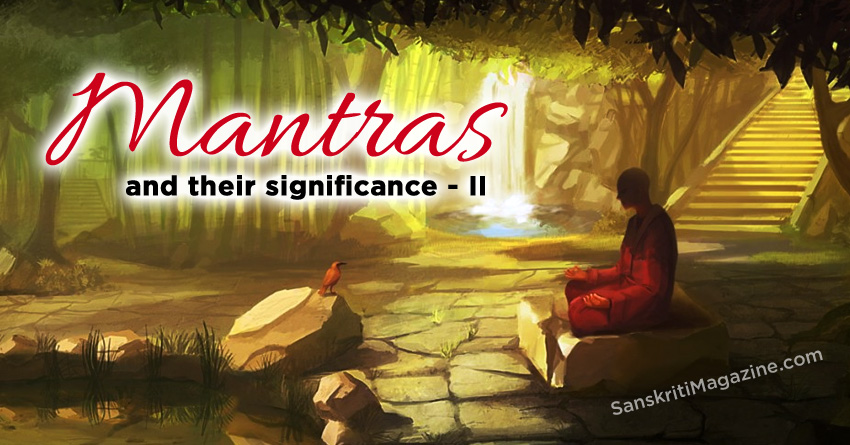
In the previous article I had given an introduction to what mantras are and how certain “aksharams” should only be combined in a particular way by Rishis or Mantra Vedis.
Now I am going to explore further into mantras in this article. I have not covered the definition of a mantra, it is as follows “मननात त्रायते इति मन्त्रः” which means repetition of which gives you protection is called a mantra.
The Darshanas based on Bhakti believe that repetition of Ishwara’s name destroys the karma of the Jiva and releases the Jiva from the bondage of Samsara. So this means that the mantras have hidden power; what is the cause of this hidden power ?
It is due to the “aksharams” themselves.
Let me quote Rajiv Malhotra’s “ Being different” to make this point more clearer “Throughout the ages, the Indian Rishis and grammarians have believed that primordial vibrations comprise all reality, that vibrations are the heartbeat of cosmos. The reverberations from this cosmic ‘pulsing’, as discovered constitute the alphabets of Sanskrit, which does not associate meanings with sounds arbitrarily”(Pg 222-Being Different).
Hence these primordial reverberations are the “Aksharams” of Sanskrit. Now why should they be called “Aksharams” ?
Here “क्षर” (shar) means that which decays or is destroyed, but “अक्षर” (akshar) is that which does not decay or is not destroyed. In the sense these primordial reverberations will not be destroyed once the cycle of creation is over, since it is on the basis of these reverberations that the next cycle of creation will begin and continue.
Let me quote Rajiv Malhotra’s being different as he explains this in a much better way:
“This deep reality from which sound and form emerge was not discovered through prophets (who merely communicate God’s message) or intellectual inquiry but by direct experience in deep meditation. A rishi is one who sees and hears the eternal truth. His (or her) extraordinary faculties enable him (or her) to experience directly the vibrations of the infinite and the concrete objects to which they correspond. The rishi does not compose hymns but hears or tunes into them.” (Pg 222 Being different).
In fact a Rishi is called a mantra drashta as per Nirukta, a Vedic dictionary which is mandatory to read before exploring the Vedas. These mantras again have different levels of vibrations, let me quote the lalita sahasranama:
“परा प्रत्यक्चिती रूपा पश्यन्ति परदेवता मध्यमा वैखरी रूपा”
This particular verse explains the levels of vibrations which are Vaikhari, Madhyama, Pashyanti and Para. “Vaikhari” is the external sound of the mantra, where as “Madhyama” is the mental image or the mental sound of the same mantra, the Pashyanti and Para are 2 levels beyond the normal thinking mind (Rajiv Malhotra explains the same in his book and some speeches). These deeper levels of mantras are known to Rishis.
Now what is the reason that only Rishis can actually see or know these vibrations and we cannot? Let me illustrate this with a story:
Once upon a time there was a Guru and Sishya, the Sishya wanted to know a particular kind of mantra whose potential when unlocked would give him all that he would desire. The Guru had made this Sishya wait for a long time, the Sishya was very eager and asked the Guru to give him the mantra.
The Guru finally agreed and gave the Sishya the mantra, telling him that the mantra was a secret. The Sishya started actually repeating the mantra but realized that everyone else also knew the mantra, the mantra here was “ ॐ” , he felt cheated since he discovered that the mantra was no longer a secret and went back to the Guru.
The Guru told him that just as there are many Gurus who give out mantras there are many Sishyas as well who got to know it, this is the reason for the mantra to be known to everyone. The Guru told him that he is willing to give him another mantra provided he carries out his instructions, to which the Sishya agreed. The Guru gave him a strange looking stone and asked him to try to sell this stone in the market but must make sure he doesn’t actually sell it but must only do this to know the value of this strange stone.
The Sishya went into the market and tried selling this stone, he went to a vegetable vendor, the vendor weighed the stone and said “this particular stone has equivalent weight to one of my weights, it should help me weigh my vegetables”.
The Sishya was disappointed, similarly he went to a fruit seller, the fruit seller looked at the stone and said “this will be useful for sharpening my knife, I am willing to give you a bunch of fruits for this”.
The Sishya went from one vendor to another and was utterly disappointed.
He finally approached a jeweler and asked the him if he could buy the stone from him, the jeweler looked at the stone and asked him “who gave you this stone?”
The Sishya asked “why are you asking?”
The jeweler replied “This stone is actually an invaluable diamond, which cannot be found easily”.
the Sishya was shocked and told him that this diamond was actually given by his Guru. He asked him its value to which the jeweler replied “I cannot estimate the value of this diamond, hence it is not possible for me to buy this from you”.
The surprised Sishya returned to his Guru, communicated his experience and asked him why he gave him such an invaluable diamond. The Guru replied “so that you may know the value of ॐ”.
Just as people in the market looked at the diamond and only saw it as a stone, some could only look at it as a way to weigh their vegetable while others looked at it as a tool to sharpen their knives, but only the trained eye of a jeweler could actually recognize it as an invaluable diamond.
Similarly the value of “ॐ” is actually unknown to many and only the Rishis have the proper vision to realize the depth of this mantra. It is the same case with other mantras. The value of the other mantras is hidden, just like how the value of the diamond was actually hidden and only recognized by trained eyes, similarly the deeper vibrations of the mantras can only be known to Rishis, and hence they are called mantra drastas.
ॐ ॐ ॐ .