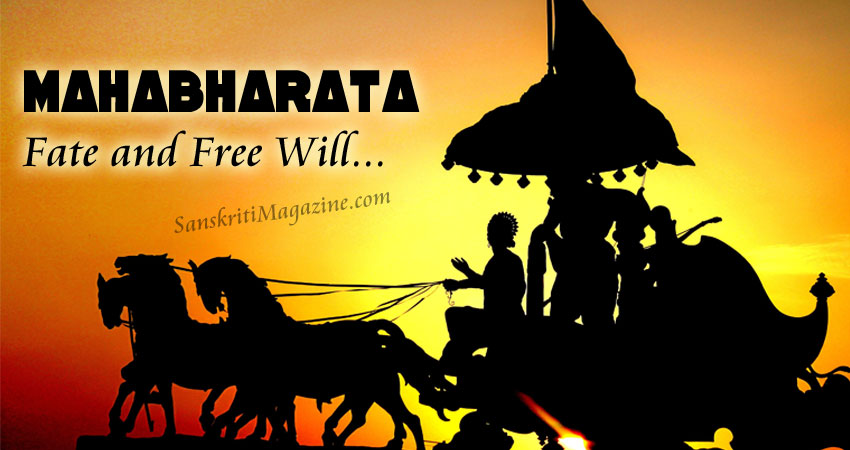
“Now I have become Time, Destroyer of worlds!”, says Krishna to Arjuna in that apocalyptic scene of the Bhagvad Gita when He shows him his awesome and terrifying Universal Form. The concept of fate and free will in the Mahabharata is deep and complex like the epic itself. The Mahabharata itself seems to support the concept that the Great War was predestined. Below is a passage from the Arghyaharana parva of the Mahabharata at the time of Yudhishthira’s Rajasuya sacrifice:
“Beholding that vast concourse of all the Kshatriyas, the Muni Narada, O king of men, became thoughtful. And, O bull amongst men, the Rishi began to recollect the words he had heard of old in the mansion of Brahma regarding the incarnation on earth of portions of every deity. And knowing, O son of the Kuru race, that that was a concourse (of incarnate) gods, Narada thought in his mind of Hari with eyes like lotus-petals.
He knew that, that creator himself of everyone, that exalted of all gods–Narayana – who had formerly commanded the celestials, saying, – ‘Be ye born on earth and slay one another and come back to heaven’ – that slayer of all the enemies of the gods, that subjugator of all hostile towns, in order to fulfil his own promise, had been born in the Kshatriya order. And Narada knew that the exalted and holy Narayana, also called Sambhu the lord of the universe, having commanded all the celestials thus, had taken his birth in the race of Yadus and that foremost of all perpetuators of races, having sprung from the line of the Andhaka-Vrishnis on earth was graced with great good fortune and was shining like the moon herself among stars.
Narada knew that Hari, the grinder of foes, whose strength of arm was ever praised by all the celestials with Indra among them, was then living in the world in human form. That the Self-Create will himself take away (from the earth) this vast concourse of Kshatriyas endued with so much strength! Such was the vision of Narada the omniscient who knew Hari or Narayana to be that Supreme Lord whom everybody worshipped with sacrifice. And Narada, gifted with great intelligence and the foremost of all persons conversant with morality, thinking of all this, sat at that sacrifice of the wise king Yudhisthira the just with feelings of awe.”
This theme resonates in the Mahabharata. Lord Krishna, Vyasa, Narada and other great rishis knew that the great catastrophe was predestined. For instance Vyasa advises Satyavati, Amba and Ambalika that they should retire to the forest after the death of Pandu as otherwise they would be witness to the suicide of their race. Draupadi is referred to as being born for the destruction of the Kauravas and Kshatriyas. In the Vana parva, Krishna assures Draupadi that the earth would drink the blood of the Kauravas in a future catastrophic war. It is as if Lord Krishna was conducting a sacrifice of war in which all the Kshatriyas of the world would be annihilated. But what was the secret behind this planned destruction of the Kshatriyas?
The reason may be that the kshatriyas and kings of the world had developed demonic tendencies of greed, arrogance and unbridled lust for conquest and power. At the time of the Mahabharata, India was a land full of powerful and ambitious empires bent on world domination. There were innumerable powerful Kshatriya dynasties which terrorized the world with their armies. Any powerful king would set out with his army and start on a conquest of the four quarters inflicting war on any state opposing their will. Their conquests stretched as far west as the yavanas (ancient greeks). The Mahabharata, although a treatise on the utter futility of War, is full of the heroic grandeur of this militarism. Vyasa doesn’t mince words when he describes a brave warrior crushing his enemy in battle. The Pandavas themselves conquer all lands for Yudhishthira’s Rajasuya. But a point came when these incessant wars of conquest started destroying the peaceful development of human life and things were so bad apparently that the Lord Himself had to incarnate and destroy this uncontrollable order of conquerors and warriors.
However true to its claim of being as broad a canvas as Life itself, the Mahabharata is a complicated jungle. The grand drama unfolds on the stage of tragic destiny but the actors are not following prescripted roles. Free will plays as big a role if not bigger in the unfolding of the Gotterdamerung. There are fundamental reasons stemming from individual beliefs, idiosyncracies, arrogance, egoism and failure which are as much causal in the epic’s grand march to Doom. Dhritarashtra’s moral blindness and personality warped by perceived injustice, Duryodhana’s flawed upbringing which filled him with envy, hate and arrogance, Shakuni’s malice, Bhishma’s narcissistic oath obsession, Karna’s suicidal fixation with self worth based on military prowess, Draupadi’s never extinguishing fire of hatred for the Kauravas and Krishna’s vision of a Dharmic India purged of the grip of self aggrandizing militaristic dictators are great pillars in the destructive edifice of the Mahabharata.
The consequences of this world war for Dharma were however disastrous for India. A highly developed and prosperous society was subjected to the horrors of cataclysmic war. The powerful order of the Kshatriyas was near annihilated and the grand combination of thinkers, statesmen and warriors which had made Mahabharata age India an unrivalled powerhouse was obliterated. All that was left was a ravaged country full of widows, children and degenerate men as warned by Lord Krishna in the Kaurava assembly and as foreseen by the intelligent Arjuna before the start of the grand carnage. This degeneration grimly manifests as the mass suicidal frenzy of Krishna’s own Yadava race thirty six years after the Great War.
Thus as in Life itself, Fate and Free Will form the two strands which weave the rich tapestry of the Epic. The spirit of the Mahabharata however is not fatalistic. Vyasa’s vision is reflected in the action packed life of Shri Krishna, the supreme hero of the epic. The great poem reverberates with His grand personality and inspires us to be like Him- mighty and full of courage, never disheartened and ever enthusiastic, ready to crush evil and establish Virtue on earth. And isn’t Arjuna’s annihilation of the Khandava forest with Krishna’s help an illustration of man’s ability to destroy the forest of self limitations with God’s grace and achieve high goals by self exertion. The heroes of the Mahabharata are the great karmayogis: Bhishma, Karna, Krishna and Arjuna and not the dubious fatalist Dhritarashtra.
~ Dr. Madhu Guptan, MD, Trainee in Diagnostic Radiology, Medical University Sofia, Bulgaria