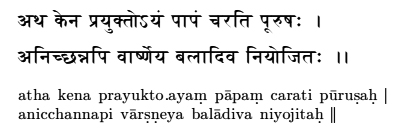
Arjuna said: Impelled by what, does man commit sin, much against his wishes, O Varshneya, compelled as it were, by force? ~ Gita Ch: III-36
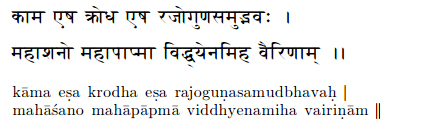
Krishna said: It is desire, it is anger born of the Rajo-Guna, all devouring, all sinful; know this as the foe here (in this world). ~ Gita Ch. III-37
The cause of sin or wrong action in this world is desire. Anger is only a modification or form of desire. Anger is desire itself. When a desire is not gratified the man becomes angry against those who stand as obstacles in the path of fulfillment. The desire is born of the quality of Rajas. When desire arises, it generates Rajas and urges the man to work in order to possess the object. Therefore know that this desire is man’s foe on this earth.
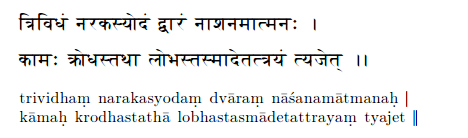
Triple is the gate of this hell, destructive of the Self – lust, anger and greed, therefore one should abandon these three. ~ Gita Ch. XVI-21
Lust, anger and greed – these highway robbers will cause a man to fall into the dark abyss of hell, misery and grief. These are the three fountain-heads of misery. These three constitute the gateway leading down to the lowest of hells. These are the enemies of peace, devotion and knowledge.
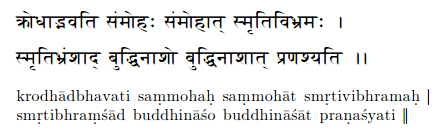
From anger comes delusion, from delusion the loss of memory; from loss of memory the destruction of discrimination; from destruction of discrimination he perishes. ~ Gita Ch. II-63
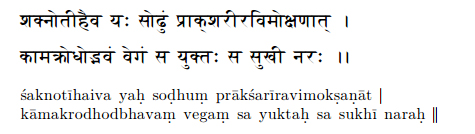
He who is able to resist the force of desire and anger even before he quits his body – he is a Yogin, he is a blessed man. ~ Gita Ch. V-23
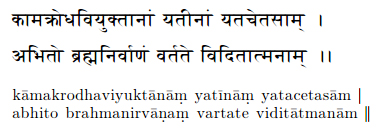
Those who are free from desire and anger, and who have subdued their minds and realized themselves – around such austere men lies the beatitude of God. ~ Gita Ch. V-26
Anger is a negative Vritti or whirlpool in the mind-lake. It is born of ignorance. It is a strong emotion, excited by a real or fancied injury and involving a desire for retaliation.
Anger is the natural passion or emotion of displeasure and antagonism aroused by injury or insult, real or imagined, and directed against the cause thereof. Anger arises from an idea of evil having been inflicted or threatened.
Anger is often accompanied by a desire to take vengeance, or to obtain satisfaction from the offending party.
It begins in folly and ends in repentance. The fire you kindle for your enemy burns yourself. When anger arises, think of the consequences. It will soon subside.
You think of objects of senses. Attachment to these objects develops. From attachment desire is born. From desire anger comes forth. From anger proceeds delusion; from delusion confused memory; from confused memory the destruction of reason; from destruction of reason you perish.
Raga or attachment is a long-standing associate of anger. Control anger through patience, enquiry, self-restrained loved and meditation. This is manly and divine. This is wise and glorious.
To become angry for trifling things is mean, childish and brutal. An angry man is angry with himself when he comes to his senses.
Anger is personal and usually selfish, aroused by real or supposed wrong to oneself. Indignation is impersonal and unselfish displeasure at unworthy acts. Pure indignation is not followed by regret and needs no repentance. It is also more self-controlled than anger. Anger is commonly a sin. Indignation is often a duty. We speak of “righteous” indignation.
Raga drives one beyond the bounds of prudence of discretion. Fury is stronger and sweeps one away into uncontrollable violence.
Wrath is deep and vengeful displeasure. It simply expresses the culmination of righteous indignation without malice in a pure being.
Anger is a stronger term than resentment, but not so strong as “indignation” which is awakened by what is flagitious in character or conduct, nor as wrath, fury, rage in which anger is wrought up to a still higher point in the order of these words. Anger is a sudden sentiment of displeasure, resentment is a continued anger, wrath is a heightened sentiment of anger.
~ Swami Sivananada