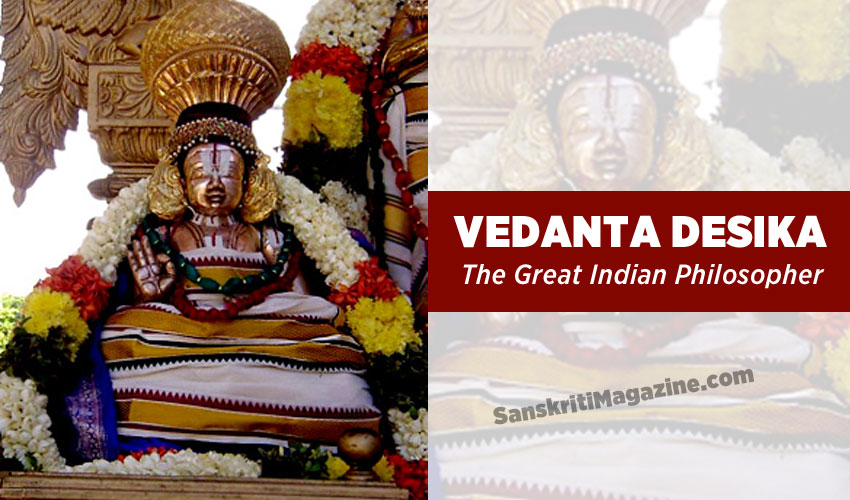
Vedanta Desika was one of the greatest philosophers and literary giants of South India. He is regarded as the second greatest Sri Vaishnava writer. He was a great poet, devotee and master-teacher. Vedanta Desika was born in a suburb of Kanchipuram called Tupul. Ananta Suri was his father and his mother was Totaramba. He belonged to an orthodox Sri Vaishnava family. His original name was ‘Venkatanatha’. He relocated to other Vaishnava centres like and the famous temple town of Srirangam, both in Tamil Nadu in his later life.
Vedanta Desika got his education under his scholarly maternal uncle named Kidambi Appullalar, who was a direct disciple of Ramanuja. It was under Kidambi Appullalar, his ‘Upanayanam’ was done. He also made him master of all the Vedas, Divyaprabandam, Puranas and Sastras. The death of the Ramanuja split the Vaishnava Sampradaya into two sects namely Vadakalai i, e, ‘Northern art’ or ‘Northern learning’ and Tenkalai i, e, or ‘Southern art’ or ‘Southern learning’. Sri Vedanta Desika was the Acharya of the followers of the Vadakalai sect. During the time of Vedanta Desika Tamil country was frequently invaded by the armies.
Vedanta Desika was a very creative writer and composer. He became a great scholar within the age of twenty, which is unique in the history of Vaishnavism itself. His writings include more than a hundred and thirty works, in both prose and verse, in Sanskrit, Prakrit, Tamil and maniprcivcila (a unique system of writing which incorporates both Sanskrit and Tamil). Vedanta Desika composed a thousand verses known as ‘Padukasabasram’ in one night time in the praise of the sacred feet of Lord Ranganatha i, e, Vishnu of Srirangam. He was a great devotee of Lord Ranganatha.
At the age of 21, Vedanta Desika got married to Tirumangai, who was also known as ‘Kanakavalli’. He had a son named ‘Varadarya’, who was born in 1317 AD. His son later became Nainar Acharya became a great scholar too and ably carried on the work of his father.
Vedanta Desika became an ‘Acharya’ at the age of 27. One of his famous works is ‘Yadhavabhyudayam’, which is a very long poem (mahakavya) in twenty-one cantos. He also wrote the ‘Hamsa Sandesa’, which is modelled on the famous poem, ‘Meghaduta’ of Kalidasa. Vedanta Desika has also written commentaries on the works of the Alvars or the Tamil Vaishnava Bhakti saints. The religious Vaishnavas and the students of Sanskrit literature of present day also appreciate and refer his works for reading because of its splendid language and style.
Once, Vedanta Desika got invitation for participating in a debate with an Advaitin in Srirangam. He went and participated and above all he won the debate, which made him -known as one of the leading philosophers and scholars of the Vadakalai school of Sri Vaishnavism. In the early 14th century, the army of Allauddin Khilji, Sultan of Delhi attacked and ransacked Srirangam. So, like other inhabitants of Srirangam, Vedanta Desika also had to flee from that place. He took shelter in a place called Satyamangalam, near Mysore. After a short period, the invading armies were beaten back from Srirangam and then he returned back to this sacred island. Then he continued his role as a writer and preceptor.
According to a traditional belief, Vedanta Desikan is regarded as the incarnation of the ghanta (bell) of the Lord of Tirupati. There is a story related to him. It is said that once Desikan went to Thiruvaheendrapuram and performed penance chanting the ‘Garuda Mantram’. Being pleased with his devotion, Garuda appeared before him and taught him the ‘Hayagriva Mantra’ (Hayagriva was an incarnation of Lord Vishnu with the head of a horse and the body of a divine Hindu god, which looked human-like, but with four arms). Hayagriva represents the knowledge in human being. So, when he chanted the ‘Hayagriva Mantra’, Lord Hayagriva appeared before him and presented an idol of himself to Vedanta Desika. Therefore now, an idol of Hayagriva adjacent to the Desikan idol can be seen in almost in all Desikan temples
Vedanta Desika while talking about the eight-lettered mantra, ‘Ashtaksharam’ of Narayana, mentioned several other things which can have an eightfold classification – like, eight kinds of devotion, eight siddhis, eight functions of the intellect and so on. In the same way, he explained eight flowers for the worship of God; these are: non-violence, sense-control, universal compassion, infinite patience, wisdom, austerity, meditation and truth.
Vedanta Deskia left the heavenly abode after living for 101 years in Srirangam. The place where he lived can be seen in Srirangam even today and is known as ‘Vedanta Desikan Thirumaligai’.