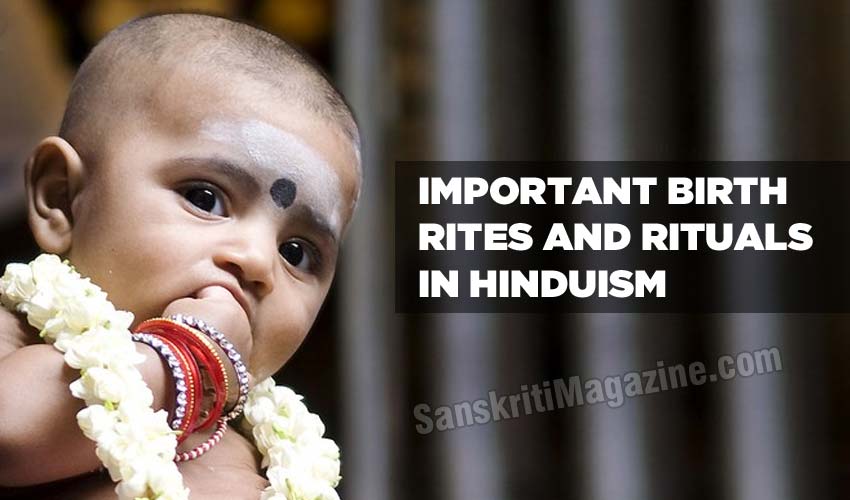
Special ceremonies are performed before the baby is born for the welfare of the mother and child. The family priest or pundit will come to the family’s home to perform various rites.
In Hindu dharma, the birth of a child is considered a religious activity. Samskaras begin prior to birth and end with the cremation of the body following death. The number of samskaras prescribed in various scriptures vary from eleven to forty, some of the most significant samskars are :-
Garbhadhana (conception)
Jatakarma (child birth)
Namakarana (naming a child)
Annaprasana (giving the child solid food)
Mundan (shaving the head)
Upanayana (sacred thread ceremony)
Garbhadhana
The rite through which a man placed his seed in a woman was called Garbhadhana. Saunaka gives the similar definition though in slightly different words; “The rite by the performance of which a woman receives semen scattered (by her husband) is call Garbhalambhanam or Garbhadhana.” In Vedic culture spiritual aspirants can get married. For them marriage is a partnership to aid them in their mutual progress in spiritual life, marriage is not simply a for sexual gratification. One of the duties of such a married couple is to produce spiritually enlightened children. Bringing such spiritually aware children into the world is beneficial both for the parents spiritually, as well as for society in general. The conception of such great children is a great science and not the mere byproduct of random recreational intercourse on the part of the parents.Unlike ordinary sexual activity which further binds the soul’s of all involved into material consciousness, the Garbhadhana Samskara is a purely spiritual act as is confirmed by Lord Krishna in the Bhagavad-gita 7.11. Such sex aimed at creating godly children is as good as God Himself.
” balam balavatam caham
kama-raga-vivarjitam
dharmaviruddho bhutesu
kamo ‘smi bharatarsabha”
“I am the strength of the strong, devoid of passion and desire. I am sex life which is not contrary to religious principles, O lord of the Bharatas [Arjuna].”
Jatakarma
The jatakarma ceremony welcomes the baby into the world. The father places a small amount of ghee and honey on the baby’s tongue and whispers the name of God in his ear. During this Sanskar, the father feeds honey to the baby and pierces the baby’s ear. This ear piercing is supposed to enhance the memory of the child .Brahmins chant Mantras for a healthy, long life of the child. This Sanskar is restricted to the family level.
Namakarana
In Namakarana ceremony the child is given a name.Nama literally means ‘name’ and karana means ‘to make, to effect’. All the activities in the world are carried on the basis of name. Every parent has the duty to give a nice name to the child, which reminds the child of some goal or objective in the life. It is very important to select a nice name for the child; the name should be meaningful which fulfills all the desires of the child. Whenever the child hears the name he will remember the meaning and purpose hidden in it and will be inspired by its meaning.Distribution of sweets to everybody. Afterwards a feast is usually arranged.
Annaprasana
This sanskar is related to the time when the child is to be given solid food apart from the mother’s milk. This emphasizes the importance of proper health care and nutrition for the child.Time for performance: In the 6th, 8th or 10th month for the male child and 5th, 7th, 9th or 11th month for the female child. The object of this ceremony is to pray to the gods with Vedic Mantras to bless the child with good digestive powers, good thoughts and talents. It is performed when the child is six months old which is the weaning time. Susruta commends this weaning time as best for both the mother and the child. Offerings are made to the goddess of speech and vigour. Prayers are offered so that the child´s senses have their full gratification and live a happy and contented life. The father feeds a little of the sweet food anointed with gold to the child with Mantras that say he feeds the child with food that may ensure a healthy life to the child and prevent ill-health. Apart from the efficacy or otherwise of this ceremony, its observance creates in all concerned an awareness of the cumulative needs of the child at that age in a scientific and tender manner. Its systematic observance therefore ensures the results expected especially when fortified by Mantras.
The Annaprashana ceremony should be performed at the time when the child gains strength to digest cereal and preparations made from cereals. The first feeding of cereal commences with this ceremony. He who desires his child to be brilliant and famous should feed cooked rice mixed with ghee (clarified butter) or the rice mixed with honey, curd and ghee . The samskar ceremony for the first feeding commences with prayer, followed by Svastivachana, Shanitkarana and complete Samanya Prakarana. It is indicated that this ceremony should be performed (when the child is six months old) on the day on which the child was born.
The rice should be prepared as below:
Rice is washed, cleaned, cooked nicely and ghee in proper quantity is mixed in the rice when it is in the cooking process. When this rice has been cooked properly and has become cold, then it should be placed in Homasthali or the tray of Homa. From this Homashali the rice is then given in small containers to the Yajman, to Purohita and Ritvij (Priests), accompanied with chanting of Mantras.The Yajmana (father of the child) then performs Agnyadhan and Samidadhana. Offers four oblations of Aghavarajyabhagahuti and four oblations of Vyahriti. Thereafter the oblation of the cooked rice that was given to the Yajman and to the priests, should be offered with one Mantras from the Rig Veda and one Mantra from the Yajur Veda. Thereafter the Yajmana mixes small quantity of curd, honey and ghee. Adds this to the rice that remained after the oblations. This should be fed to the child in minute quantity according to the desire of the child with the chanting of Mantra from the Yajurveda.
Mundan
Mundan Vidhi is performed to carry out the first hair cut of the baby. If it is carried out as per the Vedic Method it removes any deficiencies developed in the child before birth.It is also said that the shaving of the hair stimulates proper growth of the brain and nerves. During this vidhi all the hair of the baby are removed and the baby’s head is cleanly shaven.Hair collected during the hair cut are kept inbetween two puris ( fried indian bread ) and then offered to holy waters like Ganges, Yamuna or any other holy water bed.
Upanayana
In Hinduism, Upanayana, or ceremony to mark stages in the life of a Hindu. It is a religious ceremony undertaken by Hindu boys of the three highest castes. The ceremony usually takes place between the ages 7 and 11, indicating the entry into adulthood and the ability to deepen the individual’s awareness of the duties they now embrace as a Hindu. During the ceremony, a sacred thread is tied. The thread is made up of three separate threads, each with a symbolic meaning – one meaning to worship God, one meaning to show love and respect to parents, and one meaning to learn from the religious teacher. Mantras from the Hindu scripture the Rig Veda are used during the ceremony. The ceremony may end with the boy acting out his departure on religious pilgrimage, re-enacting the ways of those in the past who set out to study under the tuition of a religious guide.