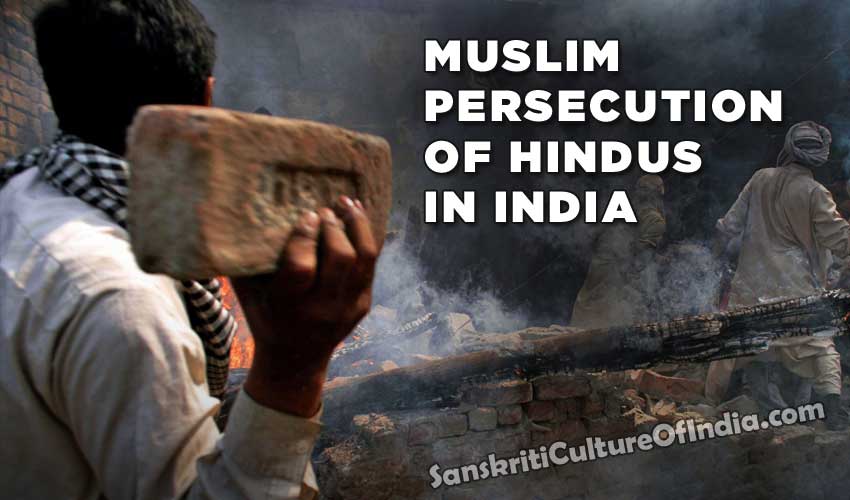
They are crossing the border illegally and violently displacing the indigenous population whose homes and possessions they either destroy or occupy. They are attacking the young, the elderly, and especially the girls and women, whom they kidnap, forcibly convert, or traffic into brothels. The locals are terrified of them. The police rarely come to their aid, nor do the politically correct media or government. Both are terrified by the criminals and terrorists who are riding these immigrant waves.
I am not talking about illegal immigrants to Europe or North America. I am describing Muslims who are penetrating India’s West Bengal region. These Bangladeshi immigrants are becoming conduits for criminal activities (arms, drugs, and sexual slavery) which also fund global jihad.
You won’t read about this in the Western mainstream media—or even in the Indian media, which has turned a blind eye to this ongoing tragedy because they are afraid to be labeled “politically incorrect” or “Islamophobic.” They are also afraid of reprisals. When Islamic zealots ransacked the office of the renowned newspaper, ‘The Statesman’ in Kolkata, in retaliation for a mere reproduction of an article condemning Islamic extremism, the Indian press remained silent. The editor and publisher of the newspaper were arrested for offending Muslim sentiments and no action was taken against the rioters.
Fortunately, there are a few very brave Hindus who are taking a stand against the Muslim terror campaign in India. One of them is Tapan Ghosh, whom I had the privilege of meeting recently when he came to New York City to talk about anti-Hindu persecution in his homeland. In 2008, Ghosh founded “Hindu Samhati” (Hindu Solidarity Movement), which serves persecuted Hindu communities in both West Bengal and Bangladesh.
As Ghosh emphasized in our interview, the Muslim persecution of Hindus in India is nothing new. Over a period of 800 years, millions of Hindus were slaughtered by Muslims as infidels or converted by the sword. In 1946-1947, when British India was divided into India and Pakistan, Muslims massacred many thousands of Hindus in Calcutta, the capital of West Bengal, and all along the fault line which separated India and Pakistan. Anti-Hindu riots and massacres continued during the 1950s and 1960s, but it was in 1971, when East Pakistan broke away to form the country of Bangladesh, that things worsened for Hindus in the area.
As Ghosh explained to me, “The liberation movement for Bangladesh was characterized by an escalation of atrocities against the Hindus and pro-liberation Muslims. Hindus were specifically singled out because they were considered a hindrance to the Islamisation of East Pakistan. In March 1971, the government of Pakistan and its supporters in Bangladesh launched a violent operation, codenamed “Operation Searchlight,” to crush all pro-liberation activities. Bangladeshi government figures put the death toll at 300,000, though nearly 3 million Hindus were never accounted for and are presumed dead.” U.S. officials in both India and Washington used the word “genocide” to describe what took place.
According to Ghosh, there has recently been a sharp increase in incidents of “Muslim rioting during Hindu festivals, destruction of Temples, desecration of Deities, and large-scale, provocative cow slaughter.” Worse: “Hundreds, thousands, of Hindu girls have been kidnapped, trafficked into sexual slavery, or taken as second or third wives for wealthy Muslim men. In recent years, Ghosh’s organization has rescued nearly 100 such girls, and one of his main missions has been to help reintegrate those survivors into their families and societies.
Ghosh wants the Indian government to stop the illegal immigration from Bangladesh and to force the return of undocumented Muslims; to ban madrassas and polygamy; to enforce a single standard of law and education; and to arrest and prosecute known Muslim mafia kingpins and terrorists. He challenges the media to report on the anti-Hindu atrocities and to address the issue of religious apartheid.
Ghosh is not optimistic. “The establishment of massive Saudi-funded Madrasas across rural Bengal is only contributing to the growing religious extremism among Muslims, [and] implementation of Sharia laws by [Islamic] courts is quite prevalent in many villages.” His greatest fear, he tells me, is that one day shouts of “Allahu Akbar” will ring out across the land and that Muslim zealots will demand that Hindus either convert or leave West Bangal—or die.
Ghosh came to America not just to appeal to Indian-Americans with family and historical ties in West Bengal and Bangladesh but to appeal to all Americans for their support. As he sees it, the battle against Muslim persecution in India is just one front in a much larger battle against Islamic expansionism and terror throughout the world.
All Americans must realize, he told me, “that the war on Islamic terrorism cannot be won without curbing religious extremism amongst the Muslim masses, be it in the suburbs of Detroit or Delhi or villages in rural Bengal. And this will require the active support and cooperation with each other, ranging from cooperation at the highest level to those who work at the grassroots level. We hope that Americans and Westerners will come out and support the Hindus in Bengal in raising resources and creating awareness about our on-the-ground realities.”
~ By Phyllis Chesler | Fox News USA, The author would like to acknowledge the assistance of Nathan Bloom in the preparation of this article.
Phyllis Chesler, Ph.D. is professor emerita of psychology and the author of thirteen books including “Woman’s Inhumanity to Woman” and “The New Anti-Semitism.” She has written extensively about Islamic gender apartheid and about honor killings. She once lived in Kabul, Afghanistan.