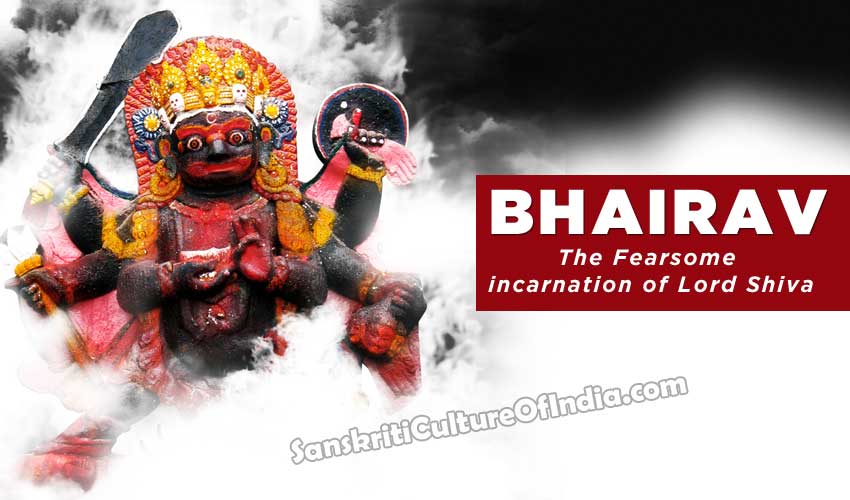
Bhairav or Bhairon is an incarnation (avatar) of Lord Shiva. Lord Bhairav is widely worshipped by tantriks and yogis to gain various siddhis. Bhairon is regarded as the protector and the kotwal. In astrology Lord Bhairav is the Lord of star (graha) Rahu so to attain the maximum benefits of Rahu, people worships Lord Bhairav. Bhairav is a fierce form of Shiva. It is believed that Bhairon is connected to the Mahavidya goddess named Bhairavi who gives Lagna shuddhi (purification of the follower). This purifies and protects the body, chracter, personality and other qualities associated with the follower. Worship of Lord Bhairon is very useful to win over your enemies, success and all materialistic comforts. It is very easy to please lord Bhairav by doing normal worship daily. Coconut, Flowers, Sindoor, Mustard oil, black til etc are offered to the God to get God’s Blessings. Bhairava himself has eight manifestations:
- Kala Bhairava
- Asitanga Bhairava
- Samhara Bhairava
- Ruru Bhairava
- Krodha Bhairava
- Kapala Bhairava
- Rudra Bhirava, and
- Unmatta Bhairava
Origin Of Lord Bhairav:
The origin of Bhairava or Bhairon can be drawn from the conversation between Lord Brahma and Lord Vishnu described in “Shiv Maha-Puran” where Lord Vishnu asks Lord Brahma who is the supreme creator of the Universe.. Lord Brahma proclaimed himself to be that superior person. On hearing this, Lord Vishnu chided Lord Brahma for his hasty and overconfident words. After the debate they decided to seek the answer from the four Vedas. Rig Veda designated Lord Rudra (Shiva) as supreme as He is the omnipotent deity who controls all living beings. Yajur Veda replied that He, whom we worship through various Yagnas (Yagam) and other such rigorous rituals, is none other than Shiva, who is supreme. Sam Veda stated that the respected figure who is worshipped by various Yogis and that Person who controls the entire world is none other than Triambakam (Shiva). Finally, Atharva Veda said, all human beings can see the Lord through Bhakti Marg and such a deity who can remove all the worries of human beings is indeed Shankar (Shiva). But both Lord Brahma and Lord Vishnu started laughing in disbelief.
Then Lord Shiva appeared as a powerful divine light. Lord Brahma stared at Him furiously with his fifth head. Lord Shiva immediately created one living being and stated that he will be King of Kaal and will be known as Kaal (Death) Bhairav. Meanwhile, Lord Brahma’s fifth head was still burning with fury and Kaal Bhairav pulled that head from Brahma. Lord Shiva directed Bhairav to go around various holy places (teerths) to get rid of Brahma Hatya. Kaal Bhairav, with Brahma’s head in his hand, started took bath in various holy places (Teerths), worshipped various Lords, nevertheless saw that Brahma Hatya Dosh was following him all along. He could not get rid of that affliction. Finally, Kaal Bhairav reached the Moksha Puri, Kashi. The moment Kaal Bhairav entered Kashi, Brahma Hatya Dosha disappeared into the netherworld. The head of Brahma, (Kapal) fell at a place which was called Kapal Mochan and there was a Teerth which was later called Kapal Mochan Teerth. Then onwards Kaal Bhairav stationed himself permanently in Kashi, giving shelter to all his devotees. Those living in or visiting Kashi, must worship Kaal Bhairav and he grants protection to all his devotees.
Ashtami day (eighth day after Poornima) in the month of Margashirsha is an important day for worshipping Kaal Bhairav. Besides, Sundays, Tuesdays, Ashtami and Chaturdasi days are very important for worshipping Kaal Bhairav. A person who circumabulates Lord Kaal Bhairav eight times will be absolved of all the sins committed by him. A devotee who worships Kaal Bhairav for six months will attain all types of Siddhi. (Kashi Khand, Chapter 31.)
Another story of the origin of Bhairava is the tale of Shiva and Shakti. Shakti, the daughter of the king of gods, Daksha chosen Shiva for marriage. Her father disapproved the marriage because he alleged that Shiva resides in jungales with animals and ghosts and hence has no equality whith him. But Shakti decides otherwise and marry Shiva. After some time King Daksha held a Yagana and invited all the gods, but not Shiva. Shakti came to the yagna alone, where Daksha publicly spoke in a belittling manner about Shiva. Shakti could not bear to hear her husband insult and jumped in the holy fire of Yagna and sacrificed her.On hearing this Lord destroyed the yagna and killed Daksha by beheading him. Then Shiva carried Shakti’s corpse on his shoulders and ran uncontrollably all around the world for days.
Since this would eventually destroy all creation, Vishnu used his Sudarshan Chakra to cut Shakti’s body into pieces, which then fell all around. These spots where Shakti’s body parts fell are now known as Shakti Peethas. In the form of the frightful Bhairava, Shiva is said to be guarding each of these Shaktipeeths. Each Shaktipeeth temple is accompanied by a temple dedicated to Bhairava (Bhairon).