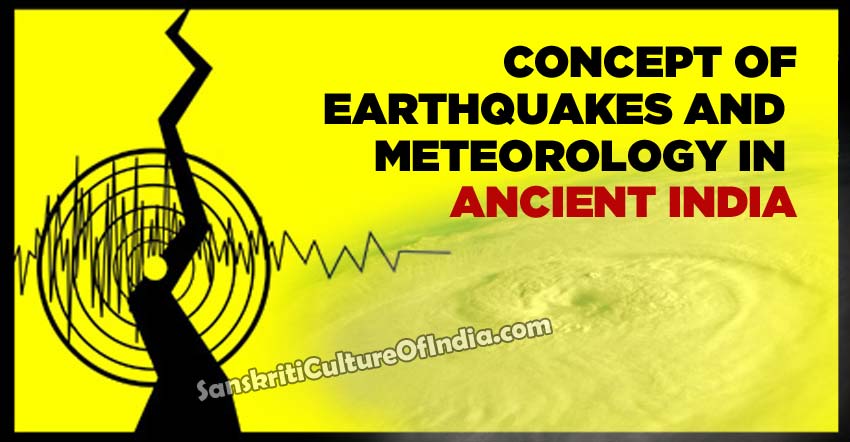
Ancient Indians invented zero. Sanskrit is the world’s most ‘scientific’ language. Ayurveda experts claim they have cures for many diseases allopathy is still struggling to find answers for. Here is another one that should make people sit up and take notice of the wisdom of an old civilisation: predicting earthquakes.
A model to predict earthquakes, developed by a California-based scholar of Chinese origin, uses the concept of “earthquake clouds”, something that has been dealt with in detail in the 32nd chapter of Varahamihira’s Brihat Samhita.
The greatness of philosopher, mathematician and astronomer Varahamihira (505-587 AD) is widely acknowledged. The Ujjain-born scholar was one of the Navaratnas in the court of King Vikramaditya Chandragupta II. His works, Pancha-Siddhantika (The Five Astronomical Canons) and Brihat Samhita (The Great Compilation), are considered seminal texts on ancient Indian astronomy and astrology.
Varahamihira was a celebrated astronomer-astrologer-
What has astonished scientists and Vedic scholars here and has renewed interest in the Brihat Samhita, are references to unusual “earthquake clouds” as precursor to earthquakes. The 32nd chapter of the manuscript is devoted to signs of earthquakes and correlates earthquakes with cosmic and planetary influences, underground water and undersea activities, unusual cloud formations, and the abnormal behavior of animals. “I find it rather odd that the description of earthquake clouds in Brihat Samhita matches the observations made by Zhonghao Shaou at the Earthquake Prediction Centre in Pasadena, California,” said B D Kulkarni, head of the National Chemical Laboratory’s Chemical Engineering Division.
Varahamihira categorises earthquakes into different kinds and says that the indications of one particular kind will appear in the form of unusual cloud formations a week before its occurrence: “Its indications appearing a week before are the following: Huge clouds resembling blue lily, bees and collyrium in colour, rumbling pleasantly, and shining with flashes of lightning, will pour down slender lines of water resembling sharp clouds. An earthquake of this circle will kill those that are dependent on the seas and rivers; and it will lead to excessive rains.”
(source: A temblor from ancient Indian treasure trove?).
Angirasa’s Tract on Meteorology
Maharishi Angirasa, whose name occurs in the Puranas frequently, is the Author of the interesting work on Cloud formation named “Meghotpatti-Prakarna.” This book contains detailed descriptions regarding formation of water by electric discharges during thunder and lightning; thunder bolts and their description; also different varieties of lightning, some of which are beneficial as they are water forming while others are ‘destructive’(as they contain electric charge which is killing, causing thunder-bolts). There is another similar book by the same author Maharishi Angirasa called “Karaka Prakarana.” The title signifies “Thunders and thunderbolts.” But in fact, the book deals with different forms of electric discharges and energy-emissions from the Sun as well as from the atmosphere; also described in the book are the different properties of sun’s rays and how different kinds of cloud-formations are caused by the different rays of the sun.
This second book is strikingly original in its theories about the origin of various precious stones and crystals in the earth which result from different kinds of Solar flares or Sun’s radiations. It has a very interesting theory regarding the origin of insects, different animals and plants which occur as sudden outbursts at certain times and again as suddenly disappear with the change in atmosphere at other times (like locust swarms, for instance). These sudden waves of seasonal or periodic changes in plant and animal life, according to Angirasa Rishi, are caused by different kinds of weather which in turn, is a result of difference of Sun’s rays. All such atmospheric changes, cloud-formations, thunder and lightning, outbursts of plant and vegetable life, electric discharges in the atmosphere, are all dealt with in this marvelous book “Karakaprakarana” which is a masterly analysis of the Sun’s rays.
(source: Hinduism in the Space Age – by E. Vedavyas)