IndianSanskriti

Significance of immersing ashes in holy rivers

The remnant of the dead body after burning is left behind in the form of ashes. Hindus respectfully call these ashes “phool” – literally flowers – to express devotion and respect for the departed soul. When children are symbolically referred to as “fruit”, it is appropriate to refer to the ashes of forefathers as “flowers”.

It is customary to gather the ashes on the fouth day after death. They are then immersed in sacred rivers like the Ganga. If it is not possible to immerse them immediately, they are kept in a locker in the crematorium and immersed as soon as possible.

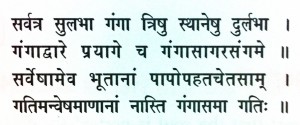
In Shankhsmriti, page 7, the consigning of ashes to the Ganga is explained:

2 (1)

As long as the ashes of the deceased person remain in the Ganga, the person continues to enjoy happiness in worthy places for thousands of years.

In the Kurmpuran, 35/31-34, it is said:
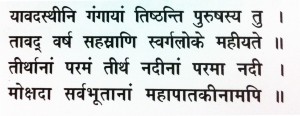
3 (1)4 (1)

Whatever number of years the ashes remain in the Ganga, the departed soul is held in reverence in heaven for thousand times the number. Of all the pilgrimages and of all the rivers, Ganga is considered most holy. It grants salvation to all, including those that have committed gross sins. Although accessible everywhere to the common man, Ganga is unique at Hardwar, Prayag and Gangasagar. Those who desire salvation, including emotionally downtrodden sinners, there is no better place than the Ganga.

Religious writers also believe that the deceased person’s journey towards the eternal home does not start until the ashes are consigned to the Ganga.

Another belief about consigning ashes to the Ganga and other sacred rivers is that the water from these rivers is used extensively to irrigate large tracts of land along the river. Since the rivers keep flowing and parting with nutrients that they carry in the water, the nutrient content reduces.

Since bones are constituted of phosphates, the ashes consigned to the rivers increase the phosphate content of the water that irrigates fields. Phosphates are essential ingredients for growing grains. With the irrigation water, phosphates are passon on to the fileds and the crops. The ultimate purpose of ensuring that the elements of the body return to nature after death is achieved.

Think it over…

The person, not larger than the thumb, dwelling within, always dwelling in the heart of man, is perceived by the heart, the thought, the mind; they who know it become immortal.      ~ Svetasvatara Upanishad

~ Prem P. Bhalla
You may also like

Search the website

Like us on Facebook

Get daily updates via Email

Enter your email address:

Recent Posts

Jamai Shashthi 2026 — The Story of Maa Shashthi, the Cat, and the Wife Who Was Forgiven

Jamai Shashthi 2026 — The Story of Maa Shashthi, the Cat, and the Wife Who Was Forgiven

On Saturday, June 20, 2026, Bengali households across Bharata will welcome their married daughters and sons-in-law home for the legendary jamai-aador feast and perform the Shashthi Vrata. But behind the warmth lies a story most Bengalis know by heart and most non-Bengalis have never heard — the wife who stole the hilsa, blamed the cat, lost six sons to Maa Shashthi’s wrath, and was finally forgiven. The Vrat Katha, the vidhi, the mantras, and the deeper teaching.

Vat Purnima 2026 — The Wife Who Argued Yama Into Returning Her Husband’s Life

On Monday, June 29, 2026, women across Maharashtra, Gujarat, and southern Bharata will tie red thread around banyan trees and hear the story of Savitri — the wife who walked behind Yamaraja Himself when He came for her husband, and out-argued the Lord of Dharma into returning Satyavan’s life. The Mahabharata’s Pativrata Mahatmya Parva, the vrat vidhi, and why the banyan witnessed everything.

Purushottam Maas — The Month No Deity Would Claim, and the Lord Who Made It Supreme

Every month of the Hindu calendar has a lord — except the rare thirteenth, the Adhika Maas, born an orphan and shunned as the “impure month.” The Puranas tell how this rejected month went in grief to Bhagavan Vishnu, who claimed it, gave it His own name — Purushottam — and made it the most fruitful month of all. The origin story, the teaching, and what it means for Purushottam Maas 2026 (May 17 – June 14).

Padmini Ekadashi 2026 — The Ekadashi Even the Devas Descend to Keep

Padmini Ekadashi 2026 — The Ekadashi Even the Devas Descend to Keep

The rarest Ekadashi of the entire Hindu calendar is three days away. The Padma Purana preserves a conversation between Bhagavan Krishna and Yudhishthira about a single Ekadashi the great Rishis spend lifetimes waiting for — Padmini. The Vrat Katha of Queen Padmini of Mahishmati, the lotus teaching, and why May 27, 2026 is the morning Vaishnavas across Bharata are preparing for.

Varada Chaturthi 2026 — The Rare Ganesha Day of Purushottam Maas

Varada Chaturthi 2026 — The Rare Ganesha Day of Purushottam Maas

Once every 2.5–3 years — when the rare 13th month of Adhika Maas opens — a thirteenth Vinayaka Chaturthi appears. The Mudgala Purana calls it Varada Chaturthi, the “boon-giving” Chaturthi, and holds it as the most fruit-bearing Ganesha day of the entire calendar. Today, Wednesday May 20, 2026, is that day.

css.php