Service to parents is described as the best service in Hinduism. Religious text equate parents with gods. Amongst parents, the mother has been accorded a higher position than the father. The mother who gives birth and the motherland that sustains an individual are described as more outstanding than heaven.
In reality, a child is born of its father and mother. Since they are instrumental in giving the body to a child they are the first gods to the child. Since the mother rears the child in her womb for nine months, bearing the pains of carrying it and giving the child good thoughts through this period, parents are worth of reverence.
Rendering services to parents has been described as “pitra-rin” – a loan from the parents. It is the duty of every child to repay this loan or debt in adult life. Therefore, a son cannot refuse to get married. Sanyas or renunciation is also prohibited unless the son has settled this loan or debt.
A teacher has a significant role in imparting knowledge to a child. However, the mother has been specially commended as the first teacher of the child.
In Manusmriti, 2/145, the situation has been described as:
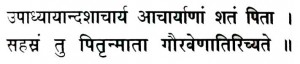
A religious teacher is 10 times more important than a teacher. A father is 100 times more important than the religious teacher. A mother is 1000 times worthier than the father.
In Manusmriti, 2/227, it is further clarified:

Parents who give birth and rear children face agony that cannot be overcome in a hundred years. Therefore, the father, mother and teacher must always be kept happy and content through care and service. This is important to attain truth and success in life.
In Manusmriti, 2/233, it is further written:

One attains happiness in the community through reverence to the mother. One attains happiness in the world through reverence to the father. One attains happiness of Brahmlok (the abode of Brahma) through reverence to the teacher. Those who have the blessings of all three find happiness that all the religions can give. Without the blessing of the three no religion can give honour or respect. None of their deeds bear beneficial fruit. As long as parents and teachers are alive, they must be served. No rituals or customs are necessary. Serving them is a duty, it is the best religion.
In the Shivpuran, the importance of parents is described thus:
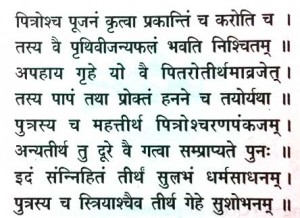
That son who reveres his father and mother wholeheartedly attains the fruit of having gone around the world. Whoever leaves them home and travels alone even though on pilgrimage sins as though he has killed his parents. For a son the feet of the parents are like a pilgrimage. To visit other pilgrimages one needs to travel long distances, this pilgrimage is close at hand. For the man the love and respect of his parents and for a woman the love and respect of her husband are the best pilgrimages available within the home.
In the religious texts, the best example of love and respect for parents one comes across is that of Shravan Kumar, who achieved immortality through his devotion. Lord Ram became an ideal son by honouring his father’s commitment and went in exile into the forests for 14 years. Motivated by the lives of great men and women one must always revere and look after parents to repay the debt of their having brought one into this world.
You may say:
Is it not unfair to bind people to many responsibilities like those to teachers, parents and forefathes? Why can’t one decide what one wants to do or not?
At no stage have any responsibilities been thrust upon anyone. The responsibilities suggested in the religious texts have been known to give happiness to many. You are free to chose what you would like to do, or not do. If you think these responsibilities invade your freedom, are you really free? Your own likes and dislikes already bind you. Greed, anger, jealousy and selfishness bind you. You are free to live with them. You are free to suffer the consequences of these attributes. When responsibilities are assigned to individuals, the purpose is not to benefit one at the expense of another. The purpose is the break the chain of weakness in human beings. This lifts them to higher levels of spiritual attainment.
~ Prem P. Bhalla