IndianSanskriti

Divinity personified friendship: Gayatri Sankar

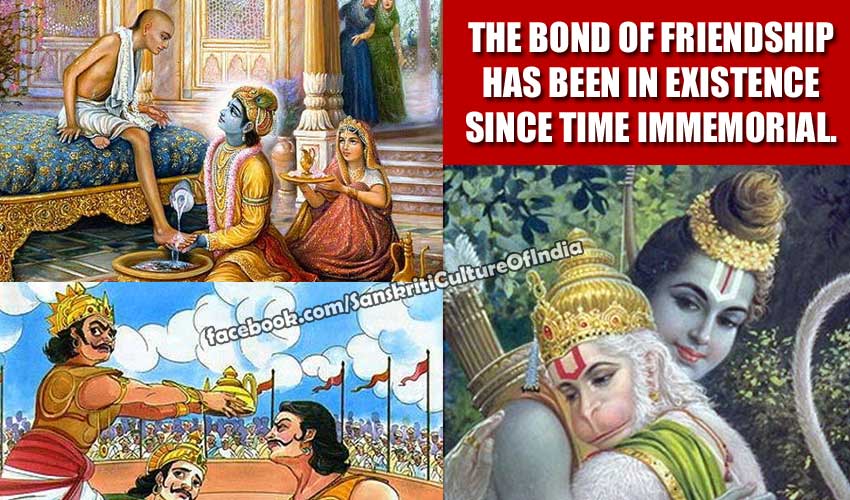
The bond of friendship has been in existence since time immemorial. As they say friendship knows no barriers of caste, colour or creed; this fact holds true for even the greatest characters from Indian epics. 

Here’s a look at some of the classic specimens of friendship, whose relationship goes beyond devotion! 


Krishna-Sudama:

Sudama belonged to a very humble and an impoverished family while his childhood friend, Krishna belonged to royal lineage. With time, the two friends lost touch and after years, they meet again at the King’s court in Dwarka.

Lord Krishna, by then had become `Dwarakadish` or the King of Dwarka. One fine day, impoverished Sudama visited Krishna, to seek help from his dear friend on his wife’s insistence and out of exasperation.

Poor Sudama had nothing but flattened rice to offer to Krishna as a token of love. He carried it in piece of cloth and on reaching the palace; he felt he was too insignificant a person in King Krishna’s life. But on seeing Sudama, Krishna instantly recognized him, went running to him like a child and hugged him with love. He made him sit and washed his feet, wiped them with his attire and showered him with limitless love.

On seeing Krishna serving him with devotion, an overwhelmed Sudama forgot all about the purpose of his visit to the palace.

But to his surprise, on his return to his hut, Sudama saw a huge mansion in place of his modest abode and his family living in luxury.

This goes to show that a true friend does not need to bank on words to express. Silence in this case acts as a catalyst to strengthen the pious bond. 

Karan-Duryodhan:

Karan, who happened to be the oldest son of Kunti, was abandoned immediately after his birth by his mother for being born out of wedlock.

Brought up by a charioteer, Karan went on to become one of the finest archers of his times. Once when Guru Dronacharya was testing his students` archery skills, Karan took the initiative to show his prowess and was confident he could outdo Arjun (his half-brother and Drona’s favourite student and a fine archer).

Duryodhan and his brothers cheered for Karan as they could see in him an accomplice, who could help them in their war against the Pandavas. The Kaurava prince befriended Karna and made him the king of Anga to make him equal to Arjun. Duryodhan stood like a pillar through thick and thin for his dear friend Karan.

Known to the world as a magnanimous human, Karan, who could never say ‘no’ to anyone, gave away his life fighting against his brothers for his friend Duryodhan.

Though Duryodhan had malicious intent to get Hastinapur from the Pandavas and indulged in all wrong doings, he did prove to be a classic example of a true friend. 


Ram-Sugreeva:

Sugreeva, the Prince of the vanar (monkey) kingdom of Kishkindha extended a helping hand to Lord Rama, who was earnestly in search of his wife Sita.

In the meanwhile, Rama helped Sugreeva from the treachery of his brother Bali and made him the king of Kishkindha.

The newly crowned king and his army accompanied Rama and his brother Lakshman to the island of Lanka where Sita was kept in custody by Lankesh (Ravan).

Ever ready to give away his life for the Prince duo, Sugreeva rendered faithful service to Rama and Lakshman. Rama and Sugreeva’s friendship grew stronger day by day.


 

You may also like

Search the website

Like us on Facebook

Get daily updates via Email

Enter your email address:

Recent Posts

Jamai Shashthi 2026 — The Story of Maa Shashthi, the Cat, and the Wife Who Was Forgiven

Jamai Shashthi 2026 — The Story of Maa Shashthi, the Cat, and the Wife Who Was Forgiven

On Saturday, June 20, 2026, Bengali households across Bharata will welcome their married daughters and sons-in-law home for the legendary jamai-aador feast and perform the Shashthi Vrata. But behind the warmth lies a story most Bengalis know by heart and most non-Bengalis have never heard — the wife who stole the hilsa, blamed the cat, lost six sons to Maa Shashthi’s wrath, and was finally forgiven. The Vrat Katha, the vidhi, the mantras, and the deeper teaching.

Vat Purnima 2026 — The Wife Who Argued Yama Into Returning Her Husband’s Life

On Monday, June 29, 2026, women across Maharashtra, Gujarat, and southern Bharata will tie red thread around banyan trees and hear the story of Savitri — the wife who walked behind Yamaraja Himself when He came for her husband, and out-argued the Lord of Dharma into returning Satyavan’s life. The Mahabharata’s Pativrata Mahatmya Parva, the vrat vidhi, and why the banyan witnessed everything.

Purushottam Maas — The Month No Deity Would Claim, and the Lord Who Made It Supreme

Every month of the Hindu calendar has a lord — except the rare thirteenth, the Adhika Maas, born an orphan and shunned as the “impure month.” The Puranas tell how this rejected month went in grief to Bhagavan Vishnu, who claimed it, gave it His own name — Purushottam — and made it the most fruitful month of all. The origin story, the teaching, and what it means for Purushottam Maas 2026 (May 17 – June 14).

Padmini Ekadashi 2026 — The Ekadashi Even the Devas Descend to Keep

Padmini Ekadashi 2026 — The Ekadashi Even the Devas Descend to Keep

The rarest Ekadashi of the entire Hindu calendar is three days away. The Padma Purana preserves a conversation between Bhagavan Krishna and Yudhishthira about a single Ekadashi the great Rishis spend lifetimes waiting for — Padmini. The Vrat Katha of Queen Padmini of Mahishmati, the lotus teaching, and why May 27, 2026 is the morning Vaishnavas across Bharata are preparing for.

Varada Chaturthi 2026 — The Rare Ganesha Day of Purushottam Maas

Varada Chaturthi 2026 — The Rare Ganesha Day of Purushottam Maas

Once every 2.5–3 years — when the rare 13th month of Adhika Maas opens — a thirteenth Vinayaka Chaturthi appears. The Mudgala Purana calls it Varada Chaturthi, the “boon-giving” Chaturthi, and holds it as the most fruit-bearing Ganesha day of the entire calendar. Today, Wednesday May 20, 2026, is that day.

css.php