IndianSanskriti

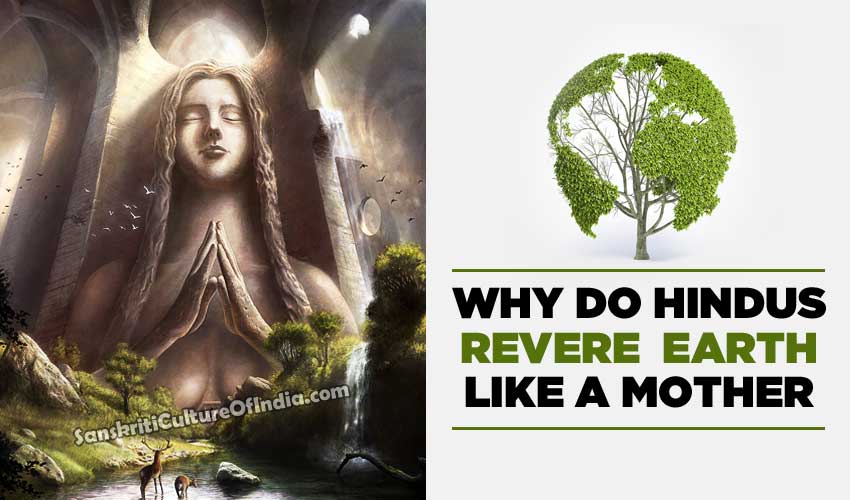
Why Do Hindus Revere Earth Like a Mother

Mata Bhumih Putroham Prithivyah, Earth is my mother, I am her son

~ Atharva Veda, 12-1-12

While the mainstream Western philosophy of Nature sees Nature as mere “resources” for human consumption, the Vedic seers advocate for a caring and reciprocal attitude. They see nature-human relation as mother-child relation. The verses of the Vedas reveal deep respect towards the Earth, just as a child is ever committed to his/her mother. The mother is considered the first Guru of the child.

That the Earth ensures well-being of all of us is illustrated in the hymns addressed to Her. As the Earth is construed as mother caring for Her off-springs, the Nature is regarded as intrinsically or inherently valuable, draws respect as well.

The concept of Mother Earth advocated in the Vedas, particularly in Bhoomisukta, is unique. The Mother Earth, adorned with mountains, hills, plains, heights, slopes, forests, plants, herbs, and treasures, takes care of every creature that breathes with things that are strength-giving and nourishing. She gives shelter to all the seekers of truth, who are tolerant and have understanding. She is the source of all creativity, and we all depend upon Her for our growth and meaningful existence.

We are inseparable from Earth, our body constituting of minerals that are an integral part of everything within the environment. The food we eat, the water we drink, the clothes we wear, the very air we breathe – we are dependent on this world. Most of us don’t realize how much we are indebted to Mother Earth for every single moment of our lives.

With this thought in mind, it is customary for many Hindus to touch the ground with reverence first thing in the morning as they are stepping out of bed. This practice gives us an opportunity to convey our gratitude to Mother Earth and to God, who created this universe.

We have no choice but to walk on Earth from the time we wake up to the time we fall asleep. To show our respect and apologize for this helplessness, Vishwamitra Smriti contains the following prayers:


समुद्रवसने देवि पर्वतस्तनमण्डले ।

विष्णुपत्नि नमस्तुभ्यं पादस्पर्शं क्षमस्वमे ॥

Oh Mother Goddess, the one who is covered with oceans as her garments and mountains as her bosom
The Consort of Lord Vishnu, please forgive us for touching You with our feet.

When we revere Mother Earth, we also revere our motherland – Our Matrubhoomi, Our Janma Bhoomi, Our Karma Bhoomi.

You may also like

Search the website

Like us on Facebook

Get daily updates via Email

Enter your email address:

Recent Posts

Jamai Shashthi 2026 — The Story of Maa Shashthi, the Cat, and the Wife Who Was Forgiven

Jamai Shashthi 2026 — The Story of Maa Shashthi, the Cat, and the Wife Who Was Forgiven

On Saturday, June 20, 2026, Bengali households across Bharata will welcome their married daughters and sons-in-law home for the legendary jamai-aador feast and perform the Shashthi Vrata. But behind the warmth lies a story most Bengalis know by heart and most non-Bengalis have never heard — the wife who stole the hilsa, blamed the cat, lost six sons to Maa Shashthi’s wrath, and was finally forgiven. The Vrat Katha, the vidhi, the mantras, and the deeper teaching.

Vat Purnima 2026 — The Wife Who Argued Yama Into Returning Her Husband’s Life

On Monday, June 29, 2026, women across Maharashtra, Gujarat, and southern Bharata will tie red thread around banyan trees and hear the story of Savitri — the wife who walked behind Yamaraja Himself when He came for her husband, and out-argued the Lord of Dharma into returning Satyavan’s life. The Mahabharata’s Pativrata Mahatmya Parva, the vrat vidhi, and why the banyan witnessed everything.

Purushottam Maas — The Month No Deity Would Claim, and the Lord Who Made It Supreme

Every month of the Hindu calendar has a lord — except the rare thirteenth, the Adhika Maas, born an orphan and shunned as the “impure month.” The Puranas tell how this rejected month went in grief to Bhagavan Vishnu, who claimed it, gave it His own name — Purushottam — and made it the most fruitful month of all. The origin story, the teaching, and what it means for Purushottam Maas 2026 (May 17 – June 14).

Padmini Ekadashi 2026 — The Ekadashi Even the Devas Descend to Keep

Padmini Ekadashi 2026 — The Ekadashi Even the Devas Descend to Keep

The rarest Ekadashi of the entire Hindu calendar is three days away. The Padma Purana preserves a conversation between Bhagavan Krishna and Yudhishthira about a single Ekadashi the great Rishis spend lifetimes waiting for — Padmini. The Vrat Katha of Queen Padmini of Mahishmati, the lotus teaching, and why May 27, 2026 is the morning Vaishnavas across Bharata are preparing for.

Varada Chaturthi 2026 — The Rare Ganesha Day of Purushottam Maas

Varada Chaturthi 2026 — The Rare Ganesha Day of Purushottam Maas

Once every 2.5–3 years — when the rare 13th month of Adhika Maas opens — a thirteenth Vinayaka Chaturthi appears. The Mudgala Purana calls it Varada Chaturthi, the “boon-giving” Chaturthi, and holds it as the most fruit-bearing Ganesha day of the entire calendar. Today, Wednesday May 20, 2026, is that day.

css.php