IndianSanskriti

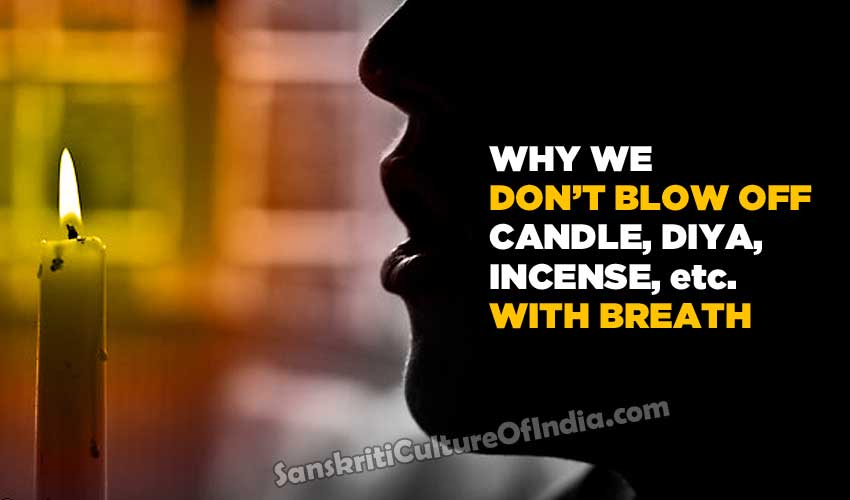
Why We Don’t Blow Off Candles, Diya, Incense

Fire is the essence of all existence. Fire is the builder, the preserver and the destroyer. Nothing can exist without fire, it is the very basis of life, from the smallest atom to the fire of cosmos, from purifying to consuming all.

Agni is the Vedic God residing in fire and is mentioned more times in the Vedic hymns than any other deities. He relates to consciousness or awareness, the carrier of the Divine spark, where there is Spirit, there is Agni and is therefore worshiped as the omniscient God.

Agni is the connection between the devotee and the deity, conveying offerings through fire. In ancient times, fire not only provided heat for cooking, warmth and light but also supplied people with their emotional and spiritual connection.

It is of no surprise then that fire plays an important role in the Hindu tradition and is incorporated in almost all rituals and practices. From lighting a diya for prayers to deities, to marriage to the finality of cremation, fire is a constant companion of a Hindu.

Fire is an aspect of the Divine and it is with this in mind, our ancestors refrained us from blowing out a candle or a fire with our breath. We may have heard several reasons on why we should not do so by our parents and grandparents.

The smallest spark of fire represents Agni, the fire God and to blow it out with our breath would be considered impolite and disrespectful to the very basis of connection between us and the Divine.

It is with this reason alone that Hindus extinguish fire either with their hands or using a candle snuffer instead.

You may also like

Search the website

Like us on Facebook

Get daily updates via Email

Enter your email address:

Recent Posts

Jamai Shashthi 2026 — The Story of Maa Shashthi, the Cat, and the Wife Who Was Forgiven

Jamai Shashthi 2026 — The Story of Maa Shashthi, the Cat, and the Wife Who Was Forgiven

On Saturday, June 20, 2026, Bengali households across Bharata will welcome their married daughters and sons-in-law home for the legendary jamai-aador feast and perform the Shashthi Vrata. But behind the warmth lies a story most Bengalis know by heart and most non-Bengalis have never heard — the wife who stole the hilsa, blamed the cat, lost six sons to Maa Shashthi’s wrath, and was finally forgiven. The Vrat Katha, the vidhi, the mantras, and the deeper teaching.

Vat Purnima 2026 — The Wife Who Argued Yama Into Returning Her Husband’s Life

On Monday, June 29, 2026, women across Maharashtra, Gujarat, and southern Bharata will tie red thread around banyan trees and hear the story of Savitri — the wife who walked behind Yamaraja Himself when He came for her husband, and out-argued the Lord of Dharma into returning Satyavan’s life. The Mahabharata’s Pativrata Mahatmya Parva, the vrat vidhi, and why the banyan witnessed everything.

Purushottam Maas — The Month No Deity Would Claim, and the Lord Who Made It Supreme

Every month of the Hindu calendar has a lord — except the rare thirteenth, the Adhika Maas, born an orphan and shunned as the “impure month.” The Puranas tell how this rejected month went in grief to Bhagavan Vishnu, who claimed it, gave it His own name — Purushottam — and made it the most fruitful month of all. The origin story, the teaching, and what it means for Purushottam Maas 2026 (May 17 – June 14).

Padmini Ekadashi 2026 — The Ekadashi Even the Devas Descend to Keep

Padmini Ekadashi 2026 — The Ekadashi Even the Devas Descend to Keep

The rarest Ekadashi of the entire Hindu calendar is three days away. The Padma Purana preserves a conversation between Bhagavan Krishna and Yudhishthira about a single Ekadashi the great Rishis spend lifetimes waiting for — Padmini. The Vrat Katha of Queen Padmini of Mahishmati, the lotus teaching, and why May 27, 2026 is the morning Vaishnavas across Bharata are preparing for.

Varada Chaturthi 2026 — The Rare Ganesha Day of Purushottam Maas

Varada Chaturthi 2026 — The Rare Ganesha Day of Purushottam Maas

Once every 2.5–3 years — when the rare 13th month of Adhika Maas opens — a thirteenth Vinayaka Chaturthi appears. The Mudgala Purana calls it Varada Chaturthi, the “boon-giving” Chaturthi, and holds it as the most fruit-bearing Ganesha day of the entire calendar. Today, Wednesday May 20, 2026, is that day.

css.php