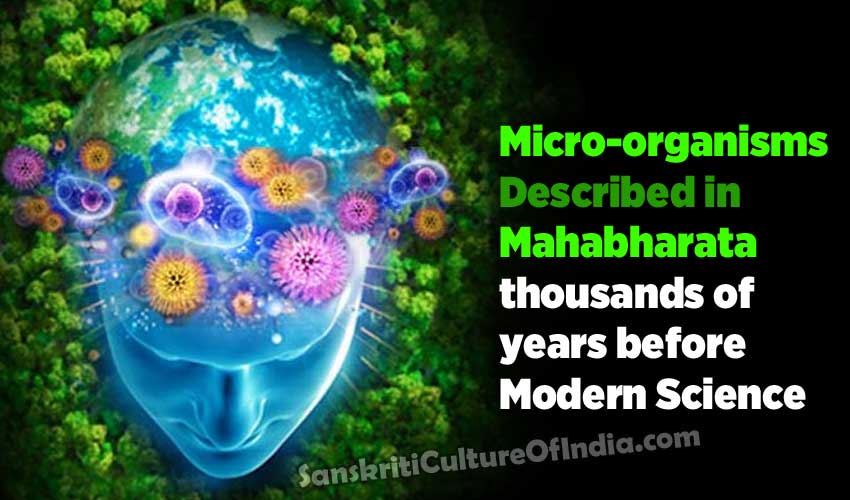
Scientists found the existence of bacteria in the 17th century AD but these have been known as micro-organisms that were invisible to the naked eye with a life span of the blink of an eyelid in Hinduism.
Descriptions of various micro-organisms have been given in Mahabharata. In Santi Parva, Section XV, Arjuna talks about the nature of this world and the strongest species killing the weakest for its survival:
I do not behold the creature in this world that supports life without doing any act of injury to others. Animals live upon animals, the stronger upon the weaker. The mongoose devours mice; the cat devours the mongoose; the dog devours the cat; the dog again is devoured by the spotted leopard. Behold all things again are devoured by the Destroyer when he comes! This mobile and immobile universe is food for living creatures. This has, been ordained by the gods. The man of knowledge, therefore, is never stupefied at it. It behoveth thee, O great king, to become that which thou art by birth. Foolish alone, restraining wrath and joy take refuge in the woods. The very ascetics cannot support their lives without killing creatures. In water, on earth, and fruits, there are innumerable creatures. It is not true that one does not slaughter them. What higher duty is there than supporting one’s life?
He even talks about how gods are given powers to destroy, punish people in this world and ahimsa (non-violence) is not for everyone, especially for the kings, kshatriyas or the rulers.
सूक्ष्मयॊनीनि भूतानि तर्क गम्यानि कानि चित
पक्ष्मणॊ ऽपि निपातेन येषां सयात सकन्धपर्ययः
There are many creatures that are so minute that their existence can only be inferred. With the falling of the the eyelids alone, they are destroyed.