What are the criteria for ensuring success in life? Is it access to elaborate material goods or something else? Lord Rama answers these questions.
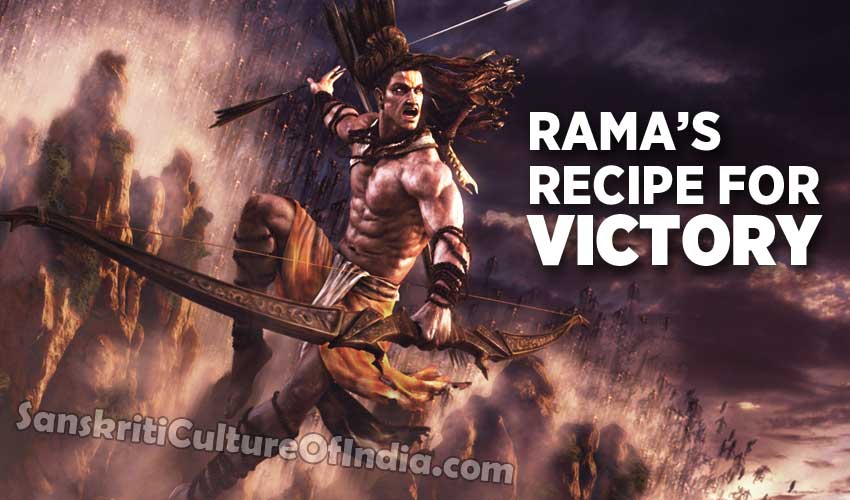
In Tulsidasa’s Ramcharitamanas, Vibhishana, the brother of Ravana, is seized with doubt when he sees Ravana enter the battlefield in a splendid chariot. Ravana is in full battle gear and his vehicle is loaded with advanced weapons. Rama, in contrast, is barefoot and has only his bow and arrows. He is dressed in simple clothes.
Whereas Ravana is fully protected by armour, Rama has no such protection, Ravana’s army is well equipped, with caparisoned elephants, horses, chariots, and trained soldiers with war experience. Rama’s army comprises mostly of monkeys and bears who are neither trained in warfare nor armed with sophisticated weapons. They only have their claws, teeth, boulders, rocks, and trees improvised as weapons.
On seeing the stark contrast between the two, Vibhishana wonders if Rama can ever be victorious. He expresses his concern to Rama thus: “You are without proper war gear; what to talk of a chariot, you do not have even a shield. Devoid of them how shall you conquer Ravana?”
Rama replies that victory is assured not by worldly chariots and armaments made of gross components, but by inputs of a different kind. The chances of winning a battle against evil forces is greater with valour and fortitude, the two ‘wheels’ of the chariot. Truthfulness and good and righteous conduct are the banners. Strength, discretion, control of one’s five senses and mind, and munificence are the four horses. Compassion, forgiveness, and equanimity are the ropes that connect the horses with the chariot.
Devotion to God is what drives the chariot that wins. As far as weapons are concerned, detachment acts as shield, and contentment serves as sword. Charity is the axe, wisdom and reason are lances, pikes and spears, and deep knowledge is the bow. An irreproachable and unwavering mind is like the arrow’s case. Shama or non-infatuation, continence, abstinence and restraint — yamas like ahimsa and pratyahar — and various niyamas or religious and moral observations are the arrows. Devotion to one’s teacher and the learned person is the armour, protective cover like armlets, breastplate, gauntlet, helmet, shell, shield and amulet.
These, according to Rama, are the ingredients of victory. One who has all of these is assured of victory. In fact, such a one has no enemies to be won over. For he has overcome the greatest enemy of all, that is, attachment to worldly things.
Our life is a perennial battle for existence. In the battle for survival, we lose sight of our compassionate nature and become cruel and covetous. We lose sight of right and wrong. Like Ravana we become obstinate, haughty, proud, and arrogant. As a result we become selfish and egotitic and are filled with ahamkara or ego which leads us to downfall and failure.
Using the allegory of a chariot, Rama is explaining the most efficacious method of keeping ego at bay. The one who, after knowing all the pros and cons of issues he is faced with, is able to manage life’s challenges with fortitude, with a detached, serene and firm mind – to him will come success as he does not act impulsively.
Success achieved by using the above ingredients is everlasting and makes one famous whereas ‘success’ attained by dubious means is shortlived and may only bring notoriety and failure.
~ Ashok Vohra, Professor at Delhi University