When we use words like feminism, patriarchy, religion and mythology, even god, or goddess, we need to constantly remind ourselves that these words originated in western universities, and more often than not, convey ideas based on western contexts. They are not always universal.
For example, in the west, there was active suppression of goddess worship: Isis, Ishtar, Cybele, were all wiped out along with other male deities to make room for a single, all-powerful male God. Mesopotamian epics like Enuma Elish where the female chaos Tiamat is defeated by the male hero Marduk makes this explicit. Greek mythology that tells the story of how Zeus seduced nymphs is interpreted as an indicator of the cult of the powerful male-god overpowering the cult of many mother-goddesses. Judaic scholars spoke Shakina, the grace of God in feminine terms, but this was never ever actually given form as goddess. The worship of Mary, mother of God, was an attempt to include goddess worship in some form within the Christian fold, but Protestants rejected this when they threw out all things associated with the Church and Pope.
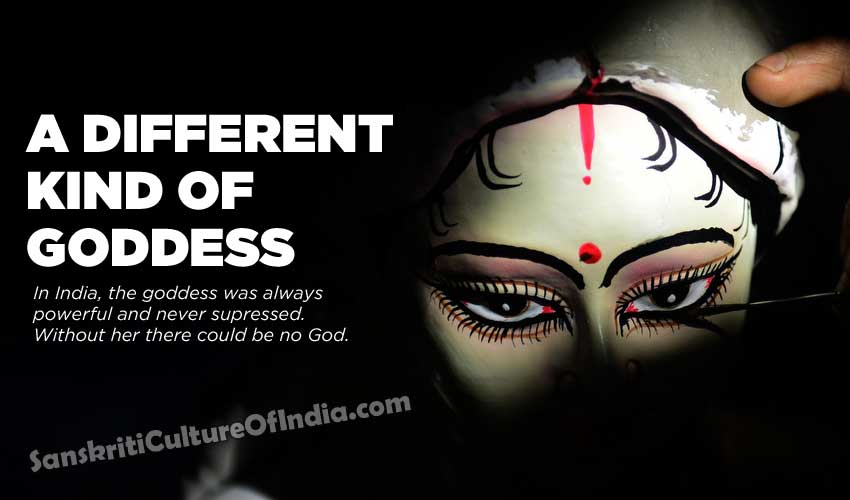
Such suppression never happened in India. In India, the goddess was always powerful. Without her there could be no God. And even God was not a single entity, visualized variously as Shiva and Vishnu.
Of course, there will be someone who will argue, if Indians have always worshiped goddesses, then why does the status of women leave much to be desired in India? This attempt to link goddess worship with status of women stems from an assumption that goddess represents womanhood in mythology. Yes, it may be so in western mythology, where the literal was always valued more than the symbolic: thus stories of Eve and Pandora are used to justify and explain suppression of women. But Hindu mythology thrives on the symbolic: the nymph of the puranas feared by the sage embodies worldly pleasures, not woman. It is very easy to confuse form (female) with thought (matter).
Nowadays when religious and secular forces use the word ‘God’, they are inadvertently referring to God of western traditions, more specifically Judeo-Christian-Islamic traditions, who is highly gendered, visualized in male form (as in the Sistine).
The Hindu idea of God was rather abstract in the pre-Buddhist period and was concretised in the post-Buddhist period. Buddha was not interested in the idea of God. He was of the opinion that ‘when one is wounded, we should focus on the doctor, not on the hunter’. But the people were interested in the idea of God. And in Hinduism, the idea of God could not be explained without the Goddess. God was the mind, the divinity within. Goddess was the world, the divinity outside.
When the mind behaves like Shiva, the hermit, and shuns all things worldly, the world around behaves like Kali and Gauri, demanding attention. When the mind behaves like Vishnu, the householder; the world around becomes like Lakshmi, Sita, Radha and Rukmini and Satyabhama, a source of joy as well as a responsibility to bear. Unfortunately, most of the time, the mind behaves like Brahma – seeking control and dominion over the world around. So the goddess turns into Shatarupa, the nymph, who cannot be captured. Brahma tries to catch her but fails. When he stops and sits and pays attention carefully, Shatarupa transforms into Saraswati, goddess of wisdom, and enables his transformation into Shiva or Vishnu.
By: Devdutt Pattanaik