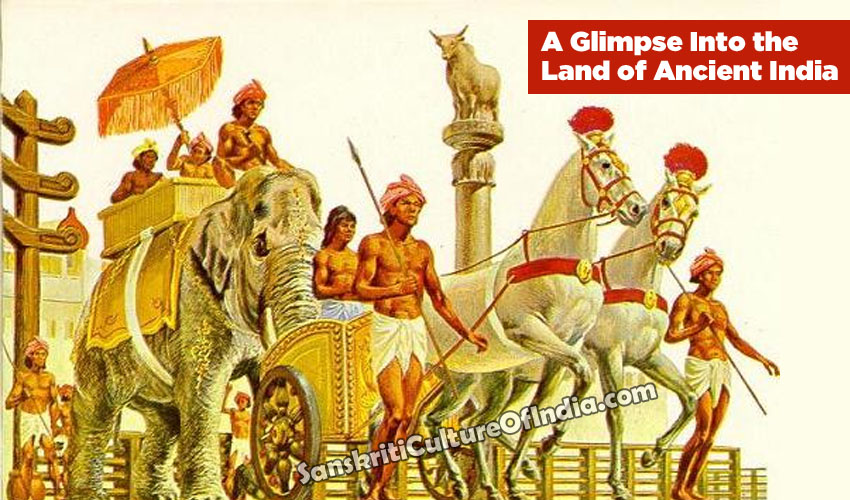
The account of India written by Megasthenes from his personal knowledge of the country is justly held to be almost invaluable for the light which it throws upon the obscurity of early Indian history. Below is a brief description of the socio-geo-political land called Indika by the Greeks.
India, which is in shape quadrilateral, has its eastern as well as its western side bounded by the great sea, but on the northern side it is divided by Mount Hemodos from that part of Skythia which is inhabited by those Skythians who are called the Sakai, while the fourth or western side is bounded by the river called the Indus, which is perhaps the largest of all rivers in the world after the Nile.
The extent of the whole country from east to west is said to be 28,000 stadia, and from north to south 32,000. Being thus of such vast extent, it seems well-nigh to embrace the whole of the northern tropic zone of the earth, and in fact at the extreme point of India the gnomon of the sundial may frequently be observed to cast no shadow, while the constellation of the Bear is by night invisible, and in the remotest parts even Arcturus disappears from view. Consistently with this, it is also stated that shadows there fall to the southward.
India has many huge mountains which abound in fruit-trees of every kind, and many vast plains of great fertility–more or less beautiful, but all alike intersected by a multitude of rivers.
The greater part of the soil, moreover, is under irrigation, and consequently bears two crops in the course of
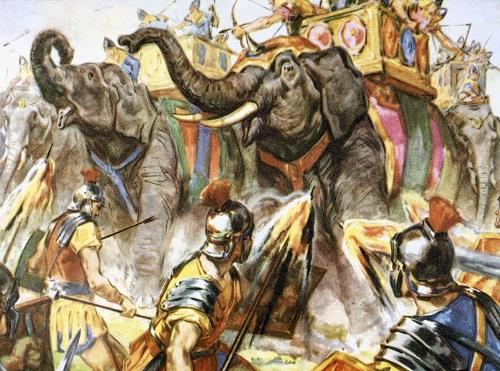
the year. It teems at the same time with animals of all sorts,– beasts of the field and fowls of the air,–of all different degrees of strength and size. It is prolific, besides, in elephants, which are of monstrous bulk, as its soil supplies food in unsparing profusion, making these animals far to exceed in strength those that are bred in Libya. It results also that, since they are caught in great numbers by the Indians and trained for war, they are of great moment in turning the scale of victory.
The inhabitants, in like manner, having abundant means of subsistence, exceed in consequence the ordinary stature, and are distinguished by their proud bearing. They are also found to be well skilled in the arts, as might be expected of men who inhale a pure air and drink the very finest water. And while the soil bears on its surface all kinds of fruits which are known to cultivation, it has also under ground numerous veins of all sorts of metals, for it contains much gold and silver, and copper and iron in no small quantity, and even tin and other metals, which are employed in making articles of use and ornament, as well as the implements and accouterments of war.
In addition to cereals, there grows throughout India much millet, which is kept well watered by the profusion of river-streams, and much pulse of different sorts, and rice also, and what is called bosporum, as well as many other plants useful for food, of which most grow spontaneously. The soil yields, moreover, not a few other edible products fit for the subsistence of animals, about which it would be tedious to write. It is accordingly affirmed that famine has never visited India, and that there has never been a general scarcity in the supply of nourishing food. For, since there is a double rainfall in the course of each year,–one in the winter season, when the sowing of wheat takes place as in other countries, and the second at the time of the summer solstice, which is the proper season for sowing rice and bosporum, as well as sesamum and millet–the inhabitants of India almost always gather in two harvests annually; and even should one of the sowings prove more or less abortive they are always sure of the other crop. The fruits, moreover, of spontaneous growth, and the esculent roots which grow in marshy places and are of varied sweetness, afford abundant sustenance for man. The fact is, almost all the plains in the country have a moisture which is alike genial, whether it is derived from the rivers, or from the rains of the summer season, which are wont to fall every year at a stated period with surprising regularity; while the great heat which prevails ripens the roots which grow in the marshes, and especially those of the tall reeds.
But, farther, there are usages observed by the Indians which contribute to prevent the occurrence of famine among them; for whereas among other nations it is usual, in the contests of war, to ravage the soil, and thus to reduce it to an uncultivated waste, among the Indians, on the contrary, by whom husbandmen are regarded as a class that is sacred and inviolable, the tillers of the soil, even when battle is raging in their neighbourhood, are undisturbed by any sense of danger, for the combatants on either side in waging the conflict make carnage of each other, but allow those engaged in husbandry to remain quite unmolested. Besides, they neither ravage an enemy’s land with fire, nor cut down its trees.
India, again, possesses many rivers both large and navigable, which, having their sources in the mountains which stretch along the northern frontier, traverse the level country, and not a few of these, after uniting with each other, fall into the river called the Ganges. Now this river, which at its source is 30 stadia broad, flows from north to south, and empties its waters into the ocean forming the eastern boundary of the Gangaridai, a nation which possesses a vast force of the largest-sized elephants. Owing to this, their country has never been conquered by any foreign king: for all other nations dread the overwhelming number and strength of these animals. [Thus Alexander the Macedonian, after conquering all Asia, did not make war upon the Gangaridai, as be did on all others; for when he had arrived with all his troops at the river Ganges, and had subdued all the other Indians, he abandoned as hopeless an invasion of the Gangaridai when he learned that they possessed four thousand elephants well trained and equipped for war.]
It is said that India, being of enormous size when taken as a whole, is peopled by races both numerous and diverse, of which not even one was originally of foreign descent, but all were evidently indigenous; and moreover that India neither received a colony from abroad, nor sent out a colony to any other nation.
The whole population of India is divided into seven castes, of which the first is formed by the collective body of the Philosophers, which in point of number is inferior to the other classes, but in point of dignity preeminent over all. For the philosophers, being exempted from all public duties, are neither the masters nor the servants of others. They are, however, engaged by private persons to offer the sacrifices due in lifetime, and to celebrate the obsequies of the dead: for they are believed to be most dear to the gods, and to be the most conversant with matters pertaining to Hades. In requital of such services they receive valuable gifts and privileges. To the people of India at large they also render great benefits, when, gathered together at the beginning of the year, they forewarn the assembled multitudes about droughts and. wet weather, and also about propitious winds, and diseases, and other topics capable of profiting-the hearers. Thus the people and the sovereign, learning beforehand what is to happen, always make adequate provision against a coming deficiency, and never fail to prepare beforehand what will help in a time of need. The philosopher who errs in his predictions incurs no other penalty than obloquy, and he then observes silence for the rest of his life.
 The second caste consists of the Husbandmen, who appear to be far more numerous than the others. Being, moreover, exempted from fighting and other public services, they devote the whole of their time to tillage; nor would an enemy coming upon a husbandman at work on his land do him any harm, for men of this class, being regarded as public benefactors, are protected from all injury. The land, thus remaining unravaged, and producing heavy crops, supplies the inhabitants with all that is requisite to make life very enjoyable. The husbandmen themselves, with their wives and children, live in the country, and entirely avoid going into town. They pay a land-tribute to the king, because all India is the property of the crown, and no private person is permitted to own land. Besides the land-tribute, they pay into the royal treasury a fourth part of the produce of the soil.
The third caste consists of the Neatherds and Shepherds and in general of all herdsmen who neither settle in towns nor in villages, but live in tents. By hunting and trapping they clear the country of noxious birds and wild beasts. As they apply themselves eagerly and assiduously to this pursuit, they free India from the pests with which it abounds,–all sorts of wild beasts, and birds which devour the seeds sown by the husbandmen.
The fourth caste consists of the Artizans. Of these some are armourers, while others make the implements which husbandmen and others find useful in their different callings. This class is not only exempted from paying taxes, but even receives maintenance from the royal exchequer.
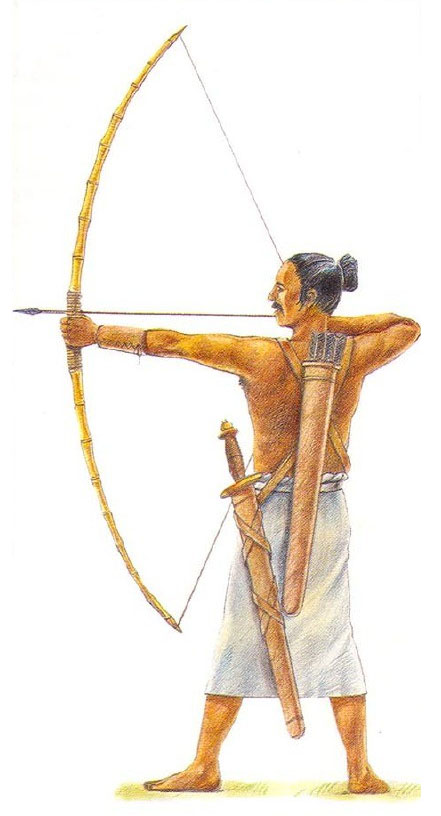
The fifth caste is the Military. It is well organized and equipped for war, holds the second place in point of numbers, and gives itself up to idleness and amusement in the times of peace. The entire force–men-at-arms, war horses, war-elephants, and all–are maintained at the king’s expense.
The sixth caste consists of the Overseers. It is their province to inquire into and superintend all that goes on in India, and make report to the king, or, where there is not a king, to the magistrates.
The seventh caste consists of the Councillors and Assessors,–of those who deliberate on public affairs. It is the smallest class, looking to number, but the most respected, on account of the high character and wisdom of its members; for from their ranks the advisers of the king are taken, and the treasurers, of the state, and the arbiters who settle disputes. The generals of the army also, and the chief magistrates, usually belong to this class.
Such, then, are about the parts into which the body politic in India is divided. No one is allowed to marry out of his own caste, or to exercise any calling or art except his own: for instance, a soldier cannot become a husbandman, or an artizan a philosopher.
Among the Indians officers are appointed even for foreigners whose duty is to see that no foreigner is wronged. Should any of them lose his health, they send physicians to attend him, and take care of him otherwise, and if he dies they bury him, and deliver over such property as he leaves to his relatives. The judges also decide cases in which foreigners are concerned, with the greatest care, and come down sharply on those who take unfair advantage of them.
~ Megasthenes, 350-290 BC