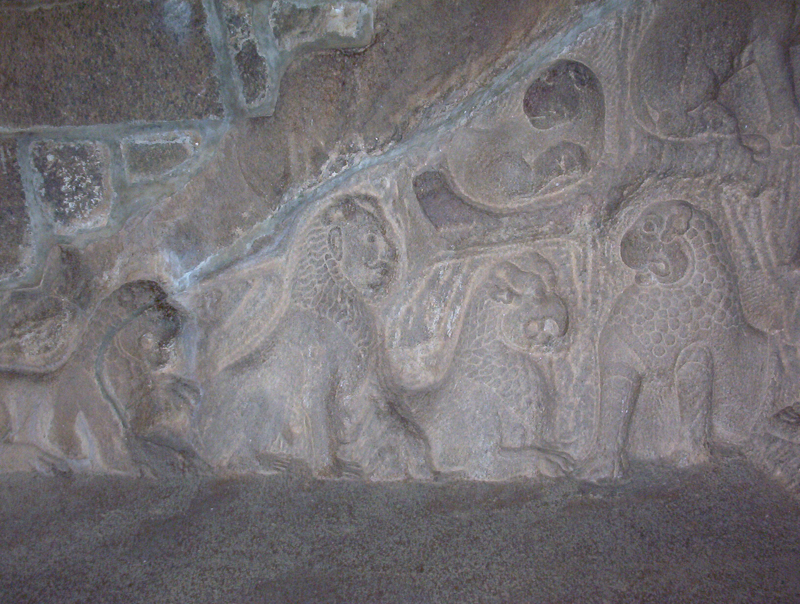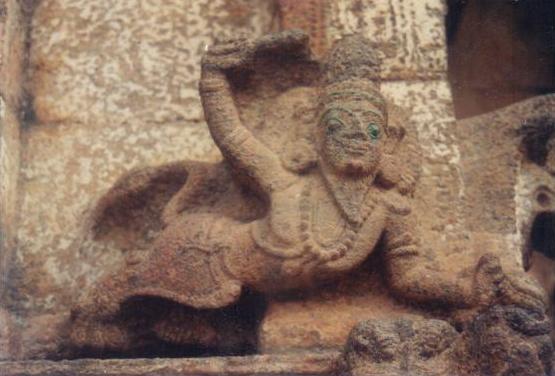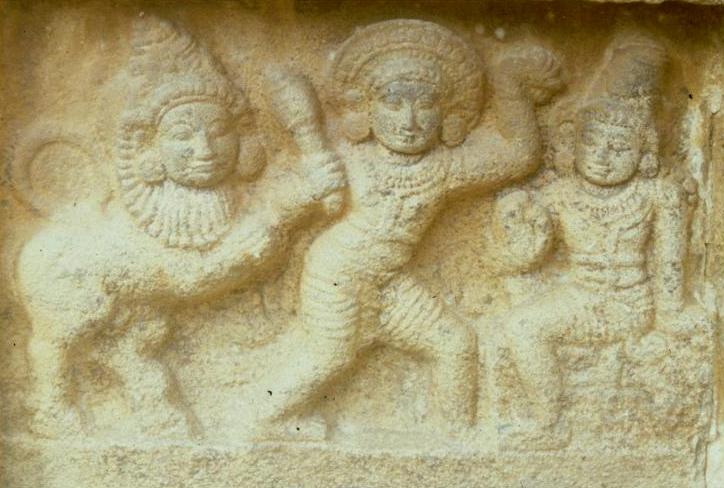
 Bhima went to the north to invite the Purushamriga to attend his brother Yudhishthira’s coronation at the Vedic Rajasuya ritual. The Purushamriga challenged Bhima. He had to run ahead of the Purushamriga so as not to disturb its devotion for Shiva. The Purushamriga would eat Bhima if he caught him. But the Purushamriga was Manovega–as fast as Manas or thought–and in spite of Bhima’s strength soon began to overtake him. Lord Krishna who had foreseen this had given Bhima twelve lingas and told him to throw one over his shoulder whenever the Purushamriga came too close. As Bhima threw linga after linga over his shoulder they turned into Shiva temples.
The Purushamriga stopped to offer worship to Shiva every time a temple appeared before him, but still he gained on Bhima. As Bhima crossed the boundaries of the kingdom with one leg the Purushamriga caught him and claimed his life. Yudhishthira gave as judgment that half of Bhima’s body belonged to the Purushamriga. Impressed with Yudhisthira’s sense of dharma, or justice, the Purushamriga gave up his claim and attended the Rajasuya.
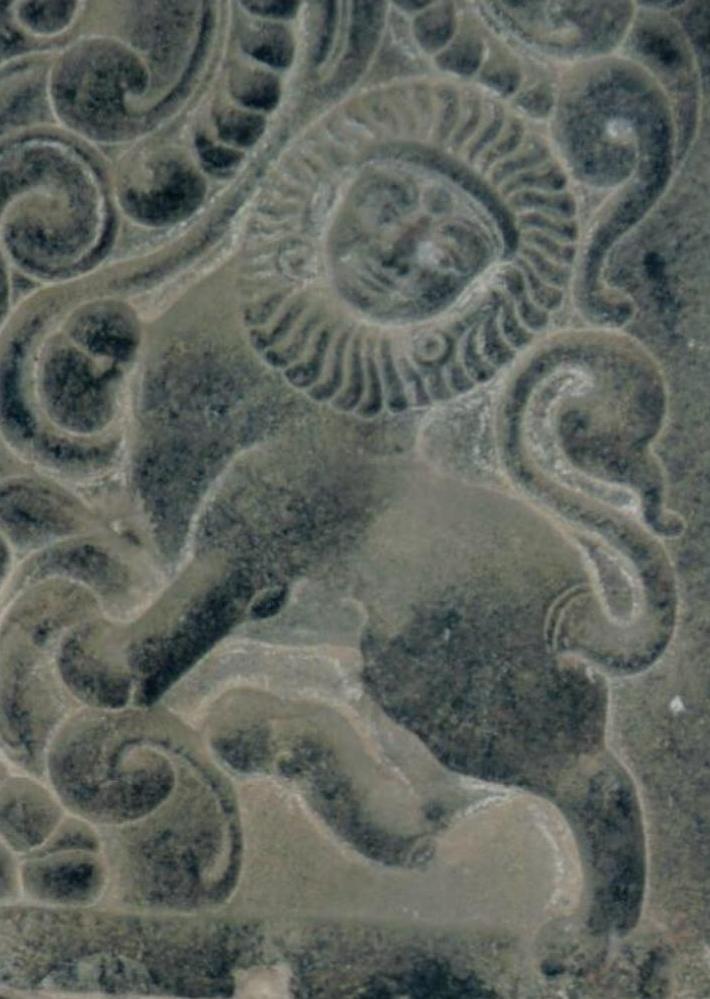
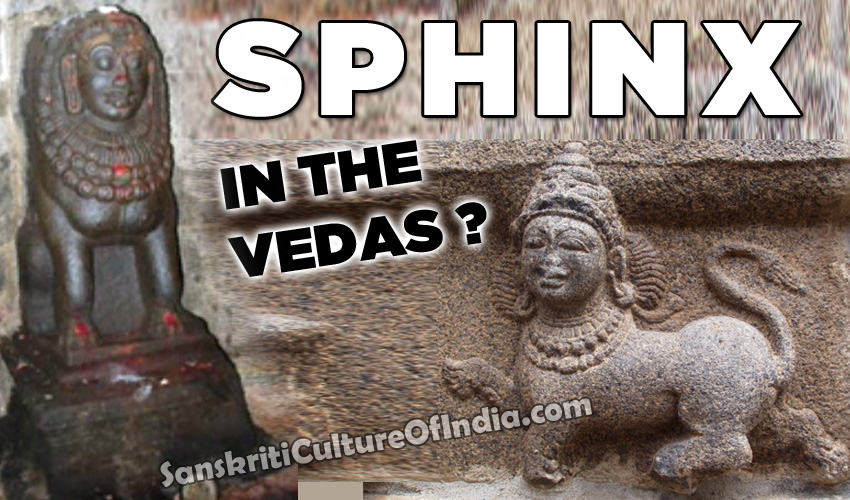
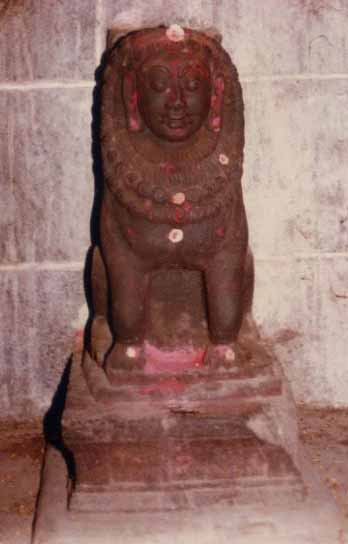
Who and what is this Purushamriga Manovega, the humanbeast as fast as thought? It/he is a rishi and yogi with a strong devotion for Shiva. After guarding the Rajasuya Yajña it asked Lord Krishna what it should do. It was advised to go to Chidambaram where Shiva would come to perform His Cosmic Dance on earth. There, on a raised platform adjacent to the grand doorway, it guards the entrance of the temple still today. It takes away the negative energy from the devotees as they descend the twenty-one steps towards the Hall of Consciousness. With a mysterious smile on its lips and curling mane surrounding its face it is part human, part lion. Its name means human beast in Sanskrit. It is also known as sphinx, Indian sphinx.
 How mysterious and how enigmatic it is. And how fascinating. From the yogic point of view the sphinx is a symbol of evolution and devolution in human existence. As our soul is on a quest towards higher realization, it is also always in danger of sliding back towards the nature of the animal. At the same time the thrust of evolution motivates the animal to aspire towards a higher form of being. Visually this process can be depicted as a Möbius strip. In the Möbius strip we see a continuous one-dimensional plane conveying the continuous and never ending evolution and devolution of the cosmos. When we draw a line in the centre of the strip it will eventually reach its own beginning.
In the sphinx evolution and devolution meet one another, like the straight line in the Möbius strip folds back to its own beginning, generating an infinite chain of being. The animal aspires to elevate its essence towards higher consciousness and attainment. The human being receives the strength and courage of animal nature. The lion represents symbolically the king of all animals, sovereignty and strength. The human being symbolizes consciousness, self realization and wisdom.
The animal aspires towards consciousness and self realization. The human being is always in danger of sliding back towards animal nature. But when they come together with the body of a lion and the head of a human, both rise above their own limitations and become a being which is greater then the sum of its parts, an image and symbol of realization, wisdom and strength–the sphinx. In India the sphinx is also called Manovega, fast as thought.
In Indian art and culture the existence and presence of the sphinx as a mythological being has so far gone unnoticed and unrecognized. But through many years of research I have found that the sphinx plays a significant role in the arts and traditions of many temples in India. And not only in the art, but also in ritual and legend.
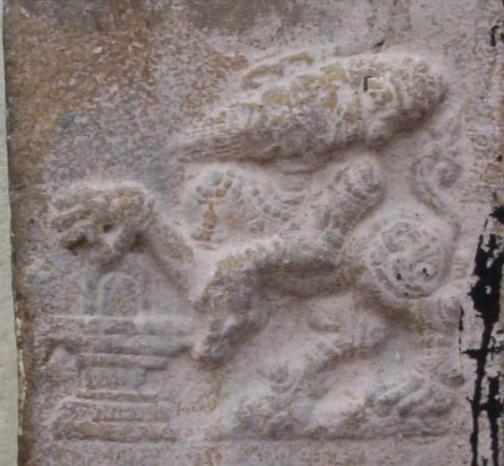
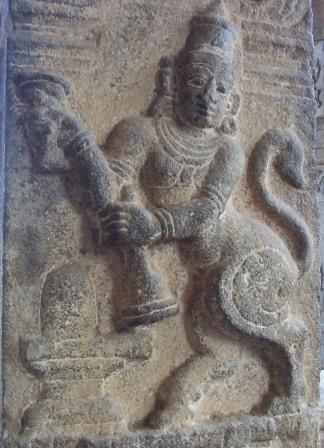
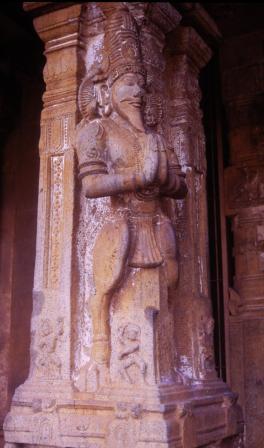
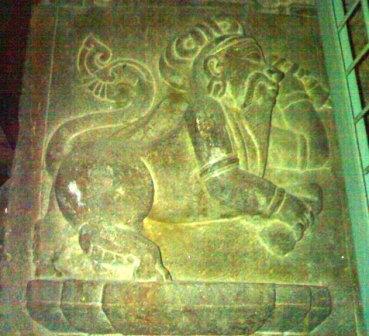 In South India, in Tamil Nadu, we find sculptures of the Purushamriga situated in ritually significant places in many temples. Not all the Purushamriga look exactly like the sphinx of Western antiquity. In South Indian art we find mainly two types. The type mostly resembling the classical image of a sphinx is that which has a full lion’s body with a human face. Some, especially sculptures from more recent centuries, are lions from the waist down, and fully human from the waist up. Some are depicted as rishis or seers, having a beard and with their hair knotted on the top of their heads. They may be worshipping a Shiva Linga with a bell and lamp. Some are virulent warriors, brandishing a club or a sword. A beautiful pair of Purushamriga stand to welcome the visitors to the mandapa in front of the Subrahmania shrine in the Brihadishvara temple in Tanjore, their hands folded in the anjalimudra of greeting. They are standing as tall as a man. Two pairs of small crouching sphinxes are positioned in the gopuram of the Sarangapani temple in Kumbakonam. And depictions of the legend of Bhima and the Purushamriga are decorating the temples in Darasuram, Tribhuvanam, and Tiruvannamalai. The Indian sphinx is also found in a few Vishnu temples.
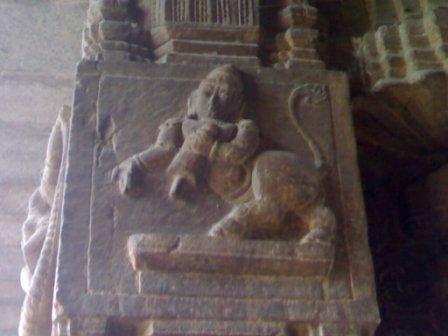 Not only are these sphinxes importantin art. They also play a role in all Shaiva temple ritual. Among the lamps offered during the ceremony of the sixteen upacaras, one is the purushamriga lamp. While presenting the lamp the priest chants a verse from the Krishna Yajurveda. And a few temples even have a Purushamriga as the vahana or vehicle of the deity in the processions of the temple festival.
But the presence of sphinxes in temples is not limited to Tamil Nadu. My research has discovered this mythological being is represented in the art of other parts of India as well. The earliest examples can be found among Buddhist and Jain art from the time of the beginning of the common era, from Sanci, Mathura, and Kausambi. But also from Jain caves in Orissa. In medieval Orissan art we find beings called Naravirala. Beautiful and ferocious, they too are half lion, half human. They appear among the friezes of the Surya temple in Konarak and in many other places as well. Other examples are found in Hampi, Srisailam, Northern Karnataka, and on the brick temples of Bengal. They are called Nara-simha in the art of Sri Lanka, Birma and Thailand.
 The developments of history have conspired to make us believe all ancient traditions are superstition and ancient monuments are only empty buildings. Their meaning has been almost lost. When one thinks of ancient Egypt, the mind remembers the Great Sphinx of Gizeh and the pyramids–its great knowledge largely ignored. Through grace and its resilience in the face of foreign invasions, the Vedic tradition lives on as an unbroken oral tradition. The existing tradition of the Veda and of the temple of Nataraja in Chidambaram can give a new voice to the monuments left to us by the ancients. They can be made to speak again after being silent for so many centuries.
The call of the sphinx, from the temple of the Dancing Shiva in Chidambaram in southern India, reaches out to the world. All can come and meet eye to eye with the sphinx, participate in the living tradition of the temple and be cleansed of all negative energy. The Indian sphinx will direct our consciousness towards the peace and oneness we seek. And it will guide our quest for the reclaiming of the knowledge and wisdom of our ancestors.
~ Raja Deekshithar, MA. Trustee, Shri Sabhanayaka Temple, Chidambaram