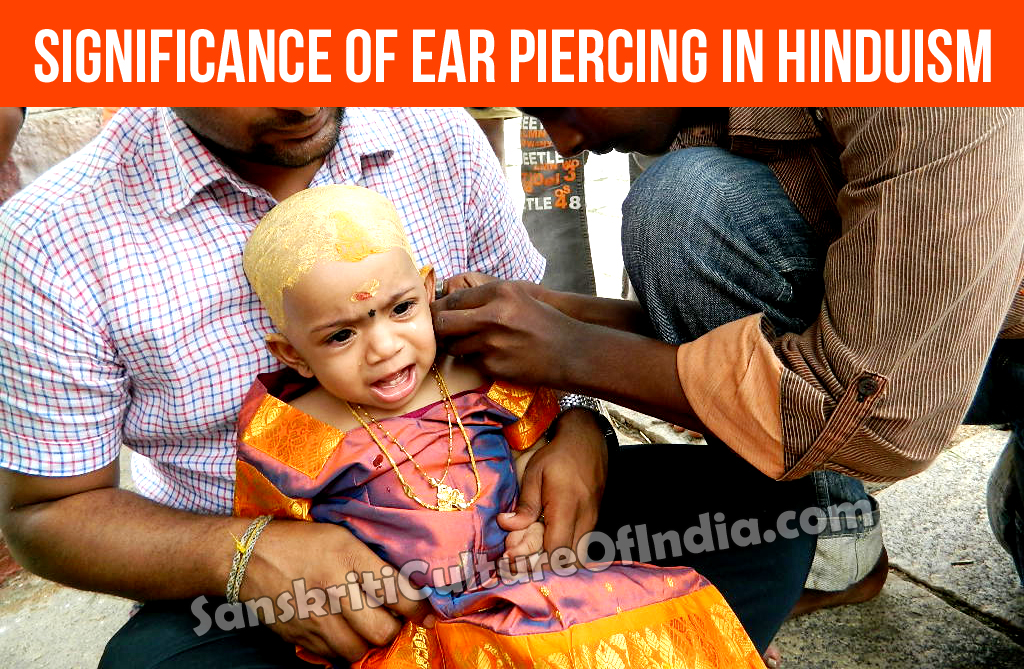
Ear lobe piercing, known as Karnvedh Sanskar, is considered an important ceremony in many Hindu traditions. There is no unanimity regarding the year to perform ear piercing on a Hindu girl child. It is usually performed during the sixth month or seventh month or third year or fifth year or 7th year after birth. An auspicious day and auspicious time is chosen for performing the ear piercing ceremony. Special pujas and prayer is done and the ceremony is done under sunlight. Earrings are then offered to the child.
According Hindu scriptures like Dharma Sindhu, Karna Vedha Sanksar must be performed on the 10th, 12th or 16th day after birth of the child. But most people avoid this calculation. They perform it during the 6th or 7th month after birth.
After this, the ritual is performed on odd years after the birth of the child – 3rd or 5th year. The ritual is not performed during even years after the birth of the child.
The ear piecing ceremony is a ritual performed by all Hindus, irrespective of caste and gender. For girl child the first ear pierced is the left ear. Earlier the ritual was also performed on the male child in many Hindu communities. This tradition is even now continued by many communities. For male child the first ear pierced is the right ear.
There are also several beliefs regarding the benefits of ear piercing. It is believed that ear piercing helps in maintaining the regularity in the menstrual cycle of a girl. It is also believed to help in getting rid of hysteria and other diseases. The earrings are believed to help in maintaining the flow of electric current in a human body.
The ear piercing in some regions is performed by the Goldsmith and he uses gold needles to pierce the earlobe. Gold never rusts and this is the reason for using gold needles.
Today, many people also perform the ear piercing under the guidance of a doctor
Nose stud or ring is worn by both married and unmarried Hindu women. The significance of the nose stud varies from region to region. As in several other rituals, there is no written code in Hinduism regarding the wearing of nose ring or nose piercing. In certain Hindu sects, a nose ring is referred as ‘Nath’ is worn during marriage and is a symbol of married woman. There are several communities in Hindu religion which does not perform nose piercing.
Nose piercing is the piercing of the skin or cartilage which forms any part of the nose, normally for the purpose of wearing jewelry; among the different varieties of nose piercings, the nostril piercing is the most common. Nose piercing is one of the most common varieties of piercing after earlobe piercing
Nostril piercing is a body piercing practice often associated with India and Nepal. In India the outside of the left is the preferred position of the piercing as this is supposed to make childbirth easier. This is because Ayurvedic medicine associates this location with the female reproductive organs. In India piercings were regarded as a mark of beauty and social standing as well as a Hindu’s honor to Parvathi the goddess of marriage in the 16th century. Nose piercing is still popular in India
Nowadays, some Hindu women see nose stud as part of modern day trendy fashion jewelry. Some are also fighting against wearing of nose rings which act as an impediment in their daily activities.
~ Abhilash Rajendran