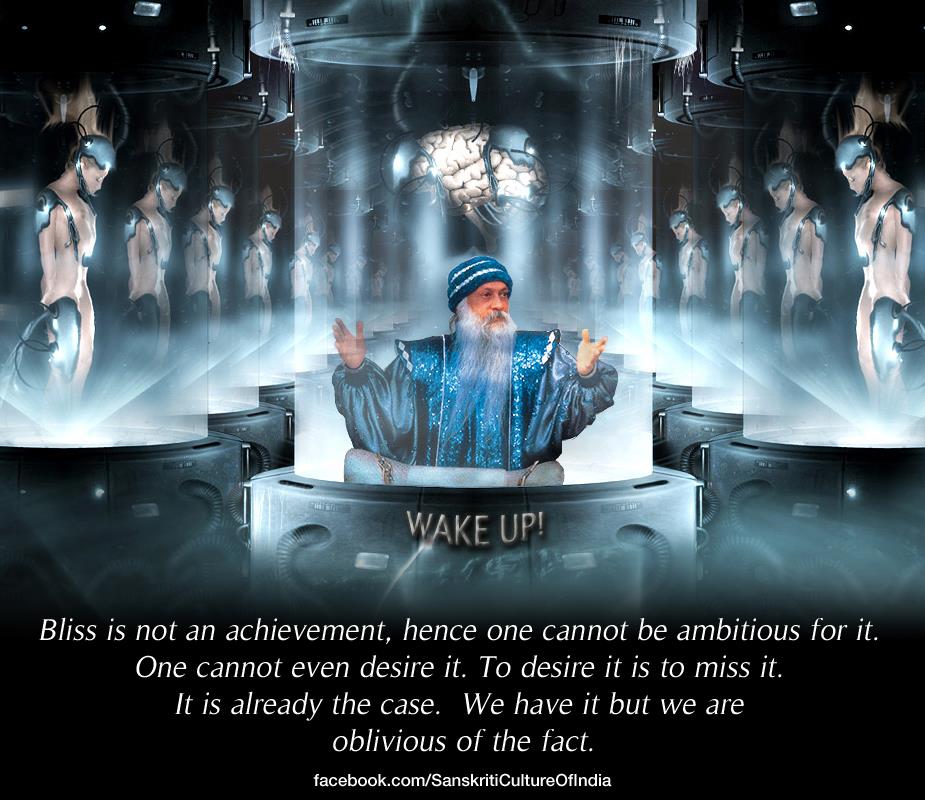
Bliss is not an achievement, hence one cannot be ambitious for it. One cannot even desire it. To desire it is to miss it. It is already the case. We have it but we are oblivious of the fact.
It is like a king who has fallen asleep and is dreaming that he has become a beggar and now is very worried about how to regain the kingdom, what to do, where to find the army, how to plan… there is no money, it seems almost impossible… and he does not want to remain a beggar either. He tosses and turns in his sleep but in the morning he wakes up and laughs at the whole dream. While he was dreaming that he was a beggar he was still the king. The dream cannot destroy the real. It can cover it, it can create a kind of fog around it, but it cannot destroy it.
That is our situation. Our nature is bliss, but we have fallen asleep, we are unconscious. We are dreaming a thousand and one things and we are desiring, planning how to attain things, how to be happy, how to be blissful. There is no question of how; no how is needed. You are already it. All that is needed is a little tossing and turning in your sleep so that you can wake up. A little effort to wake up is needed. Just remember it. Even remembrance takes one a long way.
That’s the whole function of a master: to create a certain undercurrent in you which can help you to wake up. So all kinds of devices are used. To give you a name is also a device. To give it a meaning is a device so that it becomes an undercurrent in you. Whenever anybody calls you with that spiritual name, something inside you will stir the memory that ‘Bliss is my nature,’ that ‘I have not to seek it anywhere else,’ that ‘I have not to seek it at all,’ that ‘I have only to wake up.’
And this constant hammering can break the fog that surrounds us. It is only a fog. It is not very solid, it is not very substantial — a very shadowy phenomenon. If one really intends to wake up, pulls oneself together, and gives a good shout, one will wake up.
— OSHO