~ Dharamkriti Kumar
After neglecting this topic for around 1 year I am writing on it as many of so-called intellectuals are again trying to open the graves of closed discussion after some of the recent activity in some parts of mother India.
The discussion is around a word which was not heard by many folks few months or year back .The golden word which I am talking about is “Intolerance” :.
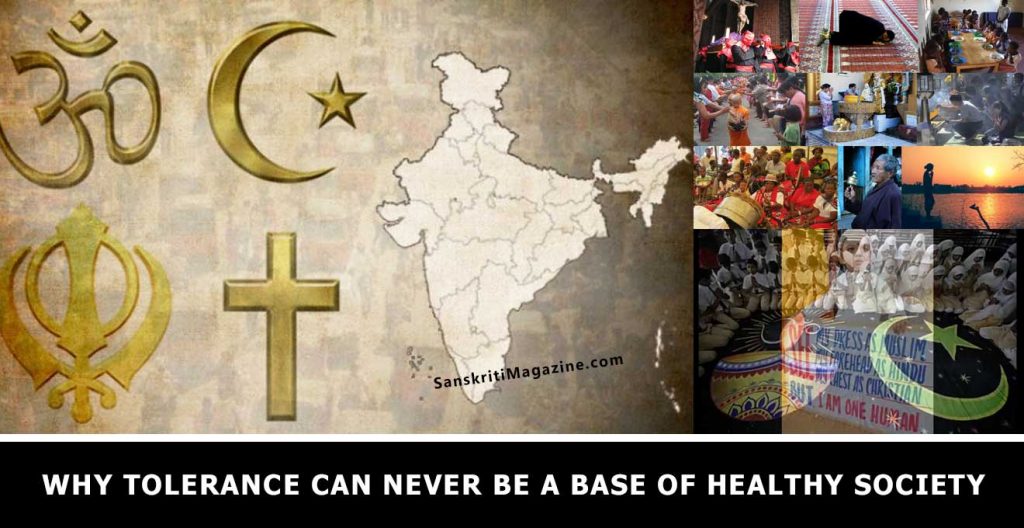
To all readers i will firstly hear mention that Indian society was never based on principal of tolerance.
To explain further the Oxford dictionary meaning of tolerance is “the ability to tolerate the existence of opinion or behavior which one dislikes or hates”
So in simple meaning it can be said tolerance is nothing but living with the thing which one dislikes or hates.
With reference to this one can say religious tolerance is living with religions which one dislikes or hates but why to dislike or hate someone’s religion at first place to tolerate in second.
Can this type of tolerance make a good society. The answer is – never, because you can live with a thing you dislike or hate, tolerating it only till a certain level after which conflict will arise which will never make a good and healthy and peaceful society.
Now let to explain further I will give some practical situation what tolerance means and why it will never end up making a good society.
Assume two person A and person B are neighbors , one person keeps his house clean all the time whereas second is by habit dirty who keeps his house unclean and also, throws his garbage in the house of Person A . Person A always keeps on cleaning garbage thrown by B in his house. When he complaint to Person B there is no change in the latter’s behavior. So after sometimes Person A stops complaining and cleans the garbage thrown without any reactions this is the concept of tolerance. Which will have a limit after sometime the person will get annoyed and may become violent for B which will be called intolerance? Now let be a case where Even if person A remains silent as he was and keeps cleaning his house, but then person C comes to his house and he get annoyed by person A then also conflict will arises and peace between both houses will be hampered .Same will happen to a society, country which functions on principal of tolerance , as tolerance has a limit and for sure the limit will be breached at a point of time .
Now a question will arise then how will a long lasting friendly society will be created.
The answer is simple a society based on principal of mutual respect will only flourish. So, what i mean by mutual-respect. Consider the previous case of person A and person B if there is no tolerance but mutual respect then irrespective of how much unclean person B is he will make sure that his uncleanness will not affect his neighbours in that case they will live as a friends and even if when person C gives visit to person A house he will be introduced to person A by person B and they too will become friends and that will be an ideal society in which all will live peacefully.
Indian society is based on Mutual respect from very beginning. “ ganga-jamuni tehjeeb “ means respecting each other’s beliefs and not tolerating each other . One should not be liable to follow others religion but should respect so that a peaceful society can be formed and this is a mutual process if its done by one end only then it will become tolerance .
PS: I am not justifying the events which has lead to this debate but i am writing just to put up my view on whole debate itself.