IndianSanskriti
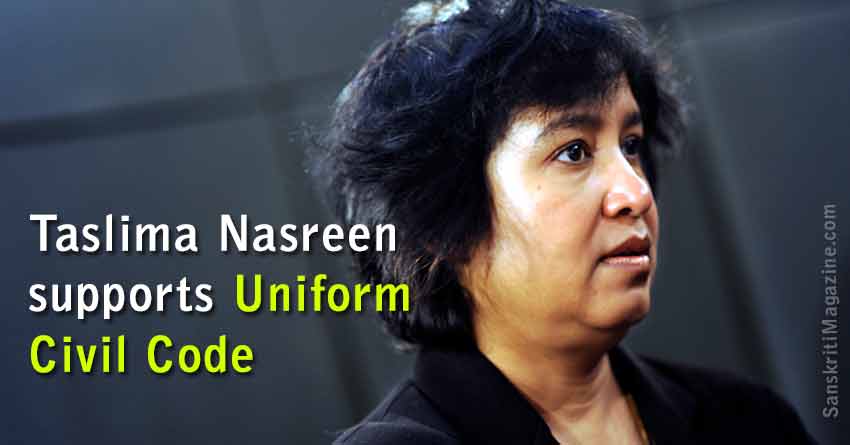
Taslima Nasreen supports Uniform Civil Code

Taslima Nasreen supports Uniform Civil Code

NEW DELHI: Bangladeshi author Taslima Nasreen has batted for adopting a uniform civil code based on equality, asserting that it was imperative to do away with religious laws in order to achieve gender parity.

She also said that a country created on the basis of religion is likely to become a fundamentalist country and that “religion is not compatible with democracy and human rights”, while adding that the Bangladesh Liberation War had proved that two-nation theory was “wrong”.

The 53-year-old author, who has written extensively on oppression of women, said that both Hindu and Muslim women were being discriminated against due to archaic religious laws.

“In South Asia, countries like India, Bangladesh and Pakistan have laws based on religion. If you have laws based on religion, then women would not have equality. We should have uniform civil code based on equality because all religions are against women,” she said.

The author, living in self-exile in India after incurring the wrath of fundamentalists back home over a novel written by her in 1994, was speaking at a panel discussion at the ‘Penguin Spring Fever’ held here late last evening.

Nasreen pointed out that Hindu women in India did get the right to equal inheritance of their father’s property as their brothers and were empowered with equal rights in marriage, but in countries like Pakistan and Bangladesh, Hindus still follow “the archaic laws of the shastras and the discrimination against women continues”.

In a similar way, she said Muslim women in India are denied equality as they abide by religious laws which, she alleged, “discriminate against women”.

The author said that while there was no model country for women, Sweden, according to her, “is a country where women get most equality.” It was imperative for countries to do away with religious laws in order to achieve gender parity, she said.

“If you create a country on the basis of religion, that country, most likely, would become a fundamentalist country. Religion is not compatible with human rights, women’s rights freedom of expression and democracy,” she said.

Former Indian foreign service officer TCA Raghavan, former Union minister Shashi Tharoor, former Pakistani diplomat Husain Haqqani, who joined via video-conferencing, and former Delhi Police commissioner Neeraj Kumar were also in the panel.

She went on to say that the Bangladesh Liberation War of 1971 proved that the phenomenon of “Muslim unity is a myth” and that “two-nation theory was a wrong theory.” She asserted that “no country should be created on the basis of religion”.
You may also like

Search the website

Like us on Facebook

Get daily updates via Email

Enter your email address:

Recent Posts

Yogini Ekadashi 2026 — The Yaksha Who Missed the Morning Flowers, and the Ekadashi That Undid His Curse

On Friday, July 10, 2026, the rare Krishna Paksha Ekadashi of Nija Ashadha arrives. The Padma Purana tells the story of Hemamali — the Yaksha gardener of Bhagavan Kubera in Alaka, whose single morning of distraction with his wife Vishalakshi cost him his form, his wife, and his celestial city. Cursed to wander the earth of Bharata as a leper for a long time, he was at last shown the way back by Sage Markandeya — a single sincere keeping of Yogini Ekadashi.

Jamai Shashthi 2026 — The Story of Maa Shashthi, the Cat, and the Wife Who Was Forgiven

Jamai Shashthi 2026 — The Story of Maa Shashthi, the Cat, and the Wife Who Was Forgiven

On Saturday, June 20, 2026, Bengali households across Bharata will welcome their married daughters and sons-in-law home for the legendary jamai-aador feast and perform the Shashthi Vrata. But behind the warmth lies a story most Bengalis know by heart and most non-Bengalis have never heard — the wife who stole the hilsa, blamed the cat, lost six sons to Maa Shashthi’s wrath, and was finally forgiven. The Vrat Katha, the vidhi, the mantras, and the deeper teaching.

Vat Purnima 2026 — The Wife Who Argued Yama Into Returning Her Husband’s Life

On Monday, June 29, 2026, women across Maharashtra, Gujarat, and southern Bharata will tie red thread around banyan trees and hear the story of Savitri — the wife who walked behind Yamaraja Himself when He came for her husband, and out-argued the Lord of Dharma into returning Satyavan’s life. The Mahabharata’s Pativrata Mahatmya Parva, the vrat vidhi, and why the banyan witnessed everything.

Nija Jyeshtha 2026 — The Real Jyeshtha Begins, and the Calendar Resumes

Nija Jyeshtha 2026 — The Real Jyeshtha Begins, and the Calendar Resumes

With Adhik Maas now closed on the Somvati Amavasya of June 15, the long-postponed festivals of Jyeshtha return — Vat Purnima (June 29, the Savitri-Yamaraja katha), Jamai Shashthi (June 20, the Bengali festival of Maa Shashthi), Sankashti Chaturthi (June 28), Yogini Ekadashi (July 10), and Devshayani Ekadashi (July 16, opening the four-month Chaturmas of Bhagavan Vishnu’s yoga-nidra). A guide to what the next four weeks hold and what the household that kept Purushottam Maas now carries forward.

The Closing of Purushottam Maas 2026 — Adhik Amavasya and the Sealing of the Month-Long Vrat

On Monday, June 15, 2026 — a rare Somvati Amavasya — the intercalary month that bears Bhagavan Vishnu’s own name comes to its close. The Acharyas teach that a vrat is not measured by its duration but by its closing. Here are the Padma Purana’s instructions for sealing the month-long Purushottam Maas vrat: the morning snan, the closing puja with the Vishnu Sahasranama, the day of dana, the Somvati Amavasya gift, and the final sarva-arpana — the offering of all merit at the feet of the Lord.

css.php