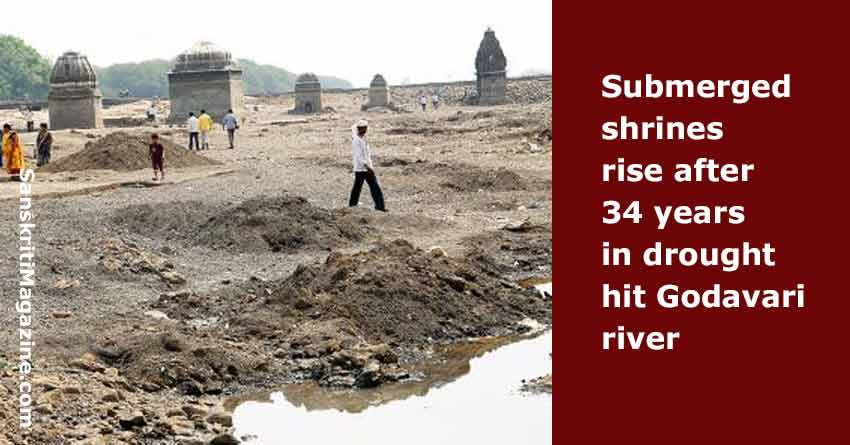
Chandori (Nashik): Stretches of the Godavari passing through Chandori village, around 25km from Nashik, have dried up because of the ongoing drought in regions of Maharashtra and several temples have resurfaced for the first time after over three decades.
The last time the villagers had seen some of these temples was way back in 1982, when Nashik had witnessed a drought of this scale. The ghats of the Godavari have also become a favourite spot for people from Chandori and neighbouring areas to visit these days. Despite the hardships caused by drought, people don’t want to miss the opportunity to pay a visit to these temples, mostly Shiva shrines.
The Archaeological Survey of India (ASI) has no record of these ancient temples and the only mention of these structures and the ghats along the Godavari could be found in the Nashik Gazetteer dating back to the British era.
“I saw these temples for the first time in my life,” said Sandeep Tarle, the young sarpanch of Chandori. “Usually during summer, we can see the pinnacles of the temples or their side walls because the shrines are under the river water across the year. The elderly in the village recall having seen the temples in 1982 when the region was hit by a drought,” he added.
Pralhad Bharle, a senior citizen from the village, recalls that the last time the Godavari had dried up was in 1982. “We had to clean up the temples from inside to get a view of the idols. The centuries-old structures and the idols were surprisingly in a good condition. This year, too, when the villagers washed and cleaned up the temples, they found the idols intact. The river had dried up only once before 1982 — in 1936,” Bharle said.
These shrines used to be a part of the ghats constructed by Sardar Hingne and Vinchurkar, the ministers of the Peshwas, who were in-charge of Chandori. The Nashik Gazetteer states that ghat and the temples were submerged after the Nandur Madhyameshwar dam was built in 1907. The villagers claimed that the temples were built in the 13th century and went under water after the Godavari changed its course.
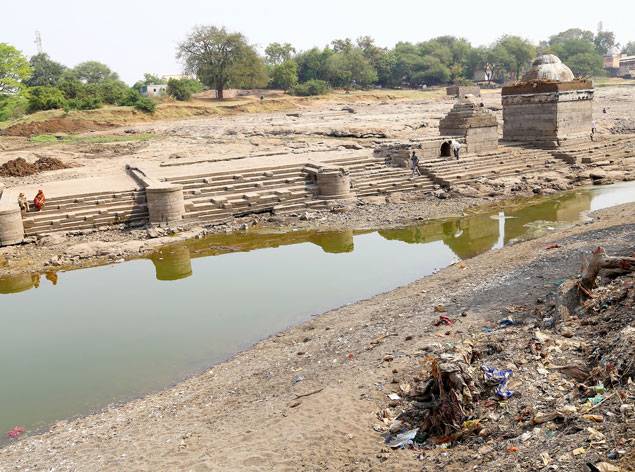 The ghats and the temples resemble the Hemadpanthi style of architecture. Each temple has a Shiva linga, which was carved in the distant past along the riverbed. The temple situated in the deepest of the riverbed has an idol of a Hindu deity in a sleeping posture, which according to the locals, is of Lord Indra. The entire riverbed contains Shiva lingas and idols of various deities, many of which are difficult to recognise. The locals are keen on collecting these idols and place them in a museum.
“Chandori is a Class C pilgrimage destination in Maharashtra as thousands of devotees visit the Khandoba temple. If the government and the ASI collect the idols and help us establish a museum in the village, it will ensure development,” said sarpanch Tarle.