This world is sometimes pushing forth and sometimes withdrawing. In the same way that a heart expands and contracts again and again, the whole universe expands and contracts. Regrouping within the one, and again manifest as the many – the one and the many – the evolution and dissolution of the material universe takes place. As a heart expands and contracts, the whole universe is manifest and withdrawn.
One ancient literature of India, the Manu Samhita, begins by describing the creation. In that book, it is written how, before the creative movement began, the tatastha potency of the Lord was in eqilibrium. Tatastha means equilibrium. Everything was in darkness, fully enveloped by ignorance. There was no possiblility of estimation; no symptoms of reality existed by which any conjecture or inference about the nature of reality would have been possible. And that state of being was unknowable: science has no capacity for investigating the nature of that stage of existence. We can only say from here that it was completely immersed in deep sleep. The analogy of deep sleep may give us some conception of that period: Material existence was at that time as if in sound sleep.
At that time, movement began from within the spiritual plane, and light came. Light was seen by the suddenly awakened seers, the sages present at the moment of creation. That light was pre-existent, but at that moment the awakened seers received the vision to see light. They began to see. The first conception of this material world after light was water. The light revealed a moving substance like water seen by the sages. That primal light is compared with personality. That light, or personality, first gave birth to onlookers – to the feelers of material existence – and then to an objective substance like water. The conscious world is represented by light and the first objective reality is represented by water. Then the seeds of consciousness are sown in the causal water which is the shadow of that light. Although the actual element of water was created long after this, the first conception of matter is compared to water because water is an accommodating, moving solution. The Sanskrit word for water – apa – means “of lower conception.” In this way, the lower creation began.
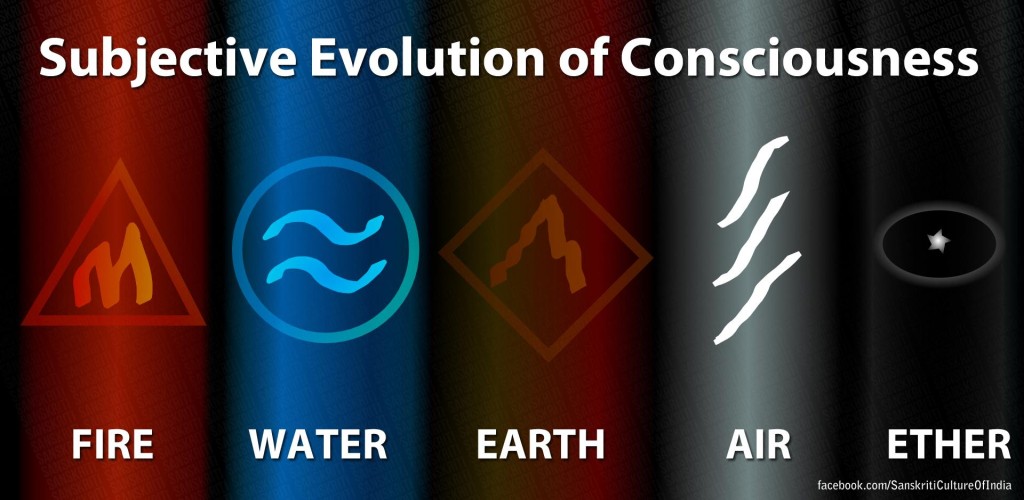
Then, in connection with the seeds of consciousness and primal water, the next production was known as mahat-tattva: the energy of consciousness represented by light, mixed with matter as a mass. When the mass of matter is infused with the energy of lightconsciousness, that is known as mahat-tattva. After further development, that entity was divided into many units of ego. First there is a mass ego as a whole. The element of conglomerate ego is called mahat-tattva; and from that conglomerate a watery objective substance evolves – by the influence of consciousness. That objective substance expresses itself in five main ways: as substance that can be seen, smelled, tasted and touched and heard. These fivefold elementary substances are the primitive principles of material existence, known as fire, earth, water, air and sky (ether, space).