IndianSanskriti
Stolen-ancient-Jain,-Hindu-statues-worth-$450,000-seized-in-the-USA

Stolen ancient Jain, Hindu statues worth $450,000 seized in the USA

Four days before two ancient Jain and Hindu statues estimated to be worth $450,000 were to be auctioned off, US officials swooped on the international art auction house Christie’s here and seized them, according to the Homeland Security Department.

The statues seized Friday by Homeland Security Investigations (HSI) special agents in “Operation Hidden Idol” were of Rishabhanata, the first Jain Thirthankar, and of Revanta, a son of God Surya, the HSI said. They were to have been auctioned on Tuesday during Asia Week in New York, an event that draws top-tier art collectors and museum curators from around the world.

Christie’s said it was unaware the statue of Rishabhanata and the panel of Revanta were stolen in India and brought into the US illegally. On behalf of the Indian government, Consul General Riva Ganguly Das commended the “HSI for the exceptional work done in locating and retrieving the sculptures brought into the United States by organised crime syndicates.” The 10th century Rishabhanata sandstone statue is from Rajasthan or Madhya Pradesh and is valued at about $150,000, according to the HSI. It stands about 57cm tall and depicts the Tirthankar seated in vajrasana position (crossed leg pose) and flanked by two devotees.
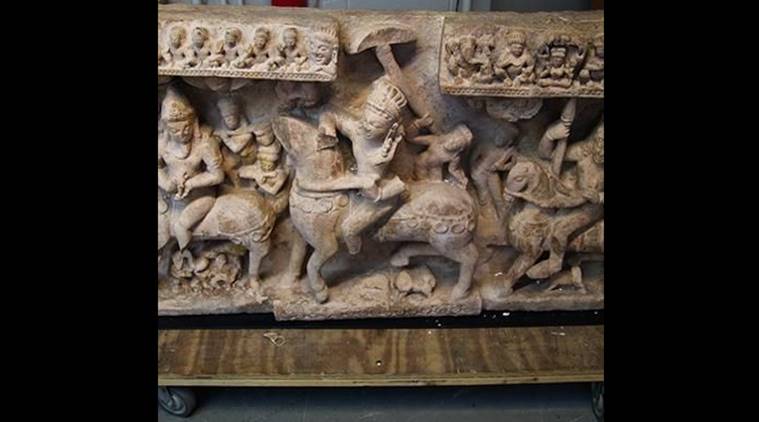
A stolen buff sandstone panel depicting Revanta and his entourage, was seized by US officials from the auction house Christie’s on March 11 in New York. It is from the 8th Century AD, approximately 76 cm by 135 cm, depicting a very rare representation of the equestrian deity, Revanta, a son of Surya, and valued at approximately 0,000. (Source: US Customs/IANS)

The sandstone panel of Revanta and his entourage is from the 8th century. It is considered “a very rare representation of the equestrian deity”, and is estimated to be worth $300,000, according to the HSI. In its statement, the HSI acknowledged the assistance of the government of India and Interpol in its investigations carried out with the Manhattan district attorney Cyrus Vance’s office. Christie’s had included the two artefacts in an auction entitled “The Lahiri Collection: Indian and Himalayan Art, Ancient and Modern,” during Asia Week New York, the HSI said.

The event’s organiser, the Asia Week New York Association, billed it on its website as “a collaboration of top-tier Asian art specialists, major auction houses, and world-renowned museums and Asian cultural institutions” in the New York area. Nineteen art dealers are participating in the India and Southeast Asia segment and have listed a range of art ranging from modern and ancient paintings and miniatures to bronze sculptures and artefacts.

“This seizure at the beginning of an international event as well recognised as Asia Week New York sends two important messages,” said Angel M. Melendez, the special agent in charge of New York HSI. “First and foremost, it demonstrates that we are committed to protecting cultural heritage around the world, and second, it demonstrates that we are monitoring the market to protect prospective buyers as well.” India’s Permanent Representative to the United Nations Syed Akbaruddin tweeted, “Stealing India’s precious heritage doesn’t pay dividends.”

HSI, which is part of the Immigration and Customs Enforcement division of the Homeland Security Department, said the Rishbhanata statue “appears to have been sold by Oliver Forge to London-based Brandon Lynch Ltd. between 2006 and 2007”. And the Revanta panel, “according to images provided by the source dealer, appeared to have contained an ‘orphan fragment’, a piece perfectly broken off to be sold by the smugglers after the sale of the main part of the sculpture”, the HSI said. In its four years, “Operation Hidden Idol” has uncovered networks of temple-looters preying on India.
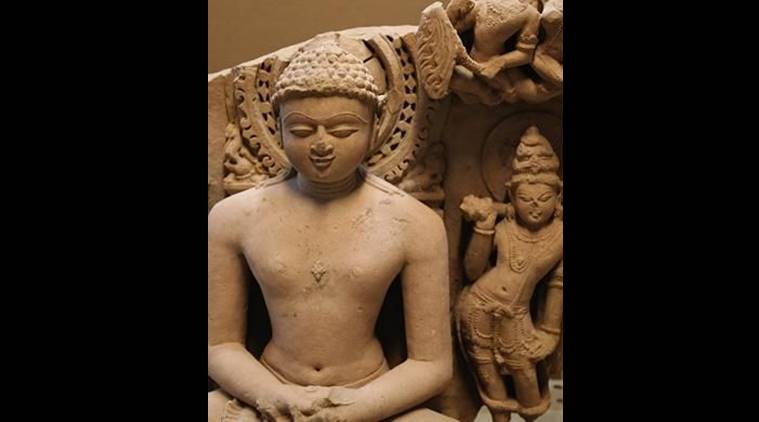
A stolen buff sandstone statue of Rishabhanata, the first Jain Thirthankar, was seized by US officials from the auction house Christie’s on March 11 in New York. It is from Rajasthan or Madhya Pradesh, in the 10th century A.D, 57cm high, and depicting a stele carved with the first Jain Tirthankara (a teacher who preaches dharma) seated in vajrasana (crossed leg pose) and flanked by a pair of standing attendants, and valued at approximately $150,000. (Source: US Customs/IANS)

In what is probably the biggest ever ancient artefact crackdown, the HSI and the Manhattan district attorney’s office announced last July they had seized over 2,500 items worth over $100 million from a single network allegedly run by art dealer Subhash Kapoor. He is in custody in Chennai in connection with alleged temple thefts from the state. The HSI said that in the past 12 months, four US museums and one major collector have surrendered illicit cultural property linked to Kapoor.

One of them was a statue of the poet Manikkavichavakar taken from the Sivan temple in Sripuranthan village in Tamil Nadu. It is estimated to be worth $1 million. In addition, Australia has returned to India a 900-year-old Chola-era bronze Nataraja and a stone statue of Ardhanariswara from around 1100.

Source : Indian Express
You may also like

Search the website

Like us on Facebook

Get daily updates via Email

Enter your email address:

Recent Posts

Yogini Ekadashi 2026 — The Yaksha Who Missed the Morning Flowers, and the Ekadashi That Undid His Curse

On Friday, July 10, 2026, the rare Krishna Paksha Ekadashi of Nija Ashadha arrives. The Padma Purana tells the story of Hemamali — the Yaksha gardener of Bhagavan Kubera in Alaka, whose single morning of distraction with his wife Vishalakshi cost him his form, his wife, and his celestial city. Cursed to wander the earth of Bharata as a leper for a long time, he was at last shown the way back by Sage Markandeya — a single sincere keeping of Yogini Ekadashi.

Jamai Shashthi 2026 — The Story of Maa Shashthi, the Cat, and the Wife Who Was Forgiven

Jamai Shashthi 2026 — The Story of Maa Shashthi, the Cat, and the Wife Who Was Forgiven

On Saturday, June 20, 2026, Bengali households across Bharata will welcome their married daughters and sons-in-law home for the legendary jamai-aador feast and perform the Shashthi Vrata. But behind the warmth lies a story most Bengalis know by heart and most non-Bengalis have never heard — the wife who stole the hilsa, blamed the cat, lost six sons to Maa Shashthi’s wrath, and was finally forgiven. The Vrat Katha, the vidhi, the mantras, and the deeper teaching.

Vat Purnima 2026 — The Wife Who Argued Yama Into Returning Her Husband’s Life

On Monday, June 29, 2026, women across Maharashtra, Gujarat, and southern Bharata will tie red thread around banyan trees and hear the story of Savitri — the wife who walked behind Yamaraja Himself when He came for her husband, and out-argued the Lord of Dharma into returning Satyavan’s life. The Mahabharata’s Pativrata Mahatmya Parva, the vrat vidhi, and why the banyan witnessed everything.

Nija Jyeshtha 2026 — The Real Jyeshtha Begins, and the Calendar Resumes

Nija Jyeshtha 2026 — The Real Jyeshtha Begins, and the Calendar Resumes

With Adhik Maas now closed on the Somvati Amavasya of June 15, the long-postponed festivals of Jyeshtha return — Vat Purnima (June 29, the Savitri-Yamaraja katha), Jamai Shashthi (June 20, the Bengali festival of Maa Shashthi), Sankashti Chaturthi (June 28), Yogini Ekadashi (July 10), and Devshayani Ekadashi (July 16, opening the four-month Chaturmas of Bhagavan Vishnu’s yoga-nidra). A guide to what the next four weeks hold and what the household that kept Purushottam Maas now carries forward.

The Closing of Purushottam Maas 2026 — Adhik Amavasya and the Sealing of the Month-Long Vrat

On Monday, June 15, 2026 — a rare Somvati Amavasya — the intercalary month that bears Bhagavan Vishnu’s own name comes to its close. The Acharyas teach that a vrat is not measured by its duration but by its closing. Here are the Padma Purana’s instructions for sealing the month-long Purushottam Maas vrat: the morning snan, the closing puja with the Vishnu Sahasranama, the day of dana, the Somvati Amavasya gift, and the final sarva-arpana — the offering of all merit at the feet of the Lord.

css.php