~ Shipraprasadini, Contributing Writer, Mumbai
Milk is a gift, divine and pure a symbol of love and vitality distilled from the Mother’s blood for nurturing its young.
Today a part of the human society greatly depends on this essential nourishment obtained mainly from Cows and other bovine animals. The collection and supply of Milk is highly industrialized and controlled, collected from the excess secreted by the bovine animals sometimes by denying its deserving calves. Milk is cherished in the Indian society, cutting across several faiths, it is given a very important place not only as a regular and essential nourishment, but also as a gift from heavens, considered a Nectar or ‘Amrit’ adored by the Gods.
Cow in Hinduism is highly revered and considered as a Mother, nourishing life. Scriptures state that ‘Kamadhenu’ – Bestower of Desires, manifested on earthly planes during the churning of the cosmic ocean –‘Samudra Manthan’ and was presented to the ‘Saptharishi’s’ or ‘Seven Seers’. She was ordered by Brahma the Creator to provide milk and other products to the sages. ‘Kamadhenu’ or ‘Surabhi’ also known as the mother of all cows is bestowed with miraculous powers to confer anything desired by the one who venerates her.
Hindus venerate cows as a physical reincarnation of this divine being and treat Cows with reverence. The body of a cow is thought to house all 33 Crore Gods of Hindu Pantheon. We have all grown up with popular stories of ‘Bhagwan Krishna’ as the Cowherd surrounded by his herd of Cows weaved into our psyche. As per Hindu Shastra Cow is the only earthly being thought to have a direct connect with the Sun through a vein running through her backbone ‘Surya Ketu Nadi’. It is thought this connect enables the cow to produce ‘gold’ mineral in her blood and hence her milk, ‘ghee’ and urine is tinged a light yellow.
‘Matrah sarva bhutanam, gavah sarv sukh prada’ – Translation: The cow being mother of all living entities gives all pleasures to everyone. Cow milk is considered an anti-toxin, ie if any poison accidentally ingested by a cow is absorbed into her flesh keeping her milk, urine etc toxin free.
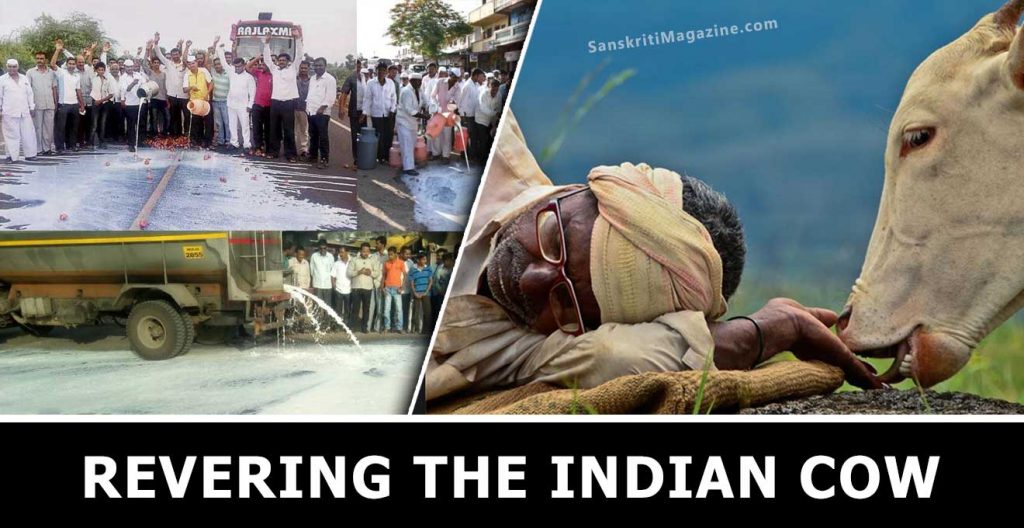
In the backdrop of such deep reverence given to Cow and Milk in the Indian and Hindu psyche, it was a sorry state to read about the hooliganism resorted to by some farmers and unscrupulous elements on the 1st June, 2017 – World Milk Day in Maharashtra by emptying out on the road several thousand litres from transport vehicles. The protesters had several demands including the waiver of loans given to them for crops. In the name of protests, their ill-thought out act ended up wasting the precious nourishment on the road. If the idea was to punish the government it ended up punishing the populace dependent on this supply. The protest would have had a far greater impact had the milk been diverted and supplied to the many thousands of starving infants and children living in ghettos along the way.
Only depraved men could resort to such villainous display of utter disrespect to their mothers by forgetting the fact that they too would have been reared and nourished in their early childhood with this precious white nectar. I wonder whether their arms trembled while pouring out gallons on the road. Did they not remember their own mothers who probably squeezed her glands to nourish them to be the healthy individuals they were while carrying out this heinous act.
In the recent past there have been several raucous attacks on Hindu beliefs regarding the venerability of Cows, with chest thumping small time politicians taking to the streets with a few extreme inhumane display of visceral hatred by public slaughtering of calves. Several vociferous and aggressive statements were made on the right of choice as far as food is concerned but mostly I suspect to rake unrest amongst the majority who abstain from beef. When the wastage of Milk was protested some jumped in with examples of wastage when milk is poured as an offering on ‘Shivalingas’ by devout Hindus during various festivals. Such analogies take away the import of a maleficent act by erroneously drawing parallels between two acts with a vast gap in magnitude. While the milk as an offering to ‘ Bhagwan Shiv’ is actually watered milk or a few spoons of milk mixed in a tumbler of water with devout intentions, the act of pouring milk on the road is a malicious act against society with intentional wastage of tons of milk.
In this backdrop it is heartening to note several ordinary individuals and groups have come forward to show their love and sensitivity for the gentle and docile Cow. The power of milk vitalizing the body and soul is anytime preferred than eating meat or beef which is consumed by slaughtering the animal.
The RSS Muslim wing – Rashtriya Manch, Bhopal recently set a commendable example by serving milk instead of the regular beef after the ‘Roza Iftar’ party during Ramazan sending out a message of brotherhood and peace. Sri Ramachadrapura Math recently announced the launch of a new social movement called MilkFest to be organized on June 11, 2017 in Bengaluru to spread awareness about the goodness and benefits of Cow Milk. Hopefully such social outreach programs to educate the common citizens on the benefits of milk will lead to a kinder attitude towards this gentle and beneficial creature.
Love not only for the self and for immediate near and dear ones but all-encompassing love for all living creatures on earth will surely help raise the sublime conscience of humanity and lead to a better life on earth.
Come let us express our gratitude to this benevolent animal, let us celebrate life and the goodness of milk, let us bow in reverence to the provider of this nectar – Cow and take an oath to protect it.
References: