IndianSanskriti

Purna Kumbha: An Essential Part of Worship in Hinduism

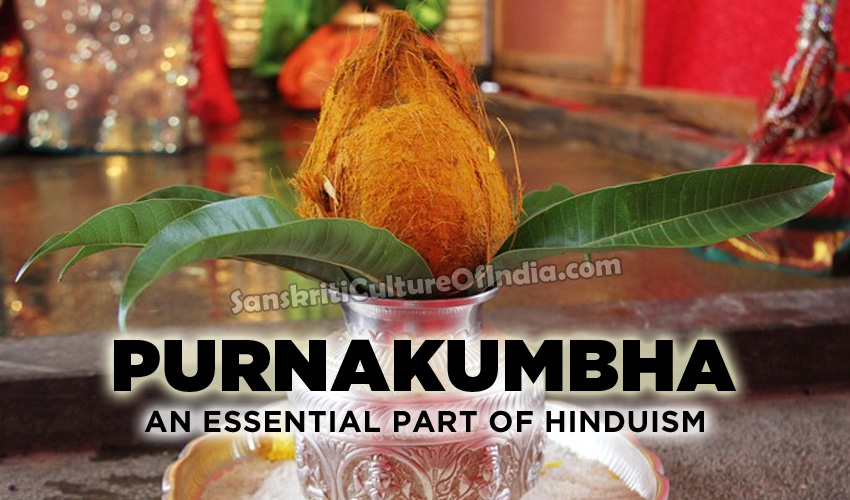
Purna Kumbha, or Purnakumbha, is an essential part of worship in Hinduism. Today it is also used in Hindu weddings, temple functions and other occasions associated with Hindu religion. Purna Kumbha, literally means a ‘full vessel’ and symbolically it is a sign of plenty, abudance and successful completion. It is also referred as Kalash or Kalasha.

The earthen pot used as Purna Kumba is decorated with geometric designs and Swastika. The geometric design various from region to region and from community to community. Depending on the society and its wealth, earthenware gives way to copper, silver, brass or gold pots.

The pot symbolizes Mother Earth. The water symbolizes the primordial water from which the entire creation emerged, the divine essence gives life to all. It is the soul filled with love and compassion, abundance and hospitality. Creation is represented by the leaves and coconut is the symbol of God-head.

Reference of Purana Kumbha is found in the Skanda Purana and the Matsya Purana. In Skanda Purana it is mentioned that the ‘Purna Kumbha’ can be worshiped. Matsya Purana indicates that people placed it at their doors as a sign of plenty.

Except for water, what goes into the pot varies from region to region. Mango leaves and the coconut is a constant factor in most areas. Purna Kumbha is also filled with twigs or leaves of five trees – Ashwatha (peepul), Vata (Banyan), Amra (Mango), Panasa (Jackfruit) and Bakula (Elengi). A lotus flower and a small bowl of rice are also put in the pot. The mouth of the pot is covered with a husked coconut, which is decorated from the sides with mango leaves.

All the items used in the Purna Kumbha signify life at its finest and full of abundance. It also indicates that human beings are part of nature and when nature thrives human beings too will flourish.

Compiled as such, the Purna Kumbha  is considered to be an object symbolizing God in Hindu culture.
You may also like

Search the website

Like us on Facebook

Get daily updates via Email

Enter your email address:

Recent Posts

Purushottam Maas — The Month No Deity Would Claim, and the Lord Who Made It Supreme

Every month of the Hindu calendar has a lord — except the rare thirteenth, the Adhika Maas, born an orphan and shunned as the “impure month.” The Puranas tell how this rejected month went in grief to Bhagavan Vishnu, who claimed it, gave it His own name — Purushottam — and made it the most fruitful month of all. The origin story, the teaching, and what it means for Purushottam Maas 2026 (May 17 – June 14).

Padmini Ekadashi 2026 — The Ekadashi Even the Devas Descend to Keep

Padmini Ekadashi 2026 — The Ekadashi Even the Devas Descend to Keep

The rarest Ekadashi of the entire Hindu calendar is three days away. The Padma Purana preserves a conversation between Bhagavan Krishna and Yudhishthira about a single Ekadashi the great Rishis spend lifetimes waiting for — Padmini. The Vrat Katha of Queen Padmini of Mahishmati, the lotus teaching, and why May 27, 2026 is the morning Vaishnavas across Bharata are preparing for.

Varada Chaturthi 2026 — The Rare Ganesha Day of Purushottam Maas

Varada Chaturthi 2026 — The Rare Ganesha Day of Purushottam Maas

Once every 2.5–3 years — when the rare 13th month of Adhika Maas opens — a thirteenth Vinayaka Chaturthi appears. The Mudgala Purana calls it Varada Chaturthi, the “boon-giving” Chaturthi, and holds it as the most fruit-bearing Ganesha day of the entire calendar. Today, Wednesday May 20, 2026, is that day.

Padmini Ekadashi 2026 — The Rare Ekadashi That Comes Only in Purushottam Maas

Padmini Ekadashi 2026 — The Rare Ekadashi That Comes Only in Purushottam Maas

Padmini Ekadashi 2026 falls on Wednesday, May 27 — the Shukla Paksha Ekadashi of Adhika Maas, the rarest Ekadashi in the entire Hindu calendar (it appears only every 2.5–3 years). The Padma Purana conversation between Bhagavan Krishna and Yudhishthira, the Vrat Katha of Queen Padmini, complete vrat vidhi with jagrana, mantras, and the lotus symbolism that gives the Ekadashi its name.

Ganga Dussehra 2026 — The Day Maa Ganga Came Down to Bhagiratha

Ganga Dussehra falls on Monday, May 25, 2026 — commemorating the day Maa Ganga descended from Vaikuntha to the earth through the millennia-long tapasya of King Bhagiratha. The full account from the Valmiki Ramayana, snan vidhi, dana traditions, mantras, and the teaching of sustained sincerity.

css.php