It took me 35 years to re-discover this verse from the ancient Upanishads and learn its true meaning.
Growing up as a child I was raised amongst a predominantly agrarian family. My maternal and paternal uncles, aunts, grandfathers and grandmothers are, and were, farmers. Most of our close, or distant relatives, were connected to farming too. Except for my mother & father most of my immediate extended family had no formal education, in the modern Western method of “schooling”.
My maternal grandfather had a very strong impact on me as a young child. He was a man deeply connected to the Earth, his farms, bulls and cattle; having always tended them with care till the very last day he could physically do no more. He taught me to never drag my feet, because it would waste the rubber on my slippers, and that was a sin. He used to give rice generously to the traveling pilgrims who came asking for alms at his doorstep. He would never charge more than what he believed was what he needed for the effort he put for growing and harvesting the rice that he cultivated. He would snap my hands in admonishment when we used to play UNO cards, which he eventually hid away, never for us to find to this day. Whenever we went to visit my grandparents at Talamanchi (Translation: “Village of Good Thoughts”), during our summer breaks, we would always return back to Visakhapatnam, a distant city where I lived with my parents, with plenty of food savories that my grandmother had prepared. This was what always made me look forward to these vacations.
It was customary, at every Indian house, whether it was a festival or not, to be offered something to eat, whoever came visiting. Festivals would only make these kind of offerings larger in proportions. It was an embodiment of जलदान (Jaladana: Water Charity) & अन्नदान (Annadana: Food Charity). Summers were always full of watermelons and తాటి ముంజలు (Telugu: Tatimunjulu: Palmyra fruit), which grew on the farms, that never seemed to end in supply. The only thing stopping us kids was a stomach ache, from overeating, ignoring the stern voice of my grandfather who warned us of it.
Pedamavayya, my eldest maternal uncle, who also worked on the farms, would always insist that I greet people by saying नमस्ते (Namaste), and bow to people elder than I, trying to inculcate into me simple virtues, which I found hard to learn, coming from a Western schooling system that had different ideas of politeness and discipline. My uncle eventually moved away, to Karnataka, from farming and went into contracting for public construction projects. He used to take me on road trips to his project sites in distant lands filled with people speaking languages (Kannada, Tulu & other tribal languages) I could not understand, at that moment, I eventually learn to speak and read Kannada. I remember him teaching me the first few words of Kannada ಚೆನ್ನಾಗಿ ಇದ್ದೀರಾ “Channagaidhira? (“How are you doing?) ಊಟ ಆಯುಥಾ? (Oota-ayuta?” translation: Have you eaten?”) These were expressions of the courtesy of inviting someone to share a meal.
My grandfather never went to any school. He was “uneducated”, by society’s definition, however, he ensured that my mother went on to study a masters degree. He believed that a girl child, the only one among his children, was a “Lakshmidevi” (Goddess of Wealth) instead he named her “Saraswathi” (Goddess of Knowledge). My mother eventually went on to get a Ph.D in Botany, living up to the name he had given her. She taught Bachelor level students in a Government college at Visakhapatnam, till her retirement; thus embodying her own name as the “Goddess of Knowledge” to her students.
As a recognition for her service she was commemorated with the best teacher award at the state level by the Chief Minister of Andhra Pradesh close to her retirement. My Pedamavayya, adventurous & enterprising man that he was, dropped out of school at 11th standard, too bored to sit in a classroom. Neither my Thathayya (Grandfather) nor my Pedamavayya ever had any initiations into any of the esoteric Vedic scriptures or verses. Today as the wisdom of this Upanishad casts a warm glow on my being, on having re-discovered it, I have come to realize that the greatest legacy a culture, or tradition, can have are the people who embody it, not the books that extoll it. And in that is the knowledge of India and its people.
I write this as a tribute to all those farmers, and ancestors, who embody the spirit of the Taittiriya Upanishad, that I have been touched by, one among who was my Grandfather. If you are reading this today, it means you had the good fortune of having eaten well that you are able to sit in peace and read them without interruption from a stomach that demands to be fed. It is said “An army marches on its stomach”.
As Sadhguru Jaggi Vasudev, wisely said in his recent talk in Coimbatore “For every species on this planet: Stomach empty only one problem. Stomach full life fulfilled. It is only for the human being: Stomach full hundred’s of problems”, if today your head is hundreds of problems with questions like “Who am I? Why am I here? What is the meaning of all this?” it is because some farmer out there toiled hard in the sun with the soil and his hands to grow the grains that made your rice or Roti.
Despite our large number of so called “uneducated” and “illiterate” people I believe the beauty of India lies in the billion expressions of her ancient & timeless wisdom. It was the fruits of this timeless wisdom of sustainability, practiced by the farmers, that brought India abundant riches throughout the centuries; and the Europeans & Mughals from across the seas. It was India’s rich & diverse produce that Chistopher Columbus was seeking when he accidentally discovered North America.
Today Christopher Columbus is replaced with agents like WTO, GMO’s and unsustainable industrial farming methods in the hope of enslaving the local farmers, and its people, in a bid to usurp their wealth through its inherent indentured methods. This is threatening India’s highly diverse agricultural ecology and farmers. The NCRB figures across 18 years for which data exist show that at least 2,84,694 Indian farmers have taken their lives since 1995 as result of these new policies and methods (Source: Farmers’ Suicide)
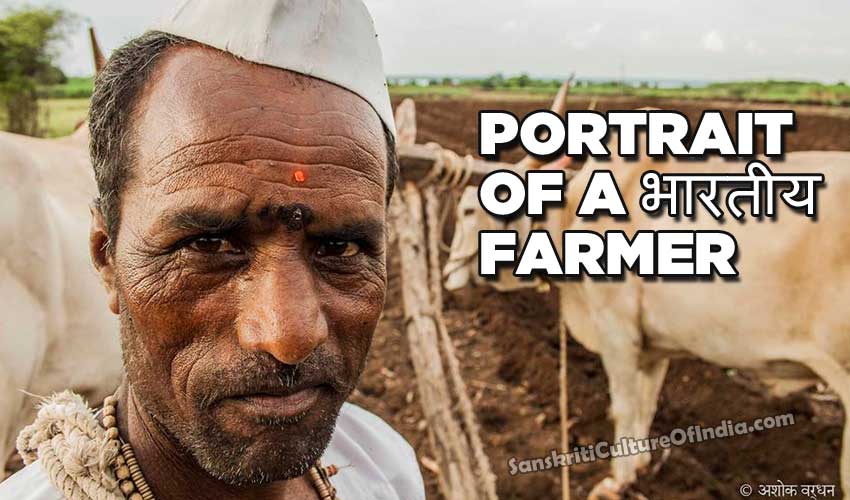
~ by Ashok Vardhan (photo shot in Maharastra)