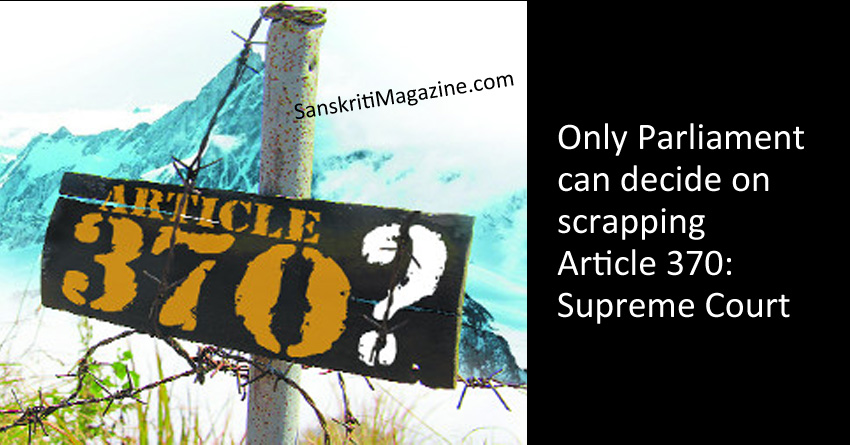
Days after the J&K High Court observed that Article 370 is a “permanent” provision of the Constitution, the Supreme Court Friday said that only Parliament can take a call on scrapping Article 370 that accords special autonomous status to Jammu and Kashmir.
Refusing to entertain a PIL that wanted Article 370 removed from the Constitution, a bench led by Chief Justice H L Dattu said that the court cannot issue such directives. “Will it be done by the court or by Parliament? Can we ask Parliament to delete a provision from the Constitution? It is not for this court to do so,” observed the bench, also comprising Justice Amitava Roy.
PIL petitioner B P Yadav, a lawyer based in Andhra Pradesh, argued that the issue required interference by the Supreme Court but the bench turned down his plea. “We can strike down a provision if it is unconstitutional but we cannot be asking Parliament to remove a provision. It has to be done by them (Parliament),” said the bench as it asked Yadav to file a better petition if he intends to pursue this matter any further.
Yadav, in his petition, had requested the court to quash Article 370 and make all laws, which are applicable to other states, also valid for Jammu and Kashmir. The plea also sought direction for removal of the words “except Jammu and Kashmir” from all the pertinent statutes where laws are made applicable to all other states and union territories.
According to Yadav, Article 370 and the consequent Presidential Order abridge the Constitutional scheme and also violate Part III, which relates to the fundamental rights of people and comprises the basic structure. He pointed out that Article 370 has been titled as a “temporary provision” that makes it amply clear that it had to go after some time.
Earlier this month, the J&K High Court had observed that notwithstanding its title “temporary provision”, Article 370 is a permanent provision of the Constitution. “It cannot be abrogated, repealed or even amended as mechanism provided under Clause (3) of Article 370 is no more available,” the court observed in its judgment on a case challenging the reservation benefit in promotions to the employees.
Noting that Article 35A protected the existing laws of the state, the High Court said that Jammu and Kashmir had retained limited sovereignty while acceding to the Dominion of India, and did not merge with the Dominion of India like the other princely states that signed the Instrument of Accession.
It said that the Constituent Assembly of 1957 was empowered to recommend to the President that Article 370 be declared to cease to be operative or operate only with the exceptions and modifications, but it did not make such a recommendation before its dissolution on January 25, 1957. It had added Article 370 embodied “conceptual framework of relationship” between the Union of India and J&K.