IndianSanskriti
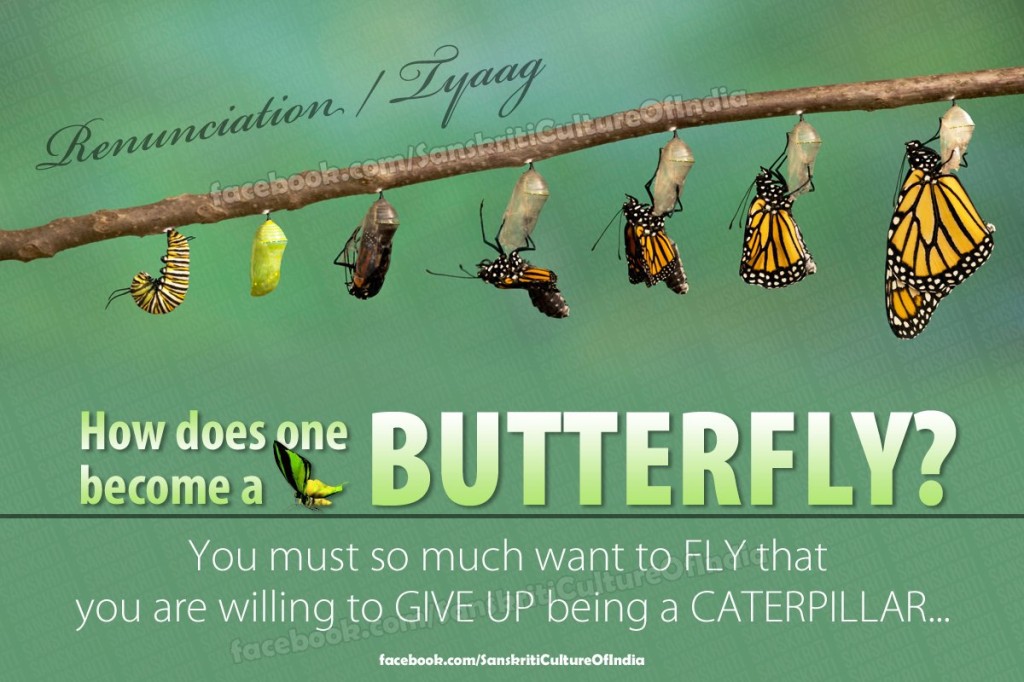
What does Renunciation / Tyaag Means?

Meaning of Renunciation / Tyaag

The word renunciation comes up frequently in discussions of Buddhism. What does it mean, exactly?To “renounce,” in English, means to give away or relinquish, to reject, or to disown. To those of us with a Christian background, this can sound a lot like penance — a kind of self-punishment or deprivation to atone for sins. But Buddhist renunciation is entirely different.The Pali word found in the sutras that is usually translated as “renunciation” is nekkhamma. This word is related to a Pali term meaning “to go forth” and also to kama, or “lust.” It is most often used to describe the act of a monk or nun going forth into a homeless life to be liberated from lust. However, renunciation can apply to lay practice as well.

Most broadly, renunciation can be understood as a letting go of whatever binds us to ignorance and suffering. The Buddha taught that genuine renunciation requires thoroughly perceiving how we make ourselves unhappy by grasping and greediness. When we do, renunciation naturally follows, and it is a positive and liberating act, not a punishment.

The Buddha said, “If, by forsaking a limited ease, he would see an abundance of ease, the enlightened man would forsake the limited ease for the sake of the abundant.” (Dhammapada, verse 290, Thanissaro Bhikkhu translation)

Renunciation as Nonattachment

It’s understood that giving oneself over to sensual pleasure is a great hindrance to enlightenment. Sensual desire is, in fact, the first of the five hindrances to enlightenment that are to be overcome through mindfulness. Through mindfulness, we see things as they really are and fully appreciate that grasping for sensual pleasure is only a temporary distraction from dukkha, stress or suffering.

When that distraction wears off, we want to grasp something else, and this grasping binds us to dukkha. As the Buddha taught in the Four Noble Truths, it is thirst or desire that puts us on an endless cycle of grasping and keeps us unsatisfied. We’re endlessly pursuing a carrot on a stick.

It’s important to understand that it’s attachment to sensual pleasure that is the hindrance. That’s why merely giving up something you enjoy isn’t necessarily renunciation. For example, if you’ve ever gone on a diet you know that all your determination to stay on the diet doesn’t stop the craving for fattening food. The craving tells you that you are still attached to that particular pleasure.

At the same time, it’s important to understand that enjoyment of something isn’t bad. If you take a bite of food and find it delicious, you certainly don’t have to spit it out. Just enjoy the food without attachment. Eat only as much as you need without being greedy. And when you are finished, as zennies say, wash your bowl.

Renunciation in Practice

Renunciation is part of the Right Intention aspect of the Eightfold Path. People who enter monastic life do discipline themselves to renounce the pursuit of sensual pleasure. Most orders of monks and nuns are celibate, for example. Traditionally, monks and nuns live simply, without unnecessary personal possessions.

As laypeople, we are not expected to give up our homes and sleep under the trees, as the first Buddhist monks did. Instead, we practice to realize the ephemeral nature of possessions and to not be attached to them.

In Theravada Buddhism, renunciation is one of the ten paramitas, or perfections. As a perfection, the primary practice is to discern through contemplation how one’s enjoyment of sensual pleasure may be impeding one’s spiritual path.

In Mahayana Buddhism, renunciation becomes a bodhisattva practice for developing bodhichitta. Through practice, we realize how attachment to sensual pleasure throws us off balance and destroys equanimity. Grasping also causes us to be greedy, depriving others to benefit ourselves.
~By Barbara O’Brien,


 

You may also like

Search the website

Like us on Facebook

Get daily updates via Email

Enter your email address:

Recent Posts

Padmini Ekadashi 2026 — The Ekadashi Even the Devas Descend to Keep

Padmini Ekadashi 2026 — The Ekadashi Even the Devas Descend to Keep

The rarest Ekadashi of the entire Hindu calendar is three days away. The Padma Purana preserves a conversation between Bhagavan Krishna and Yudhishthira about a single Ekadashi the great Rishis spend lifetimes waiting for — Padmini. The Vrat Katha of Queen Padmini of Mahishmati, the lotus teaching, and why May 27, 2026 is the morning Vaishnavas across Bharata are preparing for.

Varada Chaturthi 2026 — The Rare Ganesha Day of Purushottam Maas

Varada Chaturthi 2026 — The Rare Ganesha Day of Purushottam Maas

Once every 2.5–3 years — when the rare 13th month of Adhika Maas opens — a thirteenth Vinayaka Chaturthi appears. The Mudgala Purana calls it Varada Chaturthi, the “boon-giving” Chaturthi, and holds it as the most fruit-bearing Ganesha day of the entire calendar. Today, Wednesday May 20, 2026, is that day.

Padmini Ekadashi 2026 — The Rare Ekadashi That Comes Only in Purushottam Maas

Padmini Ekadashi 2026 — The Rare Ekadashi That Comes Only in Purushottam Maas

Padmini Ekadashi 2026 falls on Wednesday, May 27 — the Shukla Paksha Ekadashi of Adhika Maas, the rarest Ekadashi in the entire Hindu calendar (it appears only every 2.5–3 years). The Padma Purana conversation between Bhagavan Krishna and Yudhishthira, the Vrat Katha of Queen Padmini, complete vrat vidhi with jagrana, mantras, and the lotus symbolism that gives the Ekadashi its name.

Ganga Dussehra 2026 — The Day Maa Ganga Came Down to Bhagiratha

Ganga Dussehra falls on Monday, May 25, 2026 — commemorating the day Maa Ganga descended from Vaikuntha to the earth through the millennia-long tapasya of King Bhagiratha. The full account from the Valmiki Ramayana, snan vidhi, dana traditions, mantras, and the teaching of sustained sincerity.

Adhik Jyeshtha Maas 2026 — The Hidden Month That Belongs to Lord Vishnu

Once every 2.5–3 years, the Hindu calendar opens a quiet thirteenth chamber — the intercalary month Lord Vishnu took for His own. A Puranic look at Adhik Jyeshtha Maas 2026 (May 2–31), the Padma Purana account of how it became Purushottam Maas, and a complete householder’s guide for its closing days.

css.php