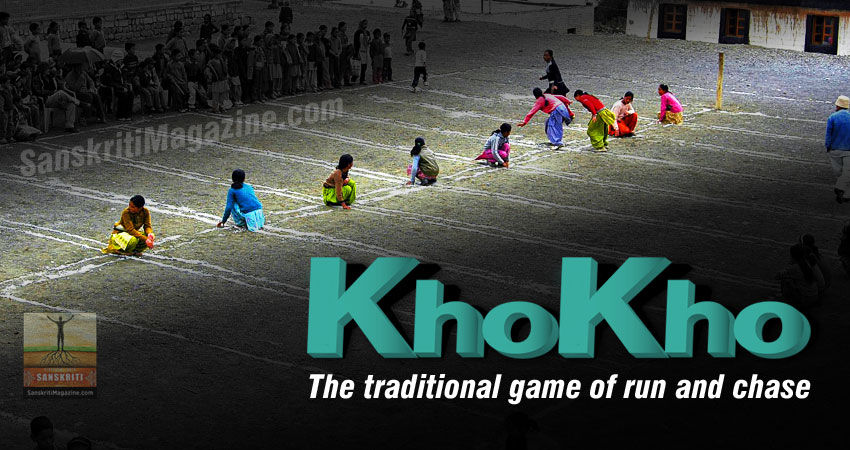
How many of you have fond memories of playing this game from your childhood?
 One of the most popular traditional sports of India is called Kho-Kho. No one knows the origins of this sports but it is believed to be a modified form of “Run-Chase”, a simpler form that involves chasing and touching a person. The game was played on “raths” or chariots in ancient times in Maharashtra and was called “Rathera”.
As a popular game, Kho-Kho can be played by men, women and children. A committee was formed at Gymkhana Poona in 1914 to set up its rules that were published from Gymkhana Barod in 1924. The first national championship was organized in Vijayawada, AP in 1959-60 and the government initiated the following awards:
- Arjuna and Eklavya Awards for men
- Rani Lakshmi Bai award for women
- Veer Abhimanyu award for boys under 18, and
- Janaki award for girls under 16
How the Game is played:
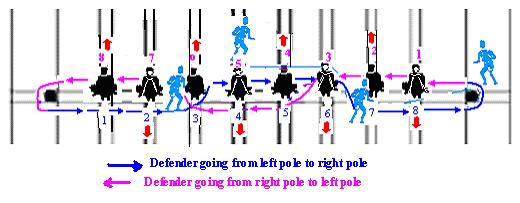 Two teams of 12 athletes compete with each other in a field measuring 27m x 15m but only nine players are allowed to play at a time.
- Each match consists of two innings that consist of chasing and running turns of 7 minutes each.
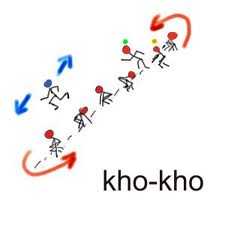
- Eight members of the “chasing” team sit or kneel in a row in the middle of the field in their eight squares on the central line and alternative and opposite directions. There are two wooden poles at each end of the line and the ninth player called the “chaser” takes his position next to one of the two poles, ready to begin the pursuit.
- Three members from the opposite teams called “defenders” enter the field to try and play out the 7 minutes time while the chasers try to dismiss them by either one of the following manner:
- Touched by an active chaser with his palm without committing foul
- If the defender steps out of the boundary of the game or
- If he enters the limit late
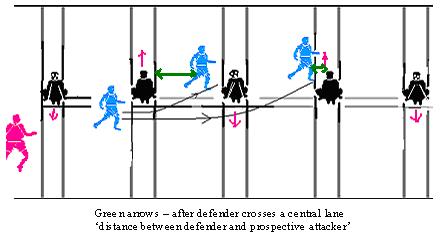 The defenders may run wherever they like but the chasers are limited to run around the entire line alone. They cannot cut across the central line of the sitters.
- An active chaser can change position with a seated chaser with their back towards them by touching them from behind with their palm and uttering the word “Kho” loudly. The chase is build up through a series of “khos” as the chase continues with a relay of chasers.
- The next set of defenders can only enter the field once the first set of defenders is caught.
- The total game lasts no more than 37 minutes with each side alternating between chasing and defence. There is a total of two innings that are set for 9 minutes each with an interval of 5 minutes then 2 minutes at the end of the innings.
- With the objective of tagging all the opponents in the shortest time possible, it is the quickest team that wins the game.
The game is inexpensive and enjoyable that keeps the players fit and healthy in an open environment while training their body and mind. It develops qualities such as orderliness, discipline, sportsmanship and excellent teamwork. Dodging, feinting and bursts of controlled speed make this game quite thrilling. To catch by pursuit – to chase, rather than just run – is the capstone of Kho-Kho.
What better way to stay in shape than playing a game of Kho-Kho ?