IndianSanskriti
kashmir---Huge-Crowds-Participating-at-Terrorist-funerals

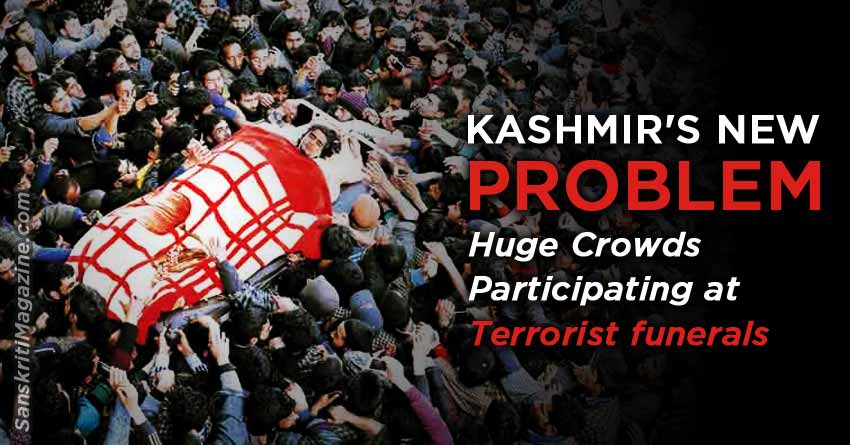
Kashmir’s New Problem: Huge Crowds Participating at Terrorist funerals

By Bashaarat Masood 

ON Monday, as thousands poured into Kulgam for the burial of Dawood Ahmad Sheikh, a Hizbul Mujahideen commander killed by security forces in an encounter the previous night, villagers were forced to delay the burial by at least 90 minutes — and conduct three funeral prayers.

While J&K police and the army have achieved significant success against militancy in south Kashmir in recent months, it is also facing a disturbing trend — growing support for militants in the form of a large number of mourners at their funerals.

“It is something that has been happening for a long time now. It is a matter of concern and we are looking into means and ways to control it,” Javed Mujtaba Gilani, Inspector General of Police, Kashmir said. 

According to senior police officers, the new phenomenon has its origins in the glamourised version of militancy symbolised by its modern day poster boy, 21-year-old Hizbul commander Burhan Muzaffar Wani.

So much so, an officer said, that when militants are trapped, youth help them escape by assembling at encounter sites and hurling stones at security forces.

“This is a dangerous trend. The fact that people are out to help militants escape even by putting their own lives in danger is a real matter of concern. It indicates that something has really gone wrong somewhere,” said a senior counter-insurgency officer of J&K police.

In November, for instance, over 30,000 gathered in Kulgam for the funeral of Qasim, a top Lashkar-e-Toiba (LeT) commander and Udhampur attack mastermind. Residents of Kulgam even observed a shutdown for three days to protest his killing by security forces.

“This is a serious issue for us and it seems that a third generation is getting attracted towards the gun,” a top police officer told The Indian Express. “For quite sometime now, people in the valley had started to de-legitimise the gun. But what is happening now, is bringing back the relevance of gun as a medium of resistance. It is a big worry for us,” he said.

Qasim’s funeral, in fact, forced J&K police to change their strategy of handing over the bodies of Pakistani militants to local residents for funerals, and revert to burying them close to the Line of Control (LoC).

Police have also issued an advisory asking people to stay away from encounter sites while the state government has banned the assembly of civilians in a radius of two and-a-half kilometres of such locations.

(Indian Express)
You may also like

Search the website

Like us on Facebook

Get daily updates via Email

Enter your email address:

Recent Posts

Yogini Ekadashi 2026 — The Yaksha Who Missed the Morning Flowers, and the Ekadashi That Undid His Curse

On Friday, July 10, 2026, the rare Krishna Paksha Ekadashi of Nija Ashadha arrives. The Padma Purana tells the story of Hemamali — the Yaksha gardener of Bhagavan Kubera in Alaka, whose single morning of distraction with his wife Vishalakshi cost him his form, his wife, and his celestial city. Cursed to wander the earth of Bharata as a leper for a long time, he was at last shown the way back by Sage Markandeya — a single sincere keeping of Yogini Ekadashi.

Jamai Shashthi 2026 — The Story of Maa Shashthi, the Cat, and the Wife Who Was Forgiven

Jamai Shashthi 2026 — The Story of Maa Shashthi, the Cat, and the Wife Who Was Forgiven

On Saturday, June 20, 2026, Bengali households across Bharata will welcome their married daughters and sons-in-law home for the legendary jamai-aador feast and perform the Shashthi Vrata. But behind the warmth lies a story most Bengalis know by heart and most non-Bengalis have never heard — the wife who stole the hilsa, blamed the cat, lost six sons to Maa Shashthi’s wrath, and was finally forgiven. The Vrat Katha, the vidhi, the mantras, and the deeper teaching.

Vat Purnima 2026 — The Wife Who Argued Yama Into Returning Her Husband’s Life

On Monday, June 29, 2026, women across Maharashtra, Gujarat, and southern Bharata will tie red thread around banyan trees and hear the story of Savitri — the wife who walked behind Yamaraja Himself when He came for her husband, and out-argued the Lord of Dharma into returning Satyavan’s life. The Mahabharata’s Pativrata Mahatmya Parva, the vrat vidhi, and why the banyan witnessed everything.

Nija Jyeshtha 2026 — The Real Jyeshtha Begins, and the Calendar Resumes

Nija Jyeshtha 2026 — The Real Jyeshtha Begins, and the Calendar Resumes

With Adhik Maas now closed on the Somvati Amavasya of June 15, the long-postponed festivals of Jyeshtha return — Vat Purnima (June 29, the Savitri-Yamaraja katha), Jamai Shashthi (June 20, the Bengali festival of Maa Shashthi), Sankashti Chaturthi (June 28), Yogini Ekadashi (July 10), and Devshayani Ekadashi (July 16, opening the four-month Chaturmas of Bhagavan Vishnu’s yoga-nidra). A guide to what the next four weeks hold and what the household that kept Purushottam Maas now carries forward.

The Closing of Purushottam Maas 2026 — Adhik Amavasya and the Sealing of the Month-Long Vrat

On Monday, June 15, 2026 — a rare Somvati Amavasya — the intercalary month that bears Bhagavan Vishnu’s own name comes to its close. The Acharyas teach that a vrat is not measured by its duration but by its closing. Here are the Padma Purana’s instructions for sealing the month-long Purushottam Maas vrat: the morning snan, the closing puja with the Vishnu Sahasranama, the day of dana, the Somvati Amavasya gift, and the final sarva-arpana — the offering of all merit at the feet of the Lord.

css.php