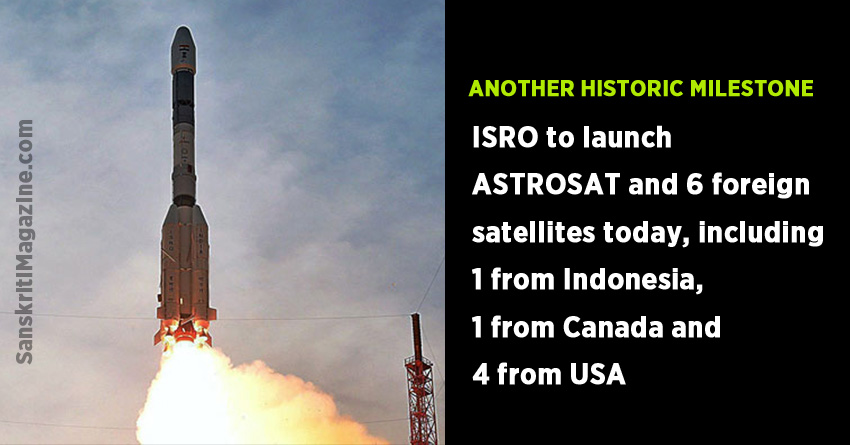
Indian Space Research Organisation (Isro) will launch ASTROSAT, a dedicated astronomy satellite for studying celestial objects, on 28 September, according to an Isro spokesperson.
Along with the satellite, the national space organization will launch six other satellites including one from Indonesia, one from Canada and four from the US. The seven satellites will be launched aboard Isro’s workhorse rocket, Polar Satellite Launch Vehicle PSLV-C30, from the Satish Dhawan Space Centre in Sriharikota, Andhra Pradesh.
The rocket with seven satellites will blast off on Monday at 10.00 am. from the first launch pad of the rocket port at Sriharikota in Andhra Pradesh. Now, ISRO will be launching seven satellites for the third time in its history.
“The launch vehicle assembly has been completed and the satellites have arrived in Sriharikota. Satellite integration will begin after initial checks are completed,” said the Isro spokesperson. After the launch, ASTROSAT will become the first mission to be operated as a space observatory by Isro.
ASTROSAT – the country’s first dedicated multi-wavelength space observatory that will help in understanding the universe – began today, the Indian space agency said.
The satellite which will have an operational lifetime of five years will produce an estimated 300 terabyte of data for this period which will be processed and archived by scientists involved in mission. The primary data archive for ASTROSAT will be located at the Indian Space Science Data Centre near Bangalore.
All these satellites will blast off from the Satish Dhawan Space Center, SHAR at 10 am on Monday, onboard PSLV-C30, which will carry them into 650 km orbit.
The first and third stages are powered by solid fuel while the second and fourth stages are powered by liquid fuel which will be filled during the countdown.
Apart from fuelling up the engines, all the systems would be checked and rechecked during the countdown.
On Monday morning the rocket will launch India’s ASTROSAT weighing 1,513 kg, apart from four from the US and one each from Indonesia and Canada.
The PSLV will carry a total payload of 1,631 kg during this mission.
Just over 22 minutes into the flight, the rocket will eject ASTROSAT at an altitude of 650 kms above the earth.
Soon after, six other satellites will be put into orbit and the whole mission will come to an end in just over 25 minutes.
ASTROSAT, with a life span of five years, will observe the universe through optical, ultraviolet, low and high energy X-ray components of the electromagnetic spectrum, whereas most other scientific satellites are capable of observing through a narrow wavelength band, the agency said.
The Indonesian 76 kg LAPAN-A2 is a micro-satellite from the National Institute of Aeronautics and Space, meant for providing maritime surveillance using automatic identification system (AIS), supporting Indonesian radio amateur communities for disaster mitigation and carrying out earth surveillance using video and digital camera.
The 14-kg NLS-14 (Ev9) of Space Flight Laboratory, University of Toronto Institute for Advanced Studies, is also a maritime monitoring Canadian nano satellite using the next generation AIS.
The remaining four LEMUR nano satellites from Spire Global Inc., San Francisco, US, are non-visual remote sensing satellites, focusing primarily on global maritime intelligence through vessel tracking via AIS and high fidelity weather forecasting using GPS radio occultation technology, the ISRO said.