The most heinous incident of attack on and stripping in public of a Black female student by a Brown Bangaluru mob has been construed as a racist act. And not a road-rage act simply because the different skin colour of the perpetrator and the victim.
However, at the same time, it is an isolated instance as no other such racist acts have been brought to our notice in the recent past in India, unless the acts of violence against North-Easterners in Delhi and burning of almost a whole train by a single caste mob demanding reservation right, in Andhra Pradesh are recalled.
The recent violence by Jats in Haryana is ostensibly due to economic reasons like job reservation. Contrast this with numerous instances of clear racism from Australia, Europe and USA. Ostracism and progrom of the Jews was commonplace all over Europe.
The violence and bigotry inflicted by high caste Hindus on lower castes especially Dalits is sometimes said to be unparalleled in any other religion. I am here reminded of traditional Shea-Sunni conflict or treatment of Ahamadias in Islam. I remember the rather recent instances of ethnic cleansing in East and Central Europe and in Africa and Boko Harem terrorism.
Till very recently, the oppression of the weak and vulnerable was rampant on all societies world over. The kind of obnoxious slavery that vitiated many societies of the West and Middle East was not present in India.
Again casteism is present in other religions too. The Latin Catholic will not enter Syrian Catholic Church. These two will not enter Marthoma Church. These three will not enter Pentecost Church. These four will not enter Salvation Army Church. These five will no enter Seventh Day Adventist Church. These six will not enter Orthodox Church. These seven will not enter Jacobite church. Like this there are 146 castes in Kerala alone for Christianity. Each will never share their churches for fellow Christians
Many writers blame Hindu fringe elements for their tendencies of ‘seeking to prescribe regressive formula like what we can eat, drink, wear and watch and so on and so forth, for protection of Hinduism.. Do we really have many such dictates except for occasional legal attempts to ban beef eating? On the other hand, ‘fatwas’ are really not unknown at all in India.
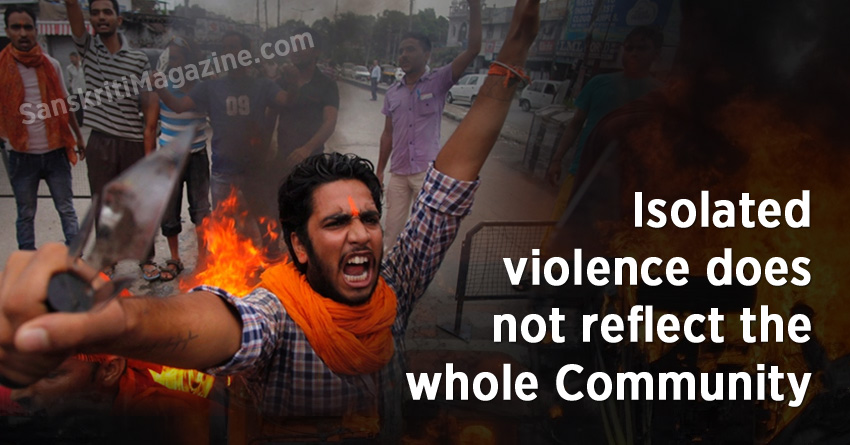
The simple thing to understand is that a nation of 128 crore people cannot be judged intolerant/ racist/communal or casteist just on the basis of some isolated incidents of inhuman crime or mob violence. Moreover, mob action is very often a frenzied response to political instigation by political interests.
Ultimately, the conflict is really individualistic, inside us. Both Good and Evil live Within. The battle is within us. Who will we give victory to, our inner goodness or the evil within?
As Bibek Debroy said that he has learnt from Mahabharata:
Dharma is one’s own perception of what is right in a given situation. It is Guhya Satya. Understanding lives deep inside in one’s heart which is conscience. It is not universal rather very individual.
An individual’s life is a journey to attainment of Sattva ie visualizing and perceiving the infinite, a journey from Tamas, ignorance, finite to the boundless.
~ By Sudip Bhattacharyya, Author is a commentator on contemporary issues in Society, Politics and Economics