“The three Bharatas seamlessly united the Satayuga, Tretayuga and Dwaparayuga and the land itself in political and cultural unity. They exemplified three ideals each that permeated Hindu civilisation and form its core values to this day. Rsabhdeva’s son Bharata gave us daya, Brahma-jñana and tapas; Dasaratha’s son Bharata gave us prema, bhakti, and bandhutva; and Dushyanta-Shakuntala’s son Bharata gave us seva, shaurya and dana.” ~ Sandhya Jain
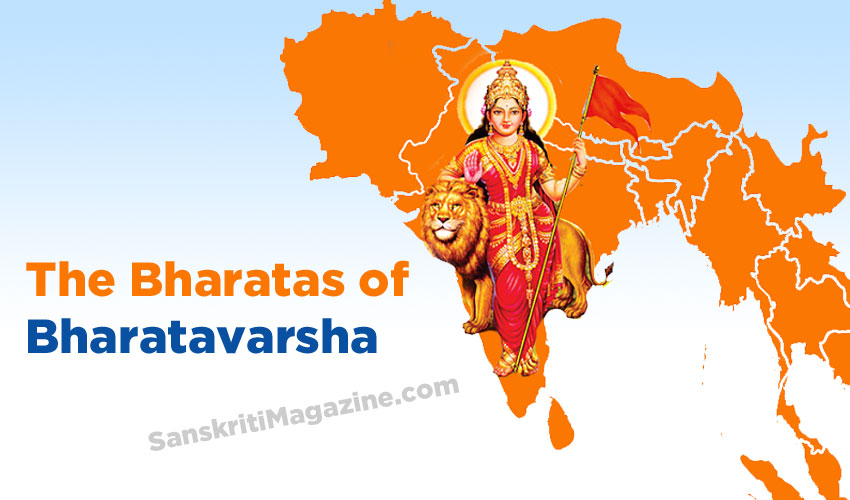
Bharatavarsha is encompassed from north to south by Sagarmatha, forehead of the ocean, a beautiful epithet for the tallest Himalayan peak, and Hind Mahasagar, the Indian Ocean. Famed as a divine creation, it is thebhumi of the Bharatas, hallowed by its sacred geography and the great souls who have guided her spiritual ascent and steered her civilizational destiny. Bharatavarsha literally means the continent (‘varsha’. Sanskrit) that is dedicated (‘rata’) to light, wisdom (‘bha’). Our Vedic Rishis devoted themselves to the quest for the eternal truth and ultimate reality, kevala jnana, satchidananda.
The Bharatas were a venerable and ancient tribe mentioned in the Rg Veda, particularly in Mandala 3 of Bharata Rishi Vishwamitra. Mandala 7 says the Bharatas were on the victorious side in the Battle of the Ten Kings.
There were three personifications of ‘Bharata’ in Hindu tradition, one each in the first three yugas, or time cycles. Together they are regarded as the epitome of the civilisational values of the Sanatana Dharma.
Bharata of the Satayuga
The first Bharata was born in the Satyuga as the son of Rshabdeva, first among recognized ancient sages. The Jaina community traces its spiritual lineage from Rshabhdeva, designated as the first Tirthankara; he is also known as Adinath, and synonymous with Siva, the foremost yogi of the Hindu tradition.
Jinasena’s Adipurana says three great events occurred simultaneously in Jaina history: Rsabhdeva attained enlightenment and became the first Jina; the cakra(wheel) appeared in the armoury of his son Bharata and proclaimed him acakravartin (emperor); and a son was born to Bharata, ensuring continuation of the Iksvaku dynasty founded by Rsabhdeva.
Elaborating the multiple rebirths of father and son in the bhogabhumi (world of enjoyment) where salvation is not possible, the Adipurana explains their evolution to karmabhumi (world of karma) where the law of retribution operates and men follow different occupations (karman). Rsabhdeva created the Ksatriya, Vaisya, and Sudra castes; Bharata later created Brahmanas and appointed kings.
The duty of the cakravartin is total conquest of all the directions (digvijaya) by means of superior moral and political powers, to unite the country under a single moral kingdom and prevent anarchy. Readers will note that the cakravartin is not merely an ideal ruler, but a powerful ancient political concept, inspired by a vision of the Hindu bhumi as a unity which was not belied by the presence of multiple centres of political power. That is why civilisational values permeated the whole land and gave the tradition its abiding continuity.
As first cakravartin, Bharata, fasted, meditated, performed puja and followed thecakra symbolizing his kingship as it moved of its own accord to various parts of the country. He paused to perform pradaksina in Saurastra, where the Jina Aristanemi (cousin of Sri Krishna) would be born, all the while circling Ayodhya, centre of Aryavarta (land of the Arya, noble ones).
Bharata thus subjugated rival kings and punished those who taxed their subjects excessively. His digvijaya was accomplished without violence, through innate capability, on account of punya (merit) acquired in previous lives through practice of Jaina precepts. He exemplified the virtues of compassion (daya), divine wisdom(Brahma-jñana) and penance (tapas).
Bharata of the Tretayuga
The second Bharata was born in the Tretayuga as the son of King Dasaratha of Ayodhya, and younger brother of Sri Rama. He embodied the virtues of love(prema), devotion (bhakti), and brotherhood (bandhutva).
The story of the Ramayana is well-known, but briefly, Keikeyi, the second wife of King Dasaratha, schemes to have the heir apparent, Sri Rama, sent into exile for fourteen years, and her own son, Bharata, appointed crown prince in his place. Rama, accompanied by his brother Lakshman, and wife Sita, departs immediately and the grief-stricken Dasaratha passes away soon afterwards.
Bharata, then on a visit to his maternal grandfather’s kingdom in Gandhara, returns only to learn of his father’s tragic demise and brother’s unfair exile. Tortured further by the thought that he could be considered complicit in this palace conspiracy, he decides – unswervingly – not to accept the throne. He then leads the people to the forest to persuade Rama to return. This political renunciation of a kingdom won illegitimately is a unique Hindu ethic.
Bharata is regarded as the symbol of dharma and idealism, second only to Sri Rama. To this day, he is revered for his adherence to family values, truth, righteousness, filial love and duty.
When Sri Rama refused to return to Ayodhya as rightful king, Bharata, at the intervention of Sita’s father, King Janaka, accepted the onerous duty of facilitating Rama to live righteously, i.e., in exile for fourteen years. He vowed to immolate himself if Rama did not return immediately at the end of the exile period and ascend his throne. Agreeing to govern Ayodhya only as regent, he placed Sri Rama’s sandals at the foot of the royal throne as the symbol of His kingship.
Bharata of the Dwaparyuga
The third Bharata was born in the Dwaparyuga as the son of Shakuntala and King Dushyant. Their story is part of the Mahabharata narrative, but it was Kalidasa who immortalized their love in Abhigyan Shakuntalam.
Shakuntala was the daughter of Rishi Vishvamitra and the apsara Menaka, who was sent by Indra to distract the sage. Menaka returned to heaven, and her daughter was raised in the hermitage of Rishi Kanva.
King Dushyant was the youngest son of King Puru, who had sacrificed his youth for his father, King Yayati. He founded the Paurava dynasty. Dushyant was hunting in the forest when, following a wounded deer into the hermitage of Rishi Kanva, he found Shakuntala nursing the animal. He fell in love and they married secretly in the Gandharva style, being their own witnesses.
The king gave her a ring as token of his love and to establish her identity as his wife. Sadly, Shakuntala lost the ring and the king refused to accept her; she retired to the forest and gave birth to Bharata, who grew up so bold and fearless that he played with lions. Some years later, the ring was found and Dushyant brought Shakuntala and Bharat to Pratishthan, where Bharata later became king.
Bharata is regarded as the greatest king of India, who lent his name to the country. He had nine sons, but deemed none of them fit to succeed him, and hence adopted a capable child as future ruler. Bharata personified the values of service (seva),valour (shaurya), and charity (dana).
Eternal values, eternal tradition
Thus the three Bharatas (two kings, one prince) seamlessly united the Satayuga, Tretayuga and Dwaparayuga and the land itself in political and cultural unity. They exemplified three ideals each that permeated Hindu civilisation and form its core values to this day. Rsabhdeva’s son Bharata gave us daya, Brahma-jñana andtapas; Dasaratha’s son Bharata gave us prema, bhakti, and bandhutva; and Dushyanta-Shakuntala’s son Bharata gave us seva, shaurya and dana.
Their sterling qualities raised a landmass to divine bhumi – Bharat Mata, mother of the Bharata people. This explains the Hindu anguish and anger over M.F. Husain’s exceedingly vulgar imagery of the Eternal Mother.
Hindus impart these nine values to every generation. The jeneu ceremony marking the transition from childhood to youth revolves around this value system. The youth bestowed the sacred thread takes nine vows; each vow is represented as a knot that binds the three separate strands of the jeneu.
The jeneu was therefore a great privilege, bestowed upon conscious Hindus. Today Hindu gurus are extending its reach to all sections of society, shattering mindsets and barriers, and raising the whole population to higher awareness about the responsibilities of religion and culture.
Useful Idiots
All this should nail the lie – peddled incessantly by Western Abrahamic so-called scholars and a modern ‘caste’ designated by some as Useful Indian Idiots – that India was not a nation until the British made it so; that Hindu dharma is not a religion but an assorted collection of ‘cults’ (whatever that means) and beliefs of folk origin (whatever that means too – who’s going to ask, anyway?).
We have only to look at ourselves as our Vedic Rishis and Gurus did – as children of the Himalayas, the Ganga, Yamuna, Narmada, Krishna, Godavari, down to Kanyakumari. According to the distinguished scholar, Prof. Lokesh Chandra, the eternal significance of Adi Sankara is that in establishing Mathams in the four corners of India, he also established the sacred geography of the four directions and united the country in common pilgrimage and cohesive culture at a time of grave danger.
As we look back, some things startle the mind. The ancient seers travelled extraordinary distances, covering every nook and corner of the country and every community howsoever remote, and uniting them in a complex religious and cultural matrix that endures to this day.
But more extraordinary is the fact that the ancient world seems to have had singular communicative skills. In the absence of what is called a common language (read English), a villager from Kerala could traverse the land and dominate the civilisation for over a thousand years, Marathi poets from the Deccan could settle in Punjab, a Guru from Punjab could reach Karnataka and Patna, one born in Gujarat could dominate north India. No one felt alien, or homeless, or misunderstood.
This is surely one of the most enduring mysteries of the Sanatana Dharma.
~ Sandhya Jain, Senior Journalist and Editor of Vijayvaani